
The recent news

June 14, 2023
Events : JoRC
► Full Reference: Journal of Regulation & Compliance (JoRC), Centre de recherche sur la justice et le règlement des conflits (CRJ) and Centre de recherche en économie (CRED) of University Paris Panthéon-Assas (Paris II), Compliance: Obligation, devoir, pouvoir, culture, ("Compliance: obligation, duty, power, culture"), Salle des Conseils, University Panthéon-Assas, Place du Panthéon, 12, Paris, June 13 & 14, 2023.
____
🏗️ This symposium takes place in the cycle of symposiums organised by the Journal of Regulation & Compliance (JoRC) and its partner Universities, focusing in 2023 on the general theme of Compliance Obligation.
► This symposium is organised by the Journal of Regulation & Compliance (JoRC) and the University of Panthéon-Assas (Paris II), through its Centre de recherche sur la justice et le règlement des conflits (CRJ) and its Centre de recherches en économie et droit (CRED).
This symposium is held in French.
the symposium is under the scientific direction of 🕴️Bruno Deffains,🕴️Marie-Anne Frison-Roche and 🕴️Jean-Baptiste Racine.
To registrer for a physical presence: anouk.leguillou@mafr.fr (the number of places is limited, you will be asked to confirm 48 hours before).
To register for a online presence: Click HERE
🧮The event takes place in the buildings Salle des Conseils of the Panthéon-Assas University (Paris II), Place du Panthéon, 12, 75005 Paris, on 14 June 2023 from 9:00 to 18:30.
____
► Presentation of the theme: "The "Obligation" is at the heart of many disciplines. Compliance techniques very often take the form of obligations. But to mention only the first questions that come to mind and in cases, especially those that are referred to the courts, it is paradoxically not so much Contract Law and Tort Law that have been used, since Compliance Law is on the one hand often assimilated to the mass of applicable regulations and its unilaterality characteristic of Regulatory Law, the branch of Law that Compliance Law extends, and on the other hand it is often associated with ethics, morality, a shared culture, everything that seems to distance it from Obligation.
The notions of "duty" and "commitment" are increasingly taking their place in Compliance Law, although their scope is still uncertain. This is why, beyond the multiplicity of "compliance obligations", one may ask whether there is an "obligation to comply", what its definition would be and its relationship with everything that, in Compliance Law, is not one obligation.
It is the topic of this conference and the articles that will follow to identify what will be this hypothesis, which is becoming more and more frequent and could become the standard.
____
Method chosen to deal with the topic: For contributing to what will later become the book on the Compliance Obligation, constituting its first chapter aimed at identifying what could be a definition of Compliance Obligation, the method is not to start from the legal instruments of compliance but rather for each of the contributors to draw on their discipline, which they has mastered technically, in order to project it and formulate what, on the basis of this previous mastery and according to his or her own conception, is or should be, or should not be, the Compliance Obligation.
Each speaker gives a half-hour presentation on his topic, which is followed by a 15-minute debate.
____
The proceedings of this colloquium will form the basis of the first chapter in the books:
📕L'obligation de Compliance, in the collection 📚Régulations & Compliance, copublished by the Journal of Regulation & Compliance (JoRC) and Dalloz.
📘Compliance Obligation, in the collection 📚Compliance & Regulation, copublished by the Journal of Regulation & Compliance (JoRC) and Bruylant.
____
Speakers:
🎤Jean-Sébastien Borghetti, professor of Law at the Panthéon-Assas University (Paris II)
🎤Louis d'Avout, professeur à l'Université Paris Panthéon-Assas (Paris II)
🎤Bruno Deffains, professor of Law & Economics at the Panthéon-Assas University (Paris II)
🎤Benoît Frydman, professor at the Université Libre de Bruxelles (ULB)
🎤Marie-Anne Frison-Roche, professor of Regulation & Compliance Law, director of the Journal of Regulation & Compliance (JoRC)
🎤Daniel Gutmann, professor at the Law School of the Panthéon-Sorbonne University (Paris I)
🎤Anne-Valérie Le Fur, professor at the Saclay University
🎤Gilles Lhuilier, professor at the ENS of Rennes, director of the department Droit, Economie, Gestion
🎤Etienne Maclouf, professor of gestion at the Panthéon-Assas University (Paris II)
🎤Stéphane Mouton, professor of Law at the Toulouse 1-Capitole University
🎤Jean-Baptiste Racine, professor of Law at the Panthéon-Assas University (Paris II)
🎤René Sève, director of the Association française de philosophie du droit - AFPD and of the Archives de Philosophie du Droit - APD
🎤Marta Torre-Schaub, director of research at the CNRS, Institute of legal and philosophical sciences of the Sorbonne, University Panthéon-Sorbonne (Paris I)
____
🔻 read a detailed presentation of the manifestation below:
April 7, 2023
Events : JoRC
► Full Reference: Journal of Regulation & Compliance (JoRC) and Law Faculty of Perpignan, Le juge face aux clauses et aux contrats de compliance (The Judge facing clauses and contracts of Compliance), Faculty of Perpignan, 7 April 2023.
____
🏗️This symposium takes place in the cycle of symposiums organised by the Journal of Regulation & Compliance (JoRC) and its partner Universities, focusing in 2023 on the general theme of Compliance Obligation.
► This symposium is organised by the Journal of Regulation & Compliance (JoRC) and the Law Faculty of the University of Perpignan.
This symposium is held in French.
This symposium is under the scientific direction of 🕴️Walid Chaiehloudj et 🕴️Marie-Anne Frison-Roche.
🧮The event takes place in the premises of the University of Perpignan, on Friday 7 April 2023, from 9:00 to 18:30. It takes place in a hybrid way.
_____
Presentation of the theme:
The Compliance obligation will increasingly take the form of contracts. This is because the texts unilaterally adopted by Public Authorities oblige economic operators to adopt clauses to give concrete form to the legal obligations of Compliance, for instance active prevention of corruption or effective vigilance in the value chain to avoid environmental or human rights violations. It also comes from the fact that companies, for many reasons, commit themselves to contribute to the efficacy achievement of the Monumental Goals of Compliance, with the contract being the most natural, balanced and flexible way to achieve this.
In this multiple contractual activity, which can manifest itself either in complete contracts, "compliance contracts", or in stipulations that more or less deviate from the regulations, the judge is never far away, because the judge is always, regardless of the legal system and the type of contract, active in this matter.
The general relationship between the Judge and Compliance Law has just been the subject of a series of symposiums and the publication of a book, La juridictionnalisation de la Compliance (Compliance Jurisdictionalisation, to be published in English). The aim here is to refocus the perspective on what happens when the judge is facing a contract that has Compliance issues at stake or, at the very least, contains Compliance stipulations.
The purpose of this symposium and the articles that will follow is to study this hypothesis, which is becoming more and more frequent and could become the standard.
_____
Some speakers:
🎤 Sarah Andjechairi-Tribillac, Senior lecturer at University of Perpignan
🎤 Jean-Baptiste Barbieri, Senior lecturer at University Panthéon-Assas (Paris 2)
🎤 Walid Chaiehloudj, Professor at Perpignan University
🎤 Marie-Anne Frison-Roche, Professor of Regulation and Compliance Law, director of the Journal of Regulation & Compliance (JoRC)
🎤 Thibault Goujon-Bethan, Professer at Lyon 3 University
🎤 Nicolas Ida, Senior lecturer at Aix-Marseille University
🎤 Hania Kassoul, Senior lecturer at Côte d'Azur University
🎤 Rebecca Legendre, Professor at Paris Nanterre University
🎤 Grégoire Leray, Professor at Côte d'Azur University
🎤 Yves Picod, Emeritus Professor at Perpignan University
🎤 Marc Segonds, Professor at Toulouse Capitole University
🎤 Sandrine Tisseyre, Professor at Toulouse Capitole University
🎤 Antoine Touzain, Professor at Rouen University
____
The proceedings of this colloquium will form the basis of a specific part in the books:
📕L'obligation de Compliance, in the collection 📚Régulations & Compliance, copublished by the Journal of Regulation & Compliance (JoRC) and Dalloz.
📘Compliance Obligation, in the collection 📚Regulation & Compliance, copublished by the Journal of Regulation & Compliance (JoRC) and Bruylant.
Nov. 4, 2021
Events : JoRC
This scientific event is part of the 2021 colloquium cycle, organized by the Journal of Regulation & Compliance (JoRC) and its Universities partners, around the general theme of Compliance Monumental Goals.
It is organized by the Journal of Regulation & Compliance (JoRC) and by the Paris Center for Law and Economics of the Panthéon-Assas University (Paris II).
This scientific event is placed under the scientific responsibility of Laurent Benzoni, Bruno Deffains and Marie-Anne Frison-Roche.
📅 The colloquium will take place in the Salle du Conseil (Panthéon-Assas University) on Thursday, November 4, 2021 from 1.30pm until 6.30pm.
🎥 The colloquium will be edited on video by the Journal of Regulation & Compliance.
Presentation of the topic :
Speakers:
🎤 Laurent Benzoni, professor of Economics at Panthéon-Assas University (Paris II), Tera Consultants
🎤Bruno Deffains, professor of Economics at Panthéon-Assas University (Paris II), director of the CRED
🎤 Marie-Anne Frison-Roche, Law professor at Sciences Po - Paris, director of the JoRC
🎤 Antoine Gaudemet, Law professor at Panthéon-Assas Université (Paris II), director of the Compliance Officer D.U.
🎤 Sabine Lochmann, CEO of Vigeo Eiris, Global Director of Moody’s ESG Solutions
🎤Frédéric Marty, economist, researcher at CNRS, member of GREDEG Côte d'Azur University
🎤 Stanislas Pottier, senior advisor to the General Management, Amundi
🎤 Jean-Christophe Roda, Law professor at Lyon 3 University
The different interventions will be then transformed into contributions in the books 📕 Les buts monumentaux de la Compliance and 📘 Compliance Monumental Goals which will be published in the Regulation & Compliance serie, jointly published by the JoRC and Dalloz for the French edition and by JoRC and Bruylant for the book in English.
Read a detailed presentation of the colloquium below:
Oct. 14, 2021
Events : JoRC
This scientific event is placed under the scientific responsibility of Marie-Anne Frison-Roche and Arnaud van Waeyenberge. It is organized by the Journal of Regulation & Compliance (JoRC) and by the Centre Perelman of Brussels University.
This event is part of the 2021 colloquia cycle around the general theme of Compliance Jurisdictionalisation.
The different interventions will be then transformed into contributions in the books La juridictionnalisation de la Compliance and Compliance Juridictionnalization which will be published in the Regulation & Compliance serie, jointly published by the JoRC and Dalloz for the book in French and by JoRC and Bruylant for the book in English.
This colloquium will take place in Brussels in October 2021.
Presentation of the theme:
Notably will speak:
- Marie-Anne Frison-Roche, professor at Sciences Po - Paris
- Arnaud van Waeyenberge, professor at HEC Paris and researcher at Centre Perelman
Read a detailed presentation of the colloquium below:
Sept. 23, 2021
Events : JoRC
►This scientific event is placed under the scientific responsibility of Marie-Anne Frison-Roche, Juliette Morel Maroger and Sophie Schiller. It is organized by the Journal of Regulation & Compliance (JoRC) and by the Centre de recherche en Droit (CR2D) of Paris Dauphine-PSL University.
This event is part of the 2021 colloquia cycle around the general theme of Compliance Jurisdictionalisation.
►The interventions will be then transformed into a chapter in the books: contributions in the 📕 La Juridictionnalisation de la Compliance , to be published the Regulation & Compliance series ries, jointly published by the Journal of Regulation & Compliance (JoR)C and Dalloz
📘Compliance Jurisdictionalisation,  to be published in the Compliance & Regulation Series , co published by the Journal of Regulation & Compliance (JoRC) and Bruylant.
____
This colloquium will take place in Paris Dauphine-PSL University in September 2021.
Presentation of the topic :
Judges, regulatory and supervisory authorities, or even authorities specially instituted by Compliance Law, such as the Agence Française Anticorruption (French Anticorruption Agency), must implement it.
The colloquium aims initially to identify and discuss the procedural rules that they then specifically implement, in particular when the strong requirements of Compliance Law, efficiency and immediacy, new negotiation techniques and commitment, must be articulated with the traditional procedural requirements that remain.
The question arises in particular as to whether the rules of a fair trial should apply (or can they be similar in transactional procedures and in the context of judicial procedures, and how the control by judges operates during homologation) in transactional procedures, with more or less specific treatment of the evidence used.
Secondly, the colloquium considers the way in which the different judges assess the different constitutive standards of Compliance Law. These are often soft Law and depending on whether the judge is repressive, administrative, or European, his or her assessment will not be legally of the same scope or of the same nature, which together leads to an issue of articulation of method. Due to the breadth of the subject, certain sectors will be particularly examined, in particular the banking sector.
Thirdly, the way in which the judge himself or herself applies Compliance Law will be examined, in what appears to be a balance between pedagogy and sanction. It then appears to play a triple role, in that it ensures compliance with standards but also in that it must find effective solutions in a Law which is more in Ex Ante than in Ex Post and that it must support operators so that they act effectively, by mastering their obligations. The motivation for decisions then appears to be a primary issue.
Because this last phase concerns the even more direct relationship between the judge and the operators and stakeholders, this theme is intended to give rise to a presentation and a round table.
______________
Will speak notably:
- Claudie Boiteau, Professor at Paris Dauphine-PSL University, Member of the Centre de Recherche en Droit de l'Université Paris Dauphine-PSL (CR2D).
- Jean-François Bohnert, Financial National Prosecutor
- Olivier Catherine, Secretary General at Sonepar
- Nicolas Cayrol, Professor at Tours Law School and Director of the Institut d'Etudes Judiciaires François Grua
- Jean-Michel Darrois, Attorney, Darrois, Villey, Maillot, Brochier Law Firm
- Marie-Laure Denis, President of the CNIL
- Eric Dezeuze, Attorney, Bredin Prat Law Firm
- Marie-Anne Frison-Roche, Professor at Sciences Po (Paris), Director of the JoRC
- Juliette Morel-Maroger, Professor at Paris Dauphine-PSL University
- Sophie Scemla, Associate attorney, Gide Law Firm
- Sophie Schiller, Professor at Paris Dauphine-PSL University
Read a more detailed presentation below:
Sept. 16, 2021
Events

This colloquium co-organized between Laboratoire DANTE and the Journal of Regulation & Compliance (JoRC) inaugurates the 2021 series of colloquia devoted to the general theme of Compliance Monumental Goals. It is placed under the scientific direction of Christophe André, Marie-Anne Frison-Roche, Marie Malaurie and Benoît Petit.
___
The works of this colloquium will be integrated into a chapter in the two following books :
📕 Les buts monumentaux de la Compliance, forthcoming in the Serie Regulations & Compliance , co published by the Journal of Regulation & Compliance (JoRC) and Dalloz.
📘Compliance Monumental Goals, forthcoming in the Serie Compliance & Regulation , co published by the Journal of Regulation & Compliance (JoRC) and Bruylant.
___
This colloquium will take place on September 16, 2021 at the Maison du Barreau. The manifestation will be opened to public onsite.
It is supported by Paris Place du Droit.
The manifestation is opened to public on site and is available online.
💼 to registration for the manifestation on site: christopheonline@orange.fr
💻 to registration for the manifestation online: https://zoom.us/webinar/register/8516215084724/WN_zLcUM4gPTNChaaB5SyxOYQ
____
Presentation of the colloquium Thematic: To understand the notion of "Monumental Goals", it is firstly necessary to take crossed perspectives on them, particularly through the prism of Labor Law, Environmental Law and Enterprise Law. Many questions appear. Does the notion of “Monumental Goals” present any substance in Law? Is it uniformly understood, or do specificities appear, forged by specific cultures and disciplinary practices? What are the sources and implicit references or echoes? Because even if we admit the part of novelty, there is undoubtedly an anchoring in traditional legal concepts, like the general interest or sovereignty. How does the shift from meta-legal (prima facie introduced by the concept) to legal take place, and where do any operational difficulties lie when legal actors are called upon to act? The question of a possible categorization of "Monumental Goals" will thus be explored, through these three legal disciplines whose historicity, goals and implications for firms differ.
These reflections allow to ask why and how these "Monumental Goals" are developed. Indeed, what is the relevance of the association of "Monumental Goals" and Compliance? Beyond theoretical considerations relating to the meaning of Law, is this really an effective alloy encouraging companies to behave differently? By what ways? These questions arise in particular with regard to the imperatives of legal certainty and the operative nature of the concept. The question of "Monumental Goals" will thus be explored by the operational actors of compliance, both those who act within companies and those who act from the lato sensu State sphere, for understanding whether this notion is a pure rhetoric figure or constitutes a particularly promising lever for the evolution of market behavior.
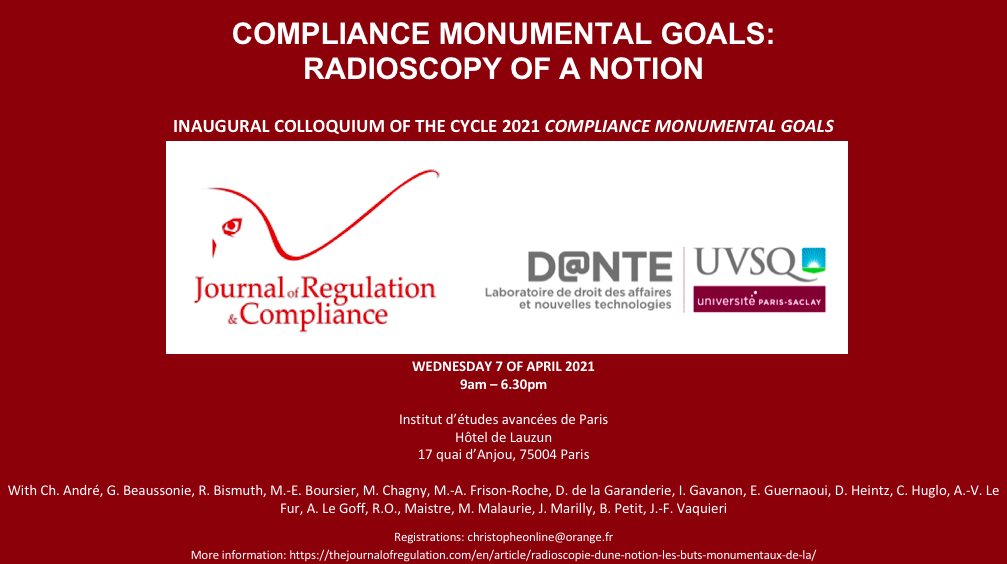
Notably with :
- Christophe André, maître de conférences à l'Université Paris - Saclay (lecturer at the Paris-Saclay University)
- Guillaume Beaussonie, professeur à l'Université Toulouse-1-Capitole (law professor at Toulouse-1-Capitole University)
- Regis Bismuth, professeur de droit à Sciences po, Paris (law professor at Sciences po Paris)
- Marie-Emma Boursier, doyen de l'Université Paris - Saclay (dean of the Paris-Saclay University)
- Muriel Chagny, professeur l'Université Paris - Saclay, directrice du Laboratoire Dante (Professor at the Paris-Saclay University, director of the Laboratory Dante)
- Marie-Anne Frison-Roche, professeur à Sciences po (Paris) (Professor at Sciences Po Paris)
- Isabelle Gavanon, avocate à la Cour d'Appel de Paris (attorney before the Paris Court of Appeal)
- Emma Guernaoui, ATER à l'Université Paris II Panthéon-Assas (ATER at Paris II Panthéon-Assas University)
- Dominique Heintz, avocat à la Cour d' appel de Paris (attorney before the Paris Court of Appeal)
- Christian Huglo, avocat à la Cour d' appel de Paris (attorney before the Paris Court of Appeal)
- Dominique de La Garanderie, avocat à la Cour d'appel de Paris (attorney before the Paris Court of Appeal)
- Anne-Valérie Le Fur, professeur à l'Université Paris - Saclay (Professor at Paris-Saclay University)
- Anne Le Goff, secrétaire générale déléguée d'Arkéa (Deputy Secretary general at Arkéa)
- Roch-Olivier Maistre, président du Conseil supérieur de l'audiovisuel (President of the French audiovisual regulation authority)
- Marie Malaurie, professeur à l'Université Paris-Saclay (professor at the Paris-Saclay University)
- Jérôme Marilly, avocat général à la Cour d'Appel de Paris (General attorney before the Paris Court of Appeal)
- Benoît Petit, maître de conférences (HDR) à l'Université Paris-Saclay (lecturer at the Paris-Saclay University)
- Jean-François Vaquieri, Secrétaire Général d'Enedis (Secretary General of Enedis)
____
Read a detailed presentation below:
Sept. 15, 2021
Events : JoRC
This scientific manifestation is placed under the scientific responsibility of Marie-Anne Frison-Roche. It is organized by the Journal of Regulation & Compliance (JoRC).
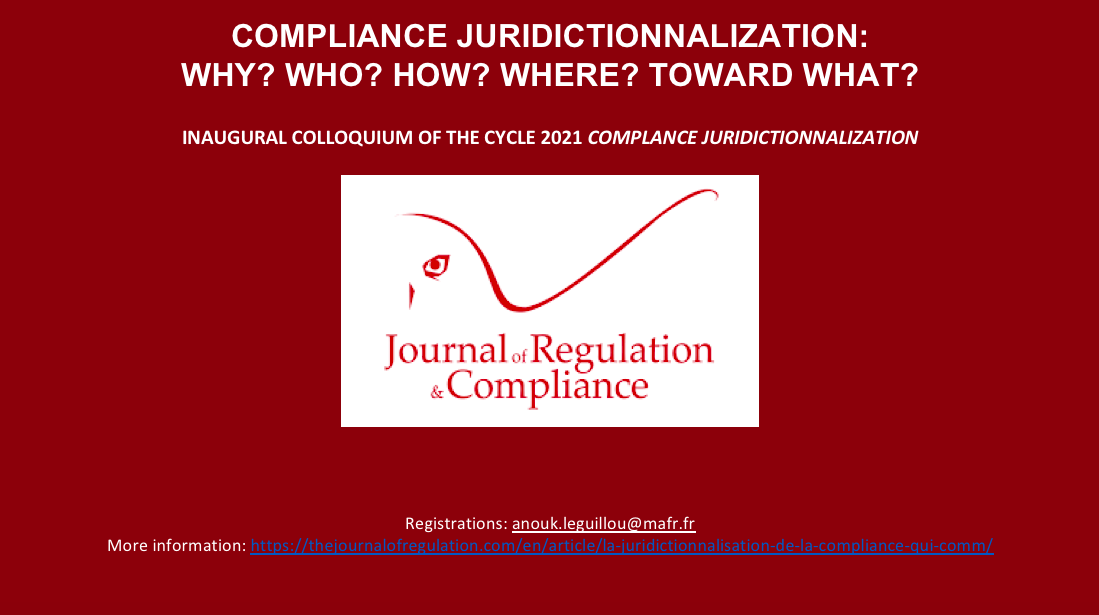
It constitutes the inaugural colloquium of the cycle of colloquia in 2021 on the general topic Compliance Jurisdictionalisation.
The work will then be incorporated into the two books La juridictionnalisation de la Compliance and Compliance Jurisdictionalization which will be published in the Regulations & Compliance series, co-edited by the JoRC with Dalloz for the book in French and with Bruylant for the book in English.
This colloquium will be held in Paris in 2021.
Presentation of the topic: Because Compliance Law is the extension of Regulatory Law, it is experiencing the same movement of Juridictionnalisation. First of all conceived as the goal of protecting systems and people, even if they seem beyond reach, this has led to the establishment of private companies as judges of themselves, to be structurally the judges and judged, those who act and those who observe. The duty of vigilance has increased this transformation. As in Regulatory Law, which is an Ex Ante branch of Law, the procedure, which is an Ex Post branch of Law, governs the functioning of companies, transfiguring Company Law under the term "governance".
The shock and transformation once received by Administrative Regulatory Authorities has been heightened by the fact that companies have been further seized by the repressive Courts on the one hand and by an American repressive Law on the other hand, two different cultures. There are therefore many technical difficulties that must first be identified and formulated and then resolved. The easiest is in a first step to ask the following questions : Why? Who? How? When? Where? Toward What?