
Search results (607 cards)

Updated: Nov. 16, 2010 (Initial publication: Oct. 1, 2010)
I. Isolated Articles
ENGLISH
I would suspect that most regulatory law practitioners—whether they represent government or private interests--feel as if the tidewaters of global regulation have slowly but surely risen within the past few years. Those involved in the fields of competition, environmental or financial law must feel as if the global regulatory waters have reached up to their knees.
FRANCAIS
Article: le G-20 et la régulation économique mondiale: un moyen d'alimenter le développement progressif du droit international?
Je soupçonnerai volontiers que la majorité des praticiens du droit de la régulation - qu'ils représentent les gouvernements ou des intérêts publics - ont le sentiment que les eaux de la régulation mondiale ont monté lentement mais sûrement au cours des dernières années. Ceux qui exercent dans les domaines légaux de la concurrence, de l'environnement ou de la finance doivent eux avoir l'impression qu'elles ont atteint leurs genoux.
GERMAN
Artikel; Die G-20 und die globale wirtschaftliche Regulierung: ein Beitrag zur Entwicklung des internationalen Privatenrechtes?
Ich vermute, dass die meisten Praktiker des Regulierungsrechtes - entweder für öffentlichen- oder privaten Institutionnen arbeitend - das Gefühl haben, dass die Gewässer der globalen Regulierung letztlich langsam aber sicher angestiegen sind. Und diejenigen, die im Bereich Wettbewerb, Umwelt oder Finanz arbeiten, haben sicher das Gefühl, dass die Gewässer schon kniehoch sind.
ITALIAN
Il G20 e la regolazione economica globale: verso l’alimentazione di uno sviluppo progressivo del diritto internazionale?
Direi che la gran parte degli operatori in materia di regolazione normativa – portatori di interessi pubblici o privati – hanno la sensazione che la marea della regolazione economica globale sia, seppur lentamente, sicuramente salita negli ultimi anni. Coloro che operano in materia di diritto della concorrenza, diritto dell’ambiente o diritto finanziario devono aver la sensazione che le acque della regolazione siano arrivate fino alle ginocchia.
CHINESE
二十国集团和全球经济调控:促进国际法前进发展?
我猜测多数的法律规制从业者,无论是代表政府或是私人利益,都感觉到全球化调控的浪潮似乎已经减缓,但事实上其在过去的几年中依然增长。与竞争、环境和金融的相关法律领域很可能已经感到全球化调控的浪潮在与日俱增。
SPANISH
El G-20 y la regulación económica global: ¿alimentando el desarrollo progresivo del derecho internacional?
Yo sospecharía que la mayoría de aquellos que practican la ley – ya sea que representen los intereses públicos o privados – se sienten como si las aguas de la regulación global han aumentado lentamente durante los últimos años. Aquellos que están involucrados en el campo de la competición o las leyes ambientales o financieras ya deben de sentirse como si las aguas de la regulación global les han llegado hasta las rodillas.
Related articles
Updated: April 4, 2012 (Initial publication: March 23, 2012)
Neutrality in Systems of Economic Regulation
Translated summaries
ENGLISH
The FCC’s 2010 “open Internet” (net neutrality) order went into effect on November 20, 2011. Verizon Communications and Metro PCS have challenged the FCC Order in court, alleging that the FCC lacked statutory power to impose net neutrality rules in connection with Internet access services.
FRENCH
L’ordonnace 2010 de la FFC (le régulateur nord-américain des communications) "open Internet" est entrée en vigueur le 20 novembre 2011. Les sociétés Verizon Communications et Metro PCS ont contesté devant le juge cette ordonnance, alléguant que la FCC n’avait pas le pouvoir légal d’imposer des règles sur la neutralité du net concernant l'accès aux services d'Internet.
Updated: July 5, 2010 (Initial publication: June 9, 2010)
I. Isolated Articles
Net Neutrality first became news in the United States just after the year 2000. The issue arose when the Federal Communications Commission (FCC) took decisions regarding conflicts between Internet Service Providers (ISPs) and cable operators. The FCC's decisions focused on ensuring non discriminatory conditions for ISP's access to the Internet communications market using existing cable networks. These issues became the basis of the debate on Internet users' rights, namely their right to freely access the content and services of their choice. On September 25, 2005 the FCC published a policy statement recognizing these issues, and clearly defined four main principles for Network Neutrality.
FRENCH
La Neutralité du Net : une perspective économique
La neutralité du Net apparu aux États-Unis au tout début des années 2000. Les problèmes ont surgi lorsque la "Federal Communications Commission -FCC" (Commission fédérale en charge des communications) a dû prendre des décisions concernant les conflits entre les fournisseurs d'accès Internet (ISP) et les opérateurs de réseaux cablés. Les décisions de la FCC étaient axées sur la garantie du caractère non discriminatoire des conditions d'accès des fournisseurs de services sur le marché des communications sur Internet via les réseaux câblés. Ces questions ont servi de base au débat sur les droits des utilisateurs d'Internet, à savoir leur droit d'accès aux contenus et aux services de leur choix. Le 25 Septembre 2005, la FCC a publié une déclaration de principe reconnaissant ces questions, et clairement définie autour de quatre grands principes.
GERMAN
Die Netzneutralität: eine wirtschaftliche Perspektive
Die Netzneutralität ist in den Vereinigten Staaten im Beginn den Jahren 2000 entstanden. Die erste Problemen sind entstanden, als die Federal Communications Commission (FCC - die amerikanische Bundeskommunikationsbehörde) Entscheidungen über Widerstreite zwischen Internetdienstanbieter und Kabeloperatoren treffen sollte. Diese Entscheidungen bestanden darauf, dass die Internetdienstanbieter durch Kabelnetzwerke Zugang zum Markt ohne Benachteiligung erhalten. Diese Fragen haben zufolge die Diskussionen über den Zugang den Internetsverbrauchern zu bestimmten Inhalten und Diensten hervorgebracht. Am 25. September 2005 hat die FCC eine Grundsatzerklärung über diese Fragen veröffentlicht, und hat vier Hauptprinzipien für die Netzneutralität dargelegt.
GREEK
La neutralidad al acceso a la red se trajo al primer plano por primera vez en los EEUU en el año 2000. Este tema surgió cuando la “Federal Communications Commission” (FCC – la Comisión americana de comunicaciones federales) tomó decisiones concerniendo los conflictos entre los “Internet Service Providers” (ISPs – los proveedores americanos de servicios de Internet) y los operadores de cables. Las decisiones de la FCC tenían el objetivo de asegurar condiciones no discriminatorias para el acceso de los ISPs al mercado de comunicaciones en Internet. Estos temas se volvieron la base del debate sobre los derechos de los usuarios de Internet, especialmente su derecho al acceso libre al contenido y a los servicios de su preferencia. El 25 de septiembre del 2005, la FCC publicó un programa que reconoce estas cuestiones y que define claramente cuatro principios esenciales para la Neutralidad sobre la red.

March 31, 2021
JoRC
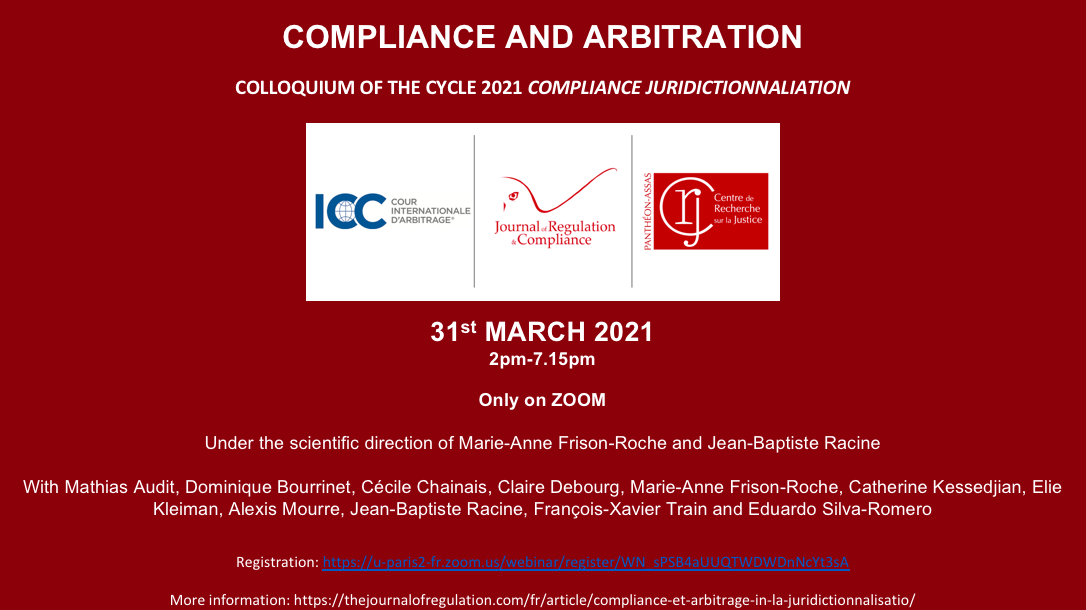
This scientific event is placed under the scientific responsibility of Marie-Anne Frison-Roche and Jean-Baptiste Racine. It is organized by the Journal of Regulation & Compliance (JoRC) and by the Centre de recherche sur la Justice et le Règlement des Conflits (CRJ) of the Panthéon-Assas (Paris II) University, with the active support of the International Chamber of Commerce ICC.
This event is the third colloquium of the 2021 colloquia cycle around the general theme of Compliance Jurisdictionalisation.
►The interventions will be then transformed into a chapter in the books: contributions in the 📕 La Juridictionnalisation de la Compliance , to be published the Regulation & Compliance series ries, jointly published by the Journal of Regulation & Compliance (JoR)C and Dalloz
📘Compliance Jurisdictionalisation,  to be published in the Compliance & Regulation Series , co published by the Journal of Regulation & Compliance (JoRC) and Bruylant.
____
This colloquium took place the 31st of March 2021.
The manifestation was live broadcasted on Zoom.
Presentation of the theme:
The arbitrator is the ordinary judge of international trade. It was natural that he or she encountered Compliance: by definition Compliance Law takes hold of the whole world and follows the paths of international trade while it can only be deployed with the help of institutions which, by nature are spreading around the world and need authorities like the Courts.
The conference is based on the already perceptible connection points between Compliance and Arbitration to better identify what is emerging for tomorrow: contradiction or convergence between the two; weakening or consolidation. We are already seeing the impact that Compliance can have on the arbitrator's treatment of corruption or the consideration of money laundering. More generally, where do we stand with the arbitrator's knowledge of the many technical issues related to compliance? Beyond these, will the courts and arbitrators be able to achieve the goals, themselves new, sometimes monumental, pursued by Compliance Law?
Through this joint exploration of these avenues, the fate of compliance clauses inserted in contracts, the relevance in the matter of private codes of conduct, etc. will be examined.
Tomorrow, as of today, is the arbitrator a full and complete judge of Compliance Law?
How, with what specificities and what controls?
Notably will speak:
- Mathias Audit, professeur à l'Université Panthéon-Sorbonne - Paris I (full professor at Sorbonne - University - Paris)
- Dominique Bourrinet, General Counsel of Société générale group
- Cécile Chainais, director of the Centre de Recherche sur la Justice et le Règlement des Conflits (CRJ) and professeur à l'Université Panthéon-Assas (Paris II) (Full professor at Panthéon-Assas (Paris II) University)
- Claire Debourg, professeure à l'Université Paris X- Nanterre (Full professor at Paris X - Nanterre)
- Marie-Anne Frison-Roche, professeur à Sciences Po - Paris (Full Professor at Sciences Po - Paris)) and Director of the Journal of Regulation & Compliance (JoRC)
- Catherine Kessedjian, professeur émérite de l'Université Panthéon-Assas (professor emeritus of Panthéon-Assas - Paris II University)
- Elie Kleiman, partner, Jones Day Law Firm
- Alexis Mourre, president of the ICC International Court of Arbitration
- Jean-Baptiste Racine, professeur à l'Université Panthéon-Assas - Paris II (Full Professor at Panthéon-Assas - Paris II University)
- François-Xavier Train, professeur à l'Université Paris X-Nanterre (Full Professor at Paris X-Nanterre University)
- Eduardo Silva-Romero, Dechert Law Firm
Read a detailed presentation of the colloquium below:
April 7, 2023
JoRC
► Full Reference: Journal of Regulation & Compliance (JoRC) and Law Faculty of Perpignan, Le juge face aux clauses et aux contrats de compliance (The Judge facing clauses and contracts of Compliance), Faculty of Perpignan, 7 April 2023.
____
🏗️This symposium takes place in the cycle of symposiums organised by the Journal of Regulation & Compliance (JoRC) and its partner Universities, focusing in 2023 on the general theme of Compliance Obligation.
► This symposium is organised by the Journal of Regulation & Compliance (JoRC) and the Law Faculty of the University of Perpignan.
This symposium is held in French.
This symposium is under the scientific direction of 🕴️Walid Chaiehloudj et 🕴️Marie-Anne Frison-Roche.
🧮The event takes place in the premises of the University of Perpignan, on Friday 7 April 2023, from 9:00 to 18:30. It takes place in a hybrid way.
_____
Presentation of the theme:
The Compliance obligation will increasingly take the form of contracts. This is because the texts unilaterally adopted by Public Authorities oblige economic operators to adopt clauses to give concrete form to the legal obligations of Compliance, for instance active prevention of corruption or effective vigilance in the value chain to avoid environmental or human rights violations. It also comes from the fact that companies, for many reasons, commit themselves to contribute to the efficacy achievement of the Monumental Goals of Compliance, with the contract being the most natural, balanced and flexible way to achieve this.
In this multiple contractual activity, which can manifest itself either in complete contracts, "compliance contracts", or in stipulations that more or less deviate from the regulations, the judge is never far away, because the judge is always, regardless of the legal system and the type of contract, active in this matter.
The general relationship between the Judge and Compliance Law has just been the subject of a series of symposiums and the publication of a book, La juridictionnalisation de la Compliance (Compliance Jurisdictionalisation, to be published in English). The aim here is to refocus the perspective on what happens when the judge is facing a contract that has Compliance issues at stake or, at the very least, contains Compliance stipulations.
The purpose of this symposium and the articles that will follow is to study this hypothesis, which is becoming more and more frequent and could become the standard.
_____
Some speakers:
🎤 Sarah Andjechairi-Tribillac, Senior lecturer at University of Perpignan
🎤 Jean-Baptiste Barbieri, Senior lecturer at University Panthéon-Assas (Paris 2)
🎤 Walid Chaiehloudj, Professor at Perpignan University
🎤 Marie-Anne Frison-Roche, Professor of Regulation and Compliance Law, director of the Journal of Regulation & Compliance (JoRC)
🎤 Thibault Goujon-Bethan, Professer at Lyon 3 University
🎤 Nicolas Ida, Senior lecturer at Aix-Marseille University
🎤 Hania Kassoul, Senior lecturer at Côte d'Azur University
🎤 Rebecca Legendre, Professor at Paris Nanterre University
🎤 Grégoire Leray, Professor at Côte d'Azur University
🎤 Yves Picod, Emeritus Professor at Perpignan University
🎤 Marc Segonds, Professor at Toulouse Capitole University
🎤 Sandrine Tisseyre, Professor at Toulouse Capitole University
🎤 Antoine Touzain, Professor at Rouen University
____
The proceedings of this colloquium will form the basis of a specific part in the books:
📕L'obligation de Compliance, in the collection 📚Régulations & Compliance, copublished by the Journal of Regulation & Compliance (JoRC) and Dalloz.
📘Compliance Obligation, in the collection 📚Regulation & Compliance, copublished by the Journal of Regulation & Compliance (JoRC) and Bruylant.
Oct. 26, 2020
JoRC
Like the previous cycles devoted to the general theme of Compliance and aiming to build a "Compliance Law", intended like them to be published in the Regulations & Compliance collection, this cycle addresses a particular aspect of this branch of Law in progress. to develop. "Compliance tools" having been the subject of the previous cycle of conferences and showing judges, lawyers, jurisdictions, this new cycle addresses a new phenomenon in Compliance: La juridictionnalisation de la Compliance (The jurisdictionalisation of Compliance).
It will take place in parallel with the series of conferences on the theme: Les buts monumental de la Compliance (The monumental goals of Compliance).
There have always been judges and lawyers in Compliance Law, in particular because this is the extension of Regulatory Law in which they have a full place. This results from the fact that the decisions taken in respect of Compliance are contestable in court, those issued by the company, such as those of States or Authorities. The novelty lies more in the phenomenon of "legalization", that is to say that the jurisdictional model penetrates all Compliance Law, and not only the Ex Post part that this includes. Furthermore, it seems that this jurisdictionalization influences the non-legal dimension of Compliance. This movement has effects that must be measured and causes that must be understood. Advantages and disadvantages that must be balanced. If only to form an opinion on this "juridictionalization of Compliance".
📅 Inaugural colloquium: Compliance jurisdictionalisation: why? Who? How? Where? and Toward What? , organized by the JoRC under the scientific direction of Marie-Anne Frison-Roche : read more information here
📅 Colloquium of March 31, 2021 : Arbitration and Compliance, co-organized by the JoRC and Paris II University, under the scientific direction of Marie-Anne Frison-Roche and Jean-Baptiste Racine : read more information here
📅 Colloquium of June 23, 2021 : The firm instituted as Court by Compliance Law, co-organized by the JoRC and the équipe de recherche Louis Josserand of Lyon 3 University, under the scientific direction of Marie-Anne Frison-Roche and Jean-Christophe Roda : read more information here
📅 Colloquium of September 23, 2021 : Which judges for Compliance? , co-organized by the JoRC and the CR2D of Paris-Dauphine University, under the scientific direction of Marie-Anne Frison-Roche and Sophie Schiller : read more information here
📅 Colloquium of October 2021 : Compliance Law, crucible between American Procedure Law and Procedure Law, co-organized by the JoRC and the Brussels University, under the scientific direction of Marie-Anne Frison-Roche and Arnaud van Waeyenberge: read more information here
Technical registration modes are specific to each colloquium.
The Journal of Regulation & Compliance (JoRC) benefits from the partnership of :
🏫 L’École d’Affaires Publiques de Sciences Po,
🏫 Le Département d’Économie de Sciences Po,
🏫 L' École de Droit de l'Université Panthéon-Sorbonne (Paris I),
🏫 L’École doctorale de Droit privé de l'Université Panthéon-Assas (Paris 2),
🏫 La Faculté de droit et de sciences politiques de l'Université de Montpellier
🏫 Le Centre Perelman de l'Université Libre de Bruxelles,
🏫 Le GREDEG de l'Université de Nice,
🏫 La Fédération de recherche "L'Europe en mutation" de l'Université de Strasbourg
🏫 Le Centre Louis Josserand de la Faculté de Droit de Lyon III.
🏫 La Faculté de droit et de sciences politiques de l'Université de Toulouse-I-Capitole,
🏫 L'école de droit de l'Université de Clermont-Ferrand.
🏫 Le centre de recherche Droit-Dauphine de l'Université Paris-Dauphine
🏫 L'École des hautes études commerciales de Paris (HEC Paris)
The cycle is supported by :
Updated: Jan. 12, 2012 (Initial publication: Jan. 12, 2012)
Others
Updated: July 21, 2010 (Initial publication: June 22, 2010)
Grey Litterature
The British Postal Services Commission (Postcomm —英国邮政行业监管委员会)在2010年5月27日公布了新的监管框架,详细说明了其在随后的2012年对于邮政领域调整的意向。此整体框架旨在于配合邮政领域的行业调整,使Royal Mail(英国皇家邮政)能够完全履行其服务义务,实现利润,从而面对投递总量急剧下降和竞争增加的局面。

Aug. 18, 2020
Newsletter MAFR - Law, Compliance, Regulation
Full reference: Frison-Roche, M.-A., Can Coordination between local Regulators replace a unique centralized Regulator? Example of the European organisation of the Open Internet Principle, Newsletter MAFR - Law, Compliance, Regulation, 18th of August 2020
Read, by freely subscribing, the other news of the Newsletter MAFR - Law, Compliance, Regulation
To go further, read Marie-Anne Frison-Roche's article: The hypothesis of interregulation
Summary of the news
The principle of "open internet" enshrined in the European regulation of 30th of April 2016 guaranteeing a non discriminatory access to Internet contents and services. However, there is no European regulator to implement such a principle. Is it possible to guarantee the effectivity of this principle without a central regulator in charge of this principle?
On 11st of June 2020, the BEREC (Body of European Regulators for Electronic Communications) adopted guidelines concerning the application of the open internet principle. The BEREC is not a European regulator but a network of national regulators aiming to coordinate their actions. This body is only a consultative body but its recommendations are taken into account by national authorities which have deep legal power, as Osborne-Clarke said about the technical implementation of the European principle of open internet at the national level.
It is thus non necessary to have a central regulator to ensure the effectivity of a principle since the moment when there is a local regulators network able to coordinate their actions through soft law.
Oct. 7, 2026
JoRC
► Full reference: Journal of Regulation & Compliance (JoRC) and Panthéon-Sorbonne University (Paris I), Institut de Recherche juridique de la Sorbonne -IRJS (Sorbonne Legal Research Institute), Compliance et droit commun des contrats (Compliance and General Contract Law), 7 October 2026.
____
🏗️ This symposium is part of the series of symposiums organised by the Journal of Regulation & Compliance (JoRC) and its partner universities, focusing in 2026 on the general theme of Compliance and Contract.
____
The symposium is under the scientific responsibility of Nicolas Bargue, 🕴️Marie-Anne Frison-Roche and 🕴️Julia Heinich.
____
To register:
____
🧮The event will take place at Panthéon-Sorbonne University (Paris I) on 15 October 2026.
Il will be held in French.
_____
Presentation of the topic: While Contract Law, in its common rules expressed by the "general theory of contracts", is often considered to be the most developed branch of Law in practice and the most studied at university, at first glance it seems to be given little consideration when it comes to compliance matter.
This is undoubtedly due to the fact that the company, which is at the heart of the action expected of it—action that is expected to be powerful (since it affects the collective future) and diversified (since it concerns all systems beyond the company's direct activity)—seems above all to have the status of a subject of law. This is exacerbated if, by mistakenly confusing the latter terms, we only talk about "conformity" and assert that it is simply for businesses a matter of "complying with the regulations that apply to them", which then leaves little room for contractual initiative. This would be associated only with Ethics, a normative order that also differs from a contract, which is a binding legal act.
The relationship between Contract and many sorts of documents, standards and ethical acts that are so numerous in compliance techniques, to which we can add the soft law produced by courts, regulators, supervisors and the companies themselves, is therefore an open question. This delicate reconciliation, which the terms "CSR" and "Governance" express without referring to very precise legal definitions, can cause difficulties in relation to general Contract Law: thus, the "commitments" that punctuate the techniques and behaviours that make up the "culture of compliance" have a central place in Compliance Law. However, their place, if not their equivalence with the contract, is not established, and may even be excluded. This too is an open question.
Based on these initial questions, it appears that in order to gain a firmer footing in the analysis of the practices of companies that include compliance clauses into multiple contracts, we must observe that compliance may consist of a comprehensive service that is the very subject of a specific contract, the "compliance contract, or even assist in the conception that judges may, or must, develop in their office when they are seized of "contractual litigation involving Compliance", we must return to common contract law.
Indeed, if we stop viewing Compliance Law solely through the prism of punishment, if we do not limit it to the "detection and prevention" of fraudulent behaviour which, if it occurred, would be punished, the contract does not have the same place in practice. In this initial restrictive conception of Compliance Law based on sanctions, simply by moving from ex post to ex ante, the company remains subject to the regulations that apply to it, and the contract would be just one of the ways in which it fulfils its legal compliance obligation.
However, the obligation of compliance can also be considered to have its legitimate source in the Contract, which in general termes is based on the autonomy of will and all its consequences (contractual freedom, binding force, effect on third parties, etc.), with the Principle of Compliance fitting into it as a second pillar linked to the first pillar, which is the Principle of free Competition.
It is therefore very useful to better understand practices by comparing the technical principles of general Contract Law with Compliance Principles, such as concern for others that contractors may pursue independently of any regulatory requirement (these others who are distant in space and time), preservation of systems, the obligation to provide evidence, etc.
This is the subject of this symposium which, according to the classic dichotomy of contractual formation and contractual execution, revisits the contractual thread based on the founding principles of autonomy and freedoms, binding force and its relativity, the meeting of consents, groups of contracts, and regulatory contracts often drawn up to implement compliance policies. Enforcement and contractual liability under general Contract Law are themselves coloured in a unique way when a compliance concern or goal has been included in the contract or is implied by it.
____
The proceedings of this symposium will form the basis of a specific chapter in the following publications:
📕Compliance and Contracts, forthcoming in the series 📚Regulations & Compliance, co-published by the Journal of Regulation & Compliance (JoRC) and Dalloz.
📘Compliance and Contract, to be published in the 📚Compliance & Regulation Serie, co-published by the Journal of Regulation & Compliance (JoRC) and Bruylant.
🔻 Read the schedule for the event below ⤵️