
Search results (720 cards)

Updated: Jan. 17, 2012 (Initial publication: Jan. 17, 2012)
Doctrine
Updated: Sept. 16, 2011 (Initial publication: Dec. 16, 2010)
Authors
Updated: Sept. 15, 2010 (Initial publication: Sept. 1, 2010)
Sectorial Analysis
The Issing Commission, also called the Advisory Group on the New Financial Order, appointed by Chancellor Angela Merkel and directed by Otmar Issing, published a White Paper for the Toronto G20 Summit on June 21, 2010, detailing the criteria for a workable approach towards bank levies and bank restructuring. The Commission recommends two new regulatory measures: the introduction of a Systemic Risk Charge (SRC), and the implementation of a transparent bank resolution regime.
FRANCAIS:
Publication par la Commission Issing du livre blanc "Criteria for a workable approach towards bank levies and bank restructuring" le 21 Juin 2010.
Le Groupe d'Experts sur le Nouvel Ordre Financier, aussi appelé Commission Issing, mis en place par la Chancelière Angela Merkel et dirigée par Otmar Issing, a publié un livre blanc en préparation du sommet du G20 de Toronto le 21 Juin 2010. Ce document détaille les critères pour une approche fonctionnelle de la taxation et la refondation des banques. La Commission Issing recommande de prendr deux mesures régulatoires: la mise en place d'une Taxe sur le Risque Systémique et l'introduction d'un système transparent de résolution bancaire.
GERMAN:
Die Issing-Kommission veröffentlicht das White Paper "Criteria for a workable approach towards bank levies and bank restructuring" am 21. Juni 2010.
Der Expertengruppe Neue Finanzmarktarchitektur, die Issing-Kommission, unter Leitung der früheren EZB-Chef Otmar Issing, und von Bundeskanzlerin Merkel angestellt, hat am 21. Juni 2010 ein White Paper veröffentlicht. Dieser Bericht, der im Rahmen der G20 Gipfel in Toronto vorbereitet wurde, befasst sich mit der Kriterien für eine durchführsbare Einstellung zu einer Bankenangabe und zur Restrukturierung der Banken. Die Issing-Kommission schlägt zuerst vor, eine Bankenabgabe einzuführen, die sich an der Risikostruktur von Bankenaktivitäten orientiert. Dazu noch setzt sich die Expertengruppe Neue Finanzmarktarchitektur für die Einführung neuer und transparenter Regeln zur Restrukturierung von Banken.
SPANISH:
La publicación del Libro Blanco “Criteria for a workable appraoch towards bank levies and bank restructuring” (Critero para un acercamiento factible hacia gravámenes bancarios y restructuración bancaria) el 21 de junio del 2010.
El Grupo de Expertos sobre la Nueva Orden Financiera, también conocido como Commission Issing, establecido por la Cancillera Angela Markel y dirigido por Otmar Issing, publicó un Libro Blanco para la Cumbre del G20 en Toronto el 21 de junio del 2010 en donde detalla el criterio para un enfoque factible sobre gravámenes bancarios y restructuración bancaria. La Comisión recomienda dos medidas regulatorias: la introducción a un Systematic Risk Charge (SRC – un cargo sistemático de riesgo) y la implementación de un régimen de transparencia bancaria.

Aug. 31, 2020
JoRC
Like the previous cycles devoted to the general theme of Compliance and aiming to build a "Compliance Law", intended like them to be published in the Regulations & Compliance collection, this cycle addresses a particular aspect of this branch of Law in progress. to develop, which was applied even before it was conceived. The Compliance mechanisms having preceded the conceptualization of this way of doing things, the "Compliance Tools" having been the subject of the previous cycle of conferences, this new cycle addresses what characterizes Compliance : Les buts monumentaux de la Compliance (Monumental Goals of Compliance) .
This cycle of scientific manifestation will take place in parallel with the cycle of conferences on the theme of La juridictionnalisation de la Compliance (Juridictionalisation of Compliance)
.
The notion of "monumental goals" was proposed in 2016!footnote-139. It is central in the compliance mechanisms in that they can only claim to constrain and cost those in which they are inserted in that they tend to achieve goals whose substantial quality is to be "monumental" . This notion is not self-evident, having to be justified, detailed, put into perspective and concretely illustrated, a series of conferences organized by numerous universities is therefore devoted to it.
These various conferences will be held in several places, according to the part taken by the various university structures which bring their support to the Journal of Regulation & Compliance (JoRC) for the realization of the cycle. This will result in two collective books, one in French: Les buts monumental de la Compliance, the other in English: Compliance Monumental Goals.
This cycle of colloquia Compliance Monumental Goals will take place between April 2021 and November 2021.
📅 Colloquium of May 17, 2021: Public norms and Compliance in time of crisis: monumental goals put to a test, co-organized by the Journal of Regulation & Compliance (JoRC) and the Montpellier University Law School, under the scientific direction of Marie-Anne Frison-Roche, Pascale Idoux, Antoine Oumedjkane and Adrien Tehrani: more information about this manifestation here
📅 Colloquium of September 16, 2021, Compliance Monumental Goals: Radioscopy of a Notion, co-organised by the Journal of Regulation & Compliance (JoRC) and Saclay University, under the scientific direction of Christophe André, Marie-Anne Frison-Roche, Marie Malaurie and Benoît Petit : more information about this manifestation here
📅 Colloquium of October 14, 2021: Compliance and Proportionality, co-organised by the Journal of Regulation & Compliance (JoRC) and the IDETCOM of Toulouse University, under the scientific direction of Marie-Anne Frison-Roche and Lucien Rapp: more information about this manifestation here
📅 Colloquium of November 4, 2021: Effectivity of Compliance and international competitiveness, co-organized by the Journal of Regulation & Compliance (JoRC) and the Centre de recherches en Economie et Droit de l'Université Paris II, under the scientific direction of Laurent Benzoni, Bruno Deffains and Marie-Anne Frison-Roche: more information about this manifestation here
The technical modes of registration are specific to each colloquium.
The Journal of Regulation & Compliance (JoRC) benefits from the partnership of :
🏫 L’École d’Affaires Publiques de Sciences Po,
🏫 Le Département d’Économie de Sciences Po,
🏫 L' École de Droit de l'Université Panthéon-Sorbonne (Paris I),
🏫 L’École doctorale de Droit privé de l'Université Panthéon-Assas (Paris 2),
🏫 La Faculté de droit et de sciences politiques de l'Université de Montpellier
🏫 Le Centre Perelman de l'Université Libre de Bruxelles,
🏫 Le GREDEG de l'Université de Nice,
🏫 La Fédération de recherche "L'Europe en mutation" de l'Université de Strasbourg
🏫 Le Centre Louis Josserand de la Faculté de Droit de Lyon III.
🏫 La Faculté de droit et de sciences politiques de l'Université de Toulouse-I-Capitole,
🏫 L'école de droit de l'Université de Clermont-Ferrand.
🏫 Le centre de recherche Droit-Dauphine de l'Université Paris-Dauphine
🏫 L'École des hautes études commerciales de Paris (HEC Paris)
The cycle is supported by :
March 31, 2021
JoRC
This scientific event is placed under the scientific responsibility of Marie-Anne Frison-Roche and Jean-Baptiste Racine. It is organized by the Journal of Regulation & Compliance (JoRC) and by the Centre de recherche sur la Justice et le Règlement des Conflits (CRJ) of the Panthéon-Assas (Paris II) University, with the active support of the International Chamber of Commerce ICC.
This event is the third colloquium of the 2021 colloquia cycle around the general theme of Compliance Jurisdictionalisation.
►The interventions will be then transformed into a chapter in the books: contributions in the 📕 La Juridictionnalisation de la Compliance , to be published the Regulation & Compliance series ries, jointly published by the Journal of Regulation & Compliance (JoR)C and Dalloz
📘Compliance Jurisdictionalisation,  to be published in the Compliance & Regulation Series , co published by the Journal of Regulation & Compliance (JoRC) and Bruylant.
____
This colloquium took place the 31st of March 2021.
The manifestation was live broadcasted on Zoom.
Presentation of the theme:
The arbitrator is the ordinary judge of international trade. It was natural that he or she encountered Compliance: by definition Compliance Law takes hold of the whole world and follows the paths of international trade while it can only be deployed with the help of institutions which, by nature are spreading around the world and need authorities like the Courts.
The conference is based on the already perceptible connection points between Compliance and Arbitration to better identify what is emerging for tomorrow: contradiction or convergence between the two; weakening or consolidation. We are already seeing the impact that Compliance can have on the arbitrator's treatment of corruption or the consideration of money laundering. More generally, where do we stand with the arbitrator's knowledge of the many technical issues related to compliance? Beyond these, will the courts and arbitrators be able to achieve the goals, themselves new, sometimes monumental, pursued by Compliance Law?
Through this joint exploration of these avenues, the fate of compliance clauses inserted in contracts, the relevance in the matter of private codes of conduct, etc. will be examined.
Tomorrow, as of today, is the arbitrator a full and complete judge of Compliance Law?
How, with what specificities and what controls?
Notably will speak:
- Mathias Audit, professeur à l'Université Panthéon-Sorbonne - Paris I (full professor at Sorbonne - University - Paris)
- Dominique Bourrinet, General Counsel of Société générale group
- Cécile Chainais, director of the Centre de Recherche sur la Justice et le Règlement des Conflits (CRJ) and professeur à l'Université Panthéon-Assas (Paris II) (Full professor at Panthéon-Assas (Paris II) University)
- Claire Debourg, professeure à l'Université Paris X- Nanterre (Full professor at Paris X - Nanterre)
- Marie-Anne Frison-Roche, professeur à Sciences Po - Paris (Full Professor at Sciences Po - Paris)) and Director of the Journal of Regulation & Compliance (JoRC)
- Catherine Kessedjian, professeur émérite de l'Université Panthéon-Assas (professor emeritus of Panthéon-Assas - Paris II University)
- Elie Kleiman, partner, Jones Day Law Firm
- Alexis Mourre, president of the ICC International Court of Arbitration
- Jean-Baptiste Racine, professeur à l'Université Panthéon-Assas - Paris II (Full Professor at Panthéon-Assas - Paris II University)
- François-Xavier Train, professeur à l'Université Paris X-Nanterre (Full Professor at Paris X-Nanterre University)
- Eduardo Silva-Romero, Dechert Law Firm
Read a detailed presentation of the colloquium below:
Updated: June 20, 2011 (Initial publication: May 6, 2011)
Books

Compliance and Regulation Law Glossary
Regulation presupposes that we move from a political conception of Act (that is to say a collective Decision expressed by the State) or a civilist one (that is, a will expressed by one or several individuals in one Contract) to an economic vision of trading organizations whose action is the expression of the market. If one relies on the adjustment of supply and demand, that is to say, the meeting of desires and interests, there will be "self-regulation", which is the "Law of the Market ", referring to competition law. The act of the operators is only a reflection of this law, in action.
La Régulation est alors plus complexe car elle vise autre chose que cette rationalité mécanique, soit en raison d’une défaillance du marché (par exemple en cas de monopole naturel) soit parce qu’on veut obtenir plus que ce que le marché peut donner (par ex. l’accès de tous à des biens communs, comme la santé, même pour des demandeurs insolvables). Dans ce cas, sont élaborées des règlementations, interventions ex ante désignées en anglais par le terme regulation. La règlementation est adéquate si elle incite des agents économiques à adopter des comportements qui concrétisent le but recherché par l’auteur de la règlementation.
Regulation is then more complex because it aims at something other than this mechanical rationality, either because of a market failure (for example in the case of a natural monopoly) or because it wants to obtain more than the market can give ( Eg access to common goods by all, such as health, even for insolvent claimants). In this case, regulations are drawn up, ex ante intervention. The regulation is adequate if it encourages economic agents to adopt behaviors that concretize the aim sought by the author of the regulatory mechanisms.
This strategic use of law then requires the necessary detour through the economic analysis of law, that is to say the analysis of law in its economic effects.
This discipline created in the United States by Ronald Coase (Nobel Prize for Economics in 1991) can be merely descriptive and reveal what economic effects the law produced. This conception, which is that of Richard Posner, makes the economic analysis of law an instrument of expertise for the political decision-maker, who can take this into account if it is necessary to modify the rules. A more radical conception of the so-called "normative economic analysis of law" is to argue that the conclusions of the analysis would oblige the decision-maker to follow it.
The issue is decisive because in the first case the law and the jurists - in particular the Legislator and the judge - still have an autonomous existence, in the second case they no longer exist, they are no more than the binding and explicit form of the "Law of the market" whose nature is a-legal.
Even in its descriptive form, economic analysis of the law is generally rejected in France in that it disregards the role of the law in that it carries moral values. It is in reality to ignore its merely descriptive, instructive and useful function, and the fact that it opens instead the amplitude of the rational choice offered to political decision-makers. Moreover, regulation is not only a technical discipline, it is also a political and philosophical issue. Descriptive economic analysis is more appropriate to it than normative economic analysis of the law, which claims to vassalize or even destroy other disciplines, which are substantially unknown.
May 29, 2026
Events
► Full reference : Journal of Regulation & Compliance(JoRC) and Jean Moulin University (Lyon 3), Contractual litigation in compliance: procedural and jurisdictional aspects, Jean Moulin University (Lyon 3), 29 May 2026.
► The colloquium is organised by the Journal of Regulation & Compliance (JoRC), the Centre Patrimoine, contrats et procédure civile -CPC2 (Centre for Estate, Contracts and Civil Procedure) and the Centre de droit de l'entreprise - CDE (Centre for Business Law) at Jean Moulin University (Lyon 3).
____
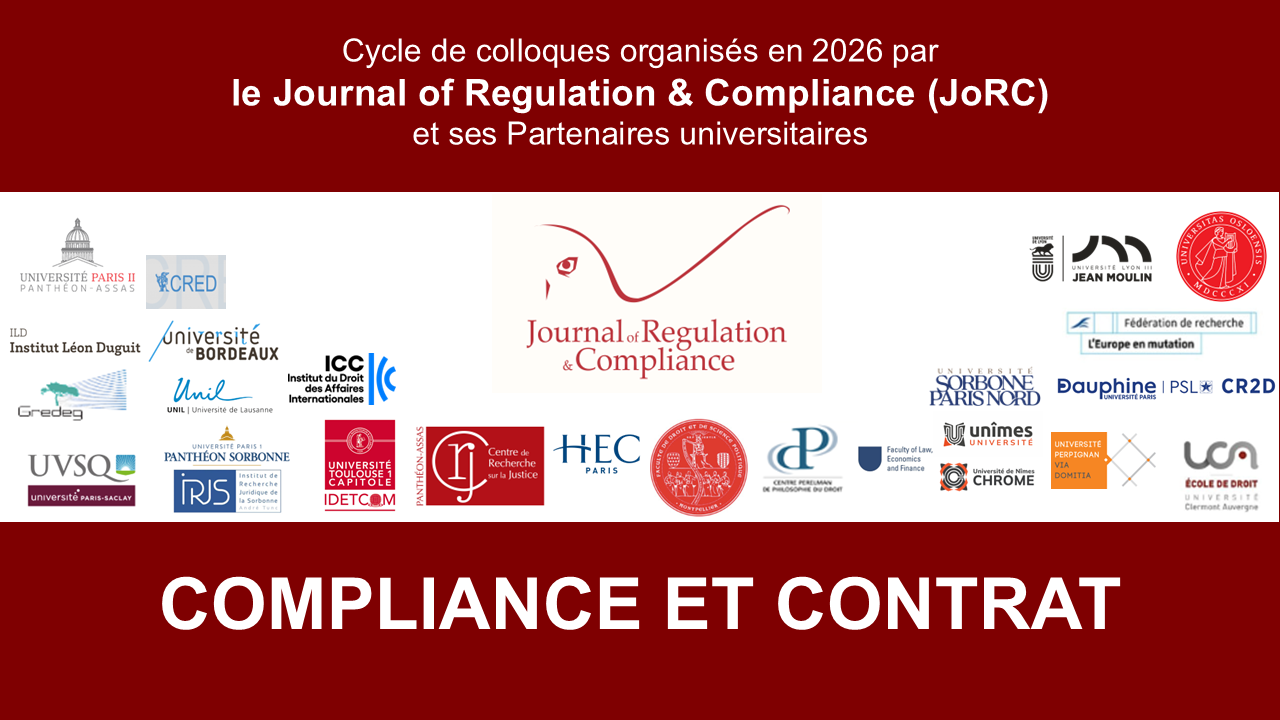
🏗️This symposium is part of the 2026 series of symposiums on "Compliance & Contracts" organised by the Journal of Regulation & Compliance (JoRC) and its partner universities.
____
The symposium is under the scientific responsibility of 🕴️Marie-Anne Frison-Roche and 🕴️Thibault Goujon-Bethan.
It will be held in French.
To register for in-person and distance learning:.....
🧮The event will take place at the Palais de l'Université, 15 quai Claude Bernard, 69007, Lyon, in the Paul Roubier lecture amphitheatre.
_____
► Presentation of the topic : Two movements intersect: firstly, what is commonly referred to as the "contractualisation of justice", an image that nevertheless refers to the inclusion of truly contractual techniques in procedural proceedings, and secondly, through the Compliance Juridictionalisation, the emergence of Systemic Litigation, which by transitivity bears the hallmarks of Compliance Law itself.
Furthermore, compliance techniques are increasingly giving way to contractual mechanisms, either through "compliance contracts" or through "compliance clauses". This therefore gives rise to contractual disputes. These are also influenced by Compliance Law, notably its norative Monumental Goals, albeit indirectly rather than directly.
Thus, in various new ways, a new field of "contractual litigation involving compliance" is emerging. This field involves procedural and jurisdictional aspects, which will be examined during this event.
Firstly, it is necessary to define this contractual dispute involving compliance (I), which has only recently emerged, because although we have always been familiar with contractual disputes on the one hand, dispute over regulation and compliance in the second instance, their entanglement with the contractualisation of justice is new. This may even come as a shock, in that Compliance Law, because it is not at all simply an obligation to obey applicable regulations, carries with it systemic ambitions for the future and thus finds itself, through contracts, brought before judges who are more accustomed to disputes between two individual parties.
This opens up the topics of judges hearing cases and judges of nature (II), the parties to the dispute and the parties to the proceedings (III), procedural treatment (IV), judgement and its enforcement (V).
____
Speakers will include :
🎤Anaïs Danet, Professor at the University of Reims
🎤 Marie-Anne Frison-Roche, Professor of Regulatory Law and Compliance, Director of the Journal of Regulation & Compliance (JoRC)
🎤Thibault Goujon-Bethan, Professor at Jean Moulin Lyon 3 University, Director of the Centre Patrimoine, contrats et procédure civile -CPC2 (Centre for Estate, Contracts and Civil Procedure)
🎤Nicolas Ida, Professor at the University of Haute-Alsace
🎤Alex Nicollet, Barrister at the Paris Bar, PhD student at Jean Moulin Lyon 3 University
🎤Cyril Nourissat, Professor at Jean Moulin Lyon 3 University
🎤Romain Raine, Senior Lecturer at Jean Moulin Lyon 3 University
🎤Fabrice Vert, First Vice-President of the Paris First Instance Court of Justice
🎤Liza Veyre, Professor at the University of Paris 8
____
The proceedings of this symposium will form the basis of a specific chapter in the following publications:
📕Compliance et Contrat, to be published in French in the collection 📚Regulations & Compliance, co-published by the Journal of Regulation & Compliance (JoRC) and Lefebvre-Dalloz.
📘Compliance and Contract, to be published in English in the 📚Compliance & Regulation Serie, co-published by the Journal of Regulation & Compliance (JoRC) and Bruylant (Larcier-Intersentia).
🔻 Read the schedule for the event below ⤵️
Updated: July 4, 2011 (Initial publication: Feb. 17, 2010)
I. Isolated Articles
Updated: July 21, 2010 (Initial publication: Jan. 26, 2010)
Symposiums