In a judgment taken on March 9th 2010, the Grand Chamber of the European Court of Justice upheld the European Commission’s action against the Federal Republic of Germany, stating that by making the authorities responsible for monitoring the processing of personal data outside the public sector in the different Länder subject to State oversight, Germany incorrectly transposed the requirement of "complete independence" of the supervisory authorities responsible for ensuring data protection, and thereby failed to fulfil its obligations under the second subparagraph of Article 28(1) of Directive 95/46/EC of 24 October 1995 "on the protection of individuals with regard to the processing of personal data and on the free movement of such data".
FRENCH
Un jugement rendu par la Grande Chambre de la Cour Européenne de Justice le 9 mars 2010 insiste sur l'indépendance nécessaire des autorités en charge de la protection des données personnelles dans les Länder allemands au regard de l'application de la directive européenne 95/46/CE du 24 Octobre 1995 relative à la protection des personnes physiques à l'égard du traitement des données à caractère personnel et à la libre circulation de ces données (Directive "Données Personnelles").
Dans un jugement rendu le 9 mars 2010, la Grande Chambre de la Cour Européenne de Justice a jugé que les autorités de protection des données des Länder allemands qui contrôlent les fichiers du secteur privé n’agissaient pas en pleine indépendance, contrairement aux exigences de la Directive européenne de 1995 sur la protection des données.
GERMAN
Am 9. März 2010 verkündete der Europäische Gerichtshof sein Urteil in der Sache EG / Deutschland (C-518/07) betreffend der Verpflichtung des Mitgliedsstaats sicherzustellen, daß die nationalen Aufsichtsbehörden, die zur Überwachung der Datenverarbeitung verantwortlich sind, ihre Funktionen vollkommen unabhängig auszuüben.
Der Europäische Gerichtshof hat am 9. März 2010 sein Urteil verkündet in der Sache EG/Deutschland, in dem er betont, dass das deutsche Datenschutzsaufsichtssytem die Verpflichtung der Unabhängigkeit von Aufsichtsbehörden, die in den Rechtlinien 95/46 vorgeschrieben ist, unvollständig umgestetzt hat.
SPANISH
En una sentencia dictada por la Gran Cámara de la Corte Europea de la Justicia el 9 de marzo del 2010 insiste en la independencia necesaria de las autoridades a cargo de la protección de la privacidad de data en German Länder, en cuanto a la aplicación de la Directiva 95/46/CE del Parlamento Europeo y del Consejo, de 24 de octubre de 1995, relativa a la protección de las personas físicas en lo que respecta al tratamiento de datos personales y a la libre circulación de estos datos
En una sentencia del 9 de marzo del 2010 la Gran Cámara de la Corte Europea de la Justicia confirmó que la acción que tomó la Comisión Europea contra la República Federal de Alemania, constatando que, al darle a las autoridades la responsabilidad de monitorear el procesamiento de data personal fuera del sector público en los diferentes Länder sujetos a la vigilancia estatal, Alemania transpuso incorrectamente el requisito de ‘independencia completa’ de las autoridades supervisoras responsables de asegurar la protección de data y por lo tanto, no cumplen con los requisitos detallados en el segundo subpárrafo del artículo 28(1) de la Directiva 95/46/CE del Parlamento Europeo y del Consejo, de 24 de octubre de 1995, relativa a la protección de las personas físicas en lo que respecta al tratamiento de datos personales y a la libre circulación de estos datos
Although Regulation Law was born from the notion "sector", constant interferences between sectors and frequent interactions between some sectors and more general questions common to different sectors, make interregulation necessary. Compliance Law being the extension of Regulation Law, this interregulation mechanism is also necessary in Compliance Law.
This interregulation can take many legal paths like letters exchanges between regulators, the creation of a network of regulators and supervisors at the world level or about some specific question or the adoption of a "cooperation protocol" as the AMF (French Financial Market Regulator) and the AFA (French Anticorruption Agency) did on 16th of September 2020 to reinforce their respective fight against corruption, against market abuses and for the protection of investors.
This cooperation protocol between the AFA and the AMF has the following subjects:
A more efficient methodology concerning the research and the analysis of corruption and market abuses.
A more efficient prevention of corruption and market abuses.
A better capacity to give recommendations of new regulations to the Legislator.
A more rigorous monitoring of international works on the topic.
The European Commission approves a Swedish export-credit insurance scheme until December 31st, 2010, in accordance with the Temporary Framework for State Aid Measures in the current financial and economic crisis
The President of the Autorité de régulation des communications électroniques et des postes (Arcep –French Electronic and Postal Communications Regulation Authority) presents his vision of Telecommunications Regulation in favour of Network Neutrality.
As the previous cycles devoted to the general theme of Compliance and aiming to build a "Compliance Law", this cycle takes a particular aspect of this branch of the Law being built and developed, which was applied even before being conceived. Since pragmatism preceded or even prevailed, the theme chosen this year is: Les outils de la Compliance(Compliance Tools).
These conferences will be in French
These tools are very diverse, not only among themselves but according to the sectors in which they are deployed or according to the geographical areas in which they are applied. It is necessary to apprehend them by going beyond the description of the instrument literally shown, as the texts or the promoters show it, without immediately going up to too large generalities. For this reason, some conferences will focus on specific, well-identified mechanisms, such as risk mapping or alert. They may also consider how Compliance Law uses more general tools to achieve its goals, such as lawsuits, incentives or new technologies. This will make it possible to problematize more clearly perceptible difficulties in Compliance Law, such as the adequacy or inadequacy of the constraint in relation to the aims, the consideration or not of the legal and political geography, the articulation or not of the tools between them.
These various conferences will take place in several places, according to the part taken by the different university structures that this year contribute to the Journal of Regulation & Compliance (JoRC) for the realization of the cycle. The result will be two books, one in French: Les outils de la Compliance, the other in English: Compliance Tools.
This cycle of conferences about Compliance tools will begin in November 2019 and will last until June 2020.
It is organized by the Journal of Regulation & Compliance (JoRC) and by the Paris Center for Law and Economics of the Panthéon-Assas University (Paris II).
This scientific event is placed under the scientific responsibility of Laurent Benzoni, Bruno Deffains and Marie-Anne Frison-Roche.
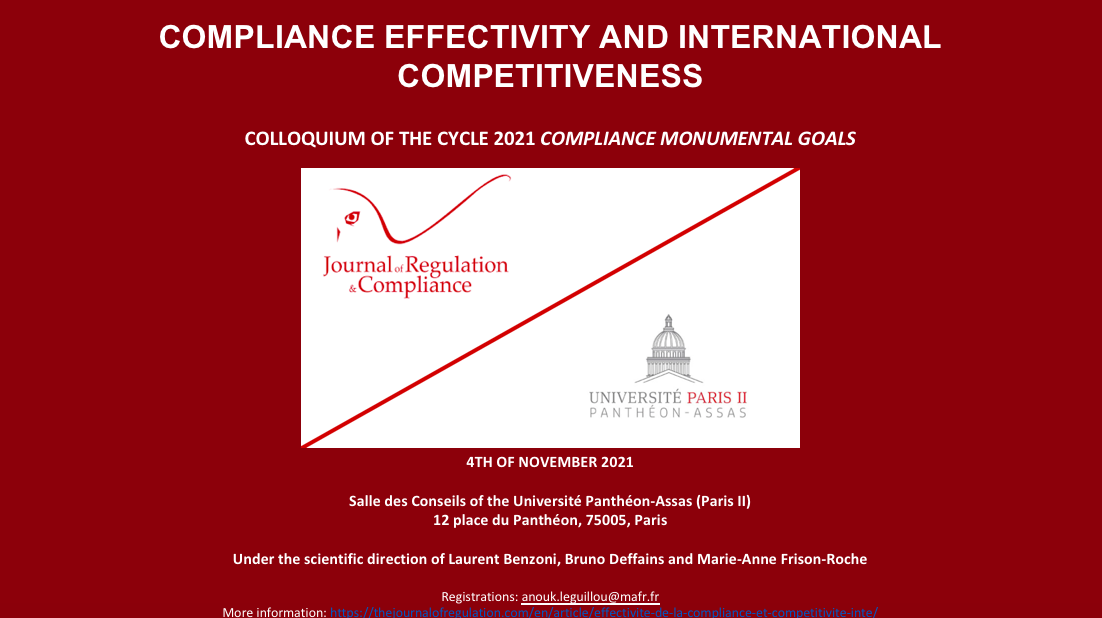
📅 The colloquium will take place in the Salle du Conseil (Panthéon-Assas University) on Thursday, November 4, 2021 from 1.30pm until 6.30pm.
🎥 The colloquium will be edited on video by the Journal of Regulation & Compliance.
Presentation of the topic :
Speakers:
🎤 Laurent Benzoni, professor of Economics at Panthéon-Assas University (Paris II), Tera Consultants
🎤Bruno Deffains, professor of Economics at Panthéon-Assas University (Paris II), director of the CRED
The different interventions will be then transformed into contributions in the books 📕Les buts monumentaux de la Compliance and 📘Compliance Monumental Goals which will be published in the Regulation & Compliance serie, jointly published by the JoRC and Dalloz for the French edition and by JoRC and Bruylant for the book in English.
Read a detailed presentation of the colloquium below:
A French Bill on banking and Financial Regulation was registered with the Presidency of the “Assemblée Nationale” (the lower house of the French Parliament, the National Assembly) on December 16th 2009, and plans for the creation of a council on financial regulation and systemic risk.
The European Commission adopted the Decision setting up a Financial Services User Group on 20 July 2010 (2010/C 199/02) to ensure proportionate user representation and expertise at all stages of the development of its policy on financial services.
FRENCH
Fiche thématique (finance) : La Commission européenne établit un groupe des utilisateurs des services financiers afin de faire une plus grande place aux opinions des utilisateurs dans le processus décisionnel européen
La Commission européenne a adopté la décision établissant un groupe des utilisateurs des services financiers le 20 juillet 2010 (2010/C 199/02) afin d'assurer une représentation proportionnelle des usagers et de profiter de leur point de vue à chaque stade du développement de sa politique envers les services financiers.
GERMAN
Thematischer Bericht (Finanz): Die Europäische Kommission hat eine neue Gruppe für Nutzer von Finanzdienstleistungen (FSUG) eingesetzt, um die Vertretung der Nutzer im EU politischen Entscheidungsführungsprozess sicherzustellen.
Die Europäische Kommission hat in einer Beschluss vom 20. Juli 2010 (2010/C199/02) die Einsetzeung einer Nutzergruppe "Finanzdienstleistungen" angenommen. Diese Gruppe soll einer angemessenen Vertretung der Nutzer in allen Phasen der Ausarbeitung der Politik der Kommission im Bereich Finanzdienstleistungen gewährleisten.
ITALIAN
Finanza: La Commissione europea ha approvato un Gruppo per gli utenti dei servizi finanziari per rafforzare la loro voce in capitolo nel processo decisionale dell’Unione europea.
Il 20 luglio 2010 la Commissione europea ha adottato la decisione (2010/C 199/02) che prevede un Gruppo per gli utenti dei servizi finanziari al fine di assicurare una rappresentazione degli stessi e considerazione della loro competenza in ogni stadio dello sviluppo della sua politica in materia di servizi finanziari.
Like the previous cycles devoted to the general theme of Compliance and aiming to build a "Compliance Law", intended like them to be published in the Regulations & Compliance collection, this cycle addresses a particular aspect of this branch of Law in progress. to develop, which was applied even before it was conceived. The Compliance mechanisms having preceded the conceptualization of this way of doing things, the "Compliance Tools" having been the subject of the previous cycle of conferences, this new cycle addresses what characterizes Compliance : Les buts monumentaux de la Compliance (Monumental Goals of Compliance) .
The notion of "monumental goals" was proposed in 2016!footnote-139. It is central in the compliance mechanisms in that they can only claim to constrain and cost those in which they are inserted in that they tend to achieve goals whose substantial quality is to be "monumental" . This notion is not self-evident, having to be justified, detailed, put into perspective and concretely illustrated, a series of conferences organized by numerous universities is therefore devoted to it.
These various conferences will be held in several places, according to the part taken by the various university structures which bring their support to the Journal of Regulation & Compliance (JoRC) for the realization of the cycle. This will result in two collective books, one in French: Les buts monumental de la Compliance, the other in English: Compliance Monumental Goals.
This cycle of colloquia Compliance Monumental Goals will take place between April 2021 and November 2021.
📅 Colloquium of May 17, 2021: Public norms and Compliance in time of crisis: monumental goals put to a test, co-organized by the Journal of Regulation & Compliance (JoRC) and the Montpellier University Law School, under the scientific direction of Marie-Anne Frison-Roche, Pascale Idoux, Antoine Oumedjkane and Adrien Tehrani: more information about this manifestation here
📅 Colloquium of September 16, 2021, Compliance Monumental Goals: Radioscopy of a Notion, co-organised by the Journal of Regulation & Compliance (JoRC) and Saclay University, under the scientific direction of Christophe André, Marie-Anne Frison-Roche, Marie Malaurie and Benoît Petit : more information about this manifestation here
📅 Colloquium of October 14, 2021: Compliance and Proportionality, co-organised by the Journal of Regulation & Compliance (JoRC) and the IDETCOM of Toulouse University, under the scientific direction of Marie-Anne Frison-Roche and Lucien Rapp: more information about this manifestation here
📅 Colloquium of November 4, 2021: Effectivity of Compliance and international competitiveness, co-organized by the Journal of Regulation & Compliance (JoRC) and the Centre de recherches en Economie et Droit de l'Université Paris II, under the scientific direction of Laurent Benzoni, Bruno Deffains and Marie-Anne Frison-Roche: more information about this manifestation here
The technical modes of registration are specific to each colloquium.