
Search results (224 cards)

Updated: Sept. 19, 2012 (Initial publication: May 15, 2011)
Sectorial Analysis
PORTUGUESE
Informe temático (Correios): A autoridade francesa de concorrência adota medidas protetivas para suspender una parceria entre La Poste e Mondial Relay.
Em 12 de maio de 2011, a Autorité de la concurrence (Autoridade francesa de concorrência) adotou medidas protetivas de suspensão de uma parceria planejada entre La Poste (o serviço postal francês) e Mondial Relay, uma empresa de envio alternativo de pacotes. A Autorité de la concurrence tem fortes suspeitas de que este acordo reforçaria a posição dominante de mercado de La Poste e afetaria o desenvolvimento da concorrência no mercado de envio de pacotes.
ITALIAN
Relazione tematica (Poste): L’autorità garante della concorrenza francese ha adottato dei provvedimenti di protezione per impedire il partenariato tra La Poste e Mondial Relay
Il 12 maggio 2011, l’Autorité de la Concurrence (l’autorità garante della concorrenza) ha adottato dei proveddimenti per sospendere un progetto di partenariato che sarebbe stato concluso tra La Poste (la società che gestisce i servizi postali francesi) e Mondial relay, un’altra società di consegna pacchi. L’Autorité de la Concurrence ha emesso forti sospetti che tale accordo puntasse a rinforzare la posizione dominante de La Poste e ad ostacolare la normale concorrenza nel mercato della consegna pacchi.
Updated: July 5, 2010 (Initial publication: June 7, 2010)
I. Isolated Articles
Updated: June 25, 2010 (Initial publication: June 3, 2010)
Grey Litterature
Updated: April 21, 2011 (Initial publication: April 15, 2011)
I. Isolated Articles
Updated: July 4, 2011 (Initial publication: Dec. 16, 2009)
I. Isolated Articles
Updated: June 19, 2012 (Initial publication: June 14, 2012)
Neutrality in Systems of Economic Regulation
TRANSLATED SUMMARIES
ENGLISH
"Acting in a neutral way" is an oxymoron. "Companies often require however that States use their powers in a neutral way (eg tax neutrality). In regulated sectors, some are right or even duty , of not being neutral. Firstly, it is the State, which requires the market for other purposes, other temporalities and other values. Secondly, they are also the "crucial operators", which are sort of regulators of second degree, such as transmission system operators or companies capital markets firms. The difficulty increases when the systeme requires neutrality of regulators and judges, when first build economic policy and the second create jurisprudence. Their consistency, impartiality and rationality can create an objectifiable neutralitys
FRENCH
«Agir de façon neutre» est un oxymoron. «Les entreprises ont souvent besoin, cependant, que les États utilisent leurs pouvoirs de manière neutre (neutralité fiscale par exemple).
Dans les secteurs réglementés, certains ont le droit ou même le devoir de ne pas être neutre. Tout d’abord, c’est l’État, qui insère le marché à d’autres fins, d’autres temporalités et d’autres valeurs. En second lieu, ils sont aussi les «opérateurs crucial», qui sont des sortes de régulateurs du second degré : par exemple les opérateurs de réseaux de transport ou de entreprises de marchés financiers.
La difficulté augmente lorsque le systeme économique et politique exige la neutralité des autorités de régulation et des juges, alors que les premiers construisent la politique économique et les seconds construisent la jurisprudence. Le respect qu'ils doivent avoir de l'impartialité et d'une rationalité suffisamment objectivables pourra permettre cette objectivité requise.
Updated: Sept. 25, 2012 (Initial publication: April 1, 2010)
Sectorial Analysis
Main information
The European Regulation of 16 September 2009 implements a new regulatory framework for credit rating agencies, in order to restore investor and consumer confidence, enable the supervision and transparency of credit ratings, and avoid conflicts of interest.
Updated: Jan. 17, 2012 (Initial publication: Jan. 13, 2012)
Books
Translated summaries
The translated summaries are done by the Editors and not by the Authors
ENGLISH
The purpose of this collective work is to understand the causes of the financial crisis. It has a strong international dimension and draws in both legal and economic science. Although composed of independent contributions from each other, it relies on a general demonstration, summary of which will largely be the focus of this first bibliographic report, the importance of justifying the work that results in three successive bibliographic reports. Furthermore, the book focuses on the specific issue of governance in international finance, which runs through regulatory issues, but one cannot be reduced to the other and vice versa.
Therefore in all three bibliographic records, abstracts will be more or less developed on the contributions, depending on whether they directly concerned by regulation, in which case they will be preferred or more remote areas, in which case they will shortly exposed.
The first bibliographic record aims to present, on the one hand, the general problem of the book, and also to highlight two contributions of historical (1920-1930/2001-2007).
FRENCH
Fiche Bibliographique (Livre) : La globalisation de l’intégration financière. Perspective de trente ans, de la réforme à la crise)
Cet ouvrage collectif a pour objet de comprendre les causes de la crise financière. Il présente une dimension fortement internationale et puise à la fois dans la science juridique et économique. Bien que constitué de contributions autonomes les unes des autres, il s’appuie sur une démonstration générale, dont le résumé sera en grande partie l’objet de cette première fiche bibliographique, l’importance de l’ouvrage justifiant qu’il donne lieu à a trois fiches bibliographiques successives. En outre, l’ouvrage porte sur la question précise de la gouvernance dans la finance internationale, ce qui traverse les questions de régulation mais l’un ne se réduit à l’autre et vice et versa.
C’est pourquoi dans chacune des trois fiches bibliographiques, des résumés seront plus au moins développés concernant des contributions, suivant que celles-ci abordent directement des thèmes de régulation, auquel cas elles seront privilégiées, ou des thèmes plus éloignés, auquel cas elles ne seront qu’évoquées.
Cette première fiche bibliographique a pour objet de présenter d’une part la problématique générale de l’ouvrage et d’autre part de mettre en valeur deux contributions, de nature historique (1920-1930/2001-2007).
SPANISH
Informe Bibliográfico (Libro): La Integración Global Financiera, perspectivas desde 30 años. De la reforma hasta la crisis.
El objetivo de este trabajo colectivo es de entender las causas de la crisis financiera. Contiene una gran dimensión internacional y se apoya tanto en las ciencias legales como en las económicas. Aunque es una colección de contribuciones independientes el uno del otro, todos tienen en común una dimensión general, lo cual será detallado en el primer informe bibliográfico, la importancia de justificar el trabajo que resulta en tres informes bibliográficos sucesivos. El libro se centra en el tema específico de la gobernabilidad en la finanza internacional, la cual se relaciona a la regulación, pero uno no se reduce al otro y viceversa.
Por lo tanto, en cada uno de los tres informes bibliográficos, abstractos serán desarrollados para cada contribución, dependiendo de su relatividad a la regulación, en dado caso se les dará preferencia sobre casos mas lejanos, los cuales serán brevemente mencionados.
El primer informe bibliográfico se propone a presentar, de un lado, el problema general del libro, y del otro, de subrayar dos contribuciones históricas (1920-1930/2001-2007).
ITALIAN
Lo scopo di questo lavoro collettivo è capire le cause della crisi finanziaria. Tale lavoro ha una forte dimensione internazionale e si posiziona in un contesto legale ed economico. Sebbene composto da contributori indipendenti l’un dall’altro, si fonda su una problematica generale, il cui riassunto sarà l’oggetto principale di questa prima relazione bibliografica. L’importanza di tale studio è tale da giustificare i tre articoli che seguiranno su tale lavoro. Inoltre, questo lavoro di ricerca si focalizza sul tema specifico della governance in materia di finanza internazionale, e tocca diversi temi relativi alla regolazione che non possono essere ridotti o confusi l’un con l’altro. Pertanto, per tutti e tre questi articoli bibliografici, gli abstract saranno più o meno approfonditi su tali contribuzioni, a seconda del fatto che tale contribuzione sia rilevante ai fini dell’analisi della regolazione, nel qual caso l’abstract sarà più consistente, o se la contribuzione tocchi solo incidentalmente la regolazione, nel qual caso gli abstract saranno più corti.
La prima relazione bibliografica punta, da un lato, a presentare la problematica generale di tale lavoro e, dall’altro, ad attirare l’attenzione su due contribuzioni, di natura storica.
.....................
Other translations forthcoming.

March 3, 2018
JoRC
Among all the things that were important to remember, one of the things that struck me most in the extraordinary conference of the President of the Court of Justice of the European Union Koen Lenaerts on "Europe of the Compliance "held on March 2, 2018 was his ability to make" live Europe ". Not only to make it understand but also to make it "live". Here is the challenge: that compliance is not an accumulation of processes without reason and without flesh, but a living whole taking its meaning into consideration of the human being, a person whose judge is concerned.
On 2 March 2018, Koen Lenaerts therefore came to an amphitheater at the University Panthéon-Assas (Paris 2) to inaugurate the series of conferences organized by the Journal of Regulation & Compliance (JoRC), a cycle that has the general title: Pour une Europe de la Compliance (For the Europe of Compliance). The School of Public Affairs of Sciences Po, the Department of Economics of Sciences Po, the Ecole doctorale de droit privé (Doctoral School of Private Law) at the Université Panthéon-Assas- Paris 2 (Panthéon-Assas University - Paris 2) and the School of Law of the University Panthéon-Sorbonne (Paris I), are associated with this cycle. Many personalities will take the floor.
Presented by Professor Thierry Bonneau, the conference made by President Koen Lenaerts was extremely rich and solid, perfectly constructed. Everyone had known the quality of the conference to be delivered by the President of the CJEU. The content of his demonstration will be found in the article he will give for the book that will be published in the Régulations & Compliance Series edited by Marie-Anne Frison-Roche at Éditions Dalloz. And the reader will find all the strength of this demonstration. This is necessary to venture into this area of "Compliance" : Koen Lenaerts recalled that we were still looking for the definition and a French term that would do justice to a satisfactory definition!footnote-90. This question was echoed by Antoine Garapon in his discussion.
Embodying the firmness that must be shown when words are uncertain, President Koen Lenaerts emphasized that the European Union is based on "Rule of Law". This means that the behaviors must respect Law. For that, - and that is why it is necessary to take in the literal sense the English expression "to comply with", the enterprise must not be passive but to make sure that its behavior is actually respectful of legal prescriptions. In this, there is a general paradigm shift, which inverses the relation betwenn the operator and the rules, from the Ex Post to the Ex Ante!footnote-89 as the entreprise has to be itself active to secure the effectiveness of the rule of Law. This internalization of the rule by the company develops both a procedural culture and a behavioral culture, in which companies can express an ethical dimension and build a "Trust Pact" !footnote-88 with states and public authorities. This change has been brought about by globalization, since states no longer have the means to impose ethical norms of behavior on businesses through the Ex Post intervention of their jurisdiction, but States like companies are gaining the benefit of this internalisation of rules in compagnies because the Compliance is inseparable from the accountability by which the company is compelled to justify that it actually tends to achieve the overall goals assigned by the public authority.
Thus, after exposing the general movement by which Europe opened up to this upheaval, President Koen Lenaerts took on three technical dimensions crossed by this new conception. The first is the Financial Markets Law. The second is Competition Law, about which the President has notably developed the Court's reflections on whether the adoption of a compliance program by an enterprise found to have violated Competition Law, in particular by "negligence" is neutral, or constitutes a mitigating circumstance or constitutes an aggravating circumstance. This question was taken up after the presentation in the discussion with the room. The third is that of personal data. Taking again as in a waltz with three times his remarks, the president of the Court of Justice found that the compliance, whereas it consists in transforming the Ex Post into Ex Ante becomes juridicalised and in this the Court of justice holds its not only in Europe but also in relation to the world, without however ever forgetting that it is the States that are drawing up the rules that are the foundation of Europe.
We will find in the article that will be published all these precious elements and no doubt that the elegance of the pen will be equal to that of speech.
But, written exercise requires, the reader will not find what we had the chance to attend: the story of two cases by the one I would prefer to name the "Professor Koen Lenaerts".
Two famous cases, which we teachers, comment and remind in our courses, that students learn and recite, quote in their copies. But never that way.
The first case is the Schrerms case, where the court said that Facebook could not transfer this person's personal data to the United States since he was opposed to it. To make it clear, the President revived it through the litigant, who was a student and for this reason he spoke directly to the students present in the amphitheater. He pointed out that the plaintiff at the origin of the case was a law student, like them. He detailed his situation in Austria, making some quotes in perfect German, pointing out that this student was now at the doctoral stage, inviting students to be brave, as he was. At each episode of the story, the speaker told the students, making some detours on his own student life because finally we were all in family ... Alma Mater. But his hands were telling the story even more: they were thrown themselves into the story, they brewed the space, it seemed as if they themselves were no more grandiloquent than the speaker but found their place exactly , in a magisterial position. Yes, here is a president in front of which companies have a hard time hiding the truth, a president with such firm hands and whose torso does not move but turns to the left and right to talk to everyone.
The second story was even more beautiful. The Google Spain case, I know it. I even know it by heart. I read it, commented on it, cited it a lot of times ... But all of a sudden that's what happened to a small Spanish merchant: President Koen Lenaerts told us his story, and I rediscovered the case. A small Spanish shopkeeper, whose name the speaker uttered in perfect Spanish, obtained from the Court of Justice that his "right to be forgotten" was recognized. President underlined the apparent paradox of his insistence for the appearance of his surname in the judgment by which this person had thus obtained the erasing of his surname! Yes, I did not notice ... Why did he ask for the mention of his name in the right to have his name deleted? Because it's a matter of honor. This is what the speaker insisted: do not joke with honor. And if you do, even Google will lose.
The merchant had been subject to a forced property sale procedure because of financial difficulty, which spanish newspapers had echoed. His honor was been trampled. Then, by a happy return of fortune, he had recovered his property, his prosperity, his reputation. But from that, the press had not talked about it. Some lines in a newspaper of legal announcements, but that it is nothing for the human soul. That's why he wanted these mechanical digital links to disappear, which always and for all end up with articles presenting him as a wretch without ever ending up with articles presenting him as a prosperous merchant (because of the non-existence of these second articles).
The speaker emphasized this dimension very much. And we know that the General Regulations that will come into force in May 2018 on personal data, which intrigues so much the Americans, draws in the judgment Google Spain its main solution in the matter: this "right to be forgotten" , subjective right so strange.
He emphasized this dimension very much. And we know that the General Regulations that will come into force in May 2018 on personal data, which intrigues so much the Americans, draws in the judgment Google Spain its main solution in the matter: this "right to be forgotten" , subjective right so strange.
Listening to President Koen Lenaerts, how not to think of Carbonnier? to his articles of it, especially on sociological rule : "small causes, great effects"?
From this conference, it will remain a great article, but as in the theater, where the ephemeral is part of the beauty of this art, what were these two stories, told by the one who knew how to listen when it was necessary to decide the two cases, stories told with the two firm hands that danced inviting students to enter this round, even as the President of the Court of Justice had to leave immediately to Luxembourg to hold such heavy obligations, yes it was simply beautiful .

Oct. 26, 2020
JoRC
Like the previous cycles devoted to the general theme of Compliance and aiming to build a "Compliance Law", intended like them to be published in the Regulations & Compliance collection, this cycle addresses a particular aspect of this branch of Law in progress. to develop. "Compliance tools" having been the subject of the previous cycle of conferences and showing judges, lawyers, jurisdictions, this new cycle addresses a new phenomenon in Compliance: La juridictionnalisation de la Compliance (The jurisdictionalisation of Compliance).
It will take place in parallel with the series of conferences on the theme: Les buts monumental de la Compliance (The monumental goals of Compliance).
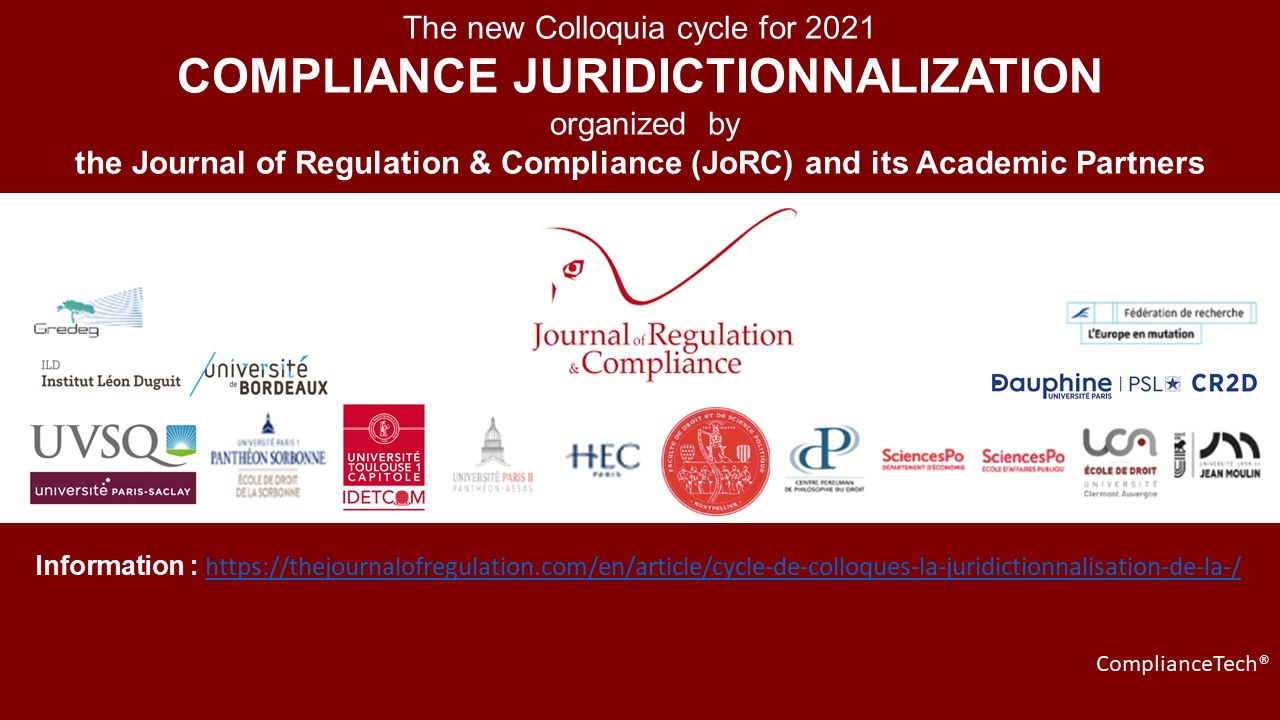
There have always been judges and lawyers in Compliance Law, in particular because this is the extension of Regulatory Law in which they have a full place. This results from the fact that the decisions taken in respect of Compliance are contestable in court, those issued by the company, such as those of States or Authorities. The novelty lies more in the phenomenon of "legalization", that is to say that the jurisdictional model penetrates all Compliance Law, and not only the Ex Post part that this includes. Furthermore, it seems that this jurisdictionalization influences the non-legal dimension of Compliance. This movement has effects that must be measured and causes that must be understood. Advantages and disadvantages that must be balanced. If only to form an opinion on this "juridictionalization of Compliance".
📅 Inaugural colloquium: Compliance jurisdictionalisation: why? Who? How? Where? and Toward What? , organized by the JoRC under the scientific direction of Marie-Anne Frison-Roche : read more information here
📅 Colloquium of March 31, 2021 : Arbitration and Compliance, co-organized by the JoRC and Paris II University, under the scientific direction of Marie-Anne Frison-Roche and Jean-Baptiste Racine : read more information here
📅 Colloquium of June 23, 2021 : The firm instituted as Court by Compliance Law, co-organized by the JoRC and the équipe de recherche Louis Josserand of Lyon 3 University, under the scientific direction of Marie-Anne Frison-Roche and Jean-Christophe Roda : read more information here
📅 Colloquium of September 23, 2021 : Which judges for Compliance? , co-organized by the JoRC and the CR2D of Paris-Dauphine University, under the scientific direction of Marie-Anne Frison-Roche and Sophie Schiller : read more information here
📅 Colloquium of October 2021 : Compliance Law, crucible between American Procedure Law and Procedure Law, co-organized by the JoRC and the Brussels University, under the scientific direction of Marie-Anne Frison-Roche and Arnaud van Waeyenberge: read more information here
Technical registration modes are specific to each colloquium.
The Journal of Regulation & Compliance (JoRC) benefits from the partnership of :
🏫 L’École d’Affaires Publiques de Sciences Po,
🏫 Le Département d’Économie de Sciences Po,
🏫 L' École de Droit de l'Université Panthéon-Sorbonne (Paris I),
🏫 L’École doctorale de Droit privé de l'Université Panthéon-Assas (Paris 2),
🏫 La Faculté de droit et de sciences politiques de l'Université de Montpellier
🏫 Le Centre Perelman de l'Université Libre de Bruxelles,
🏫 Le GREDEG de l'Université de Nice,
🏫 La Fédération de recherche "L'Europe en mutation" de l'Université de Strasbourg
🏫 Le Centre Louis Josserand de la Faculté de Droit de Lyon III.
🏫 La Faculté de droit et de sciences politiques de l'Université de Toulouse-I-Capitole,
🏫 L'école de droit de l'Université de Clermont-Ferrand.
🏫 Le centre de recherche Droit-Dauphine de l'Université Paris-Dauphine
🏫 L'École des hautes études commerciales de Paris (HEC Paris)
The cycle is supported by :