Through a decree of 31st of August 2020, the government created a national service, the "Pôle d'expertise de la régulation numérique" (digital regulation expertise pole). It has to furnish to State services a technical expertise in computer science, data science and algorithm processes in order to assist them in their role of control, investigation and study. The aim is to favor information sharing between researchers and State services in charge of regulating digital space.
As its acronym indicates, this pole of expertise aims to represents constance in a changing world. Moreover, more than being a national service, this organism must adopt a transversal dimension, its creation decree being signed by the Prime Minister, Minister of Economy, Minister of Culture and Minister of Digital Transition. The creation of such a pole shows the awareness of the government of the importance of technical competency in the regulation of digital space and of the necessity to centralize these expertises in one organ.
However, as the decree indicates, this pole of expertise could be consulted only by "State services", that excludes regulators which are independent from the State and which could put the pole in conflict of interest, and courts even if they are supposed to play a central role in the regulation of digital space and even if they are allowed to ask the advice of the regulator about some cases. But if regulators cannot size the pole, to whom does it benefit except the legislator and a few officials?
It would therefore have been better for this pole of expertise to be placed under the direction of regulatory and supervisory bodies, which would have enabled it to be able to be consulted both by regulators and by judges, both of whom are key players in digital regulation.
Summary: By its judgment of September 24, 2020, the Constitutional Court of Belgium released an essential judgment which considers:
- Compliance Law which imposes obligations on entities to fight against money laundering and the financing of terrorism is legal requirements which must be analyzed on the basis of these goals
- the national transposition law is "broader" than the transposed European texts since it is anchored in the Constitution
- the provisions of the law imposing the declaration of suspicion on an employee of the Attorney or on a Compliance Officer concerning information covered by the professional secrecy of the Attorney, the basis of Democracy, must therefore be canceled.
This reasoning is remarkable and very solid.
It is not unique to Belgium.
The activity of money laundering is detrimental not only in itself but also because it permits the development and the sustainability of other criminal activities such as drug trafficking, weapon trafficking or human beings selling. Fighting against money laundering could permit to indirectly fight against these underlying activities, by the way very difficult to fight. Thus, the fight against money laundering has become a "monumental goal", which justifies the adoption of tools sometimes much more powerful than those used by classical criminal Law. For the sake of efficiency, the legal obligation to prevent money laundering is given to every body able to do it, as banks, real estate agents or gaming society, under the penalty of sanction.
On 10th of August 2020, the Luxembourgish financial market supervisor convicts the International Bank of Luxembourg to pay a fine of 4,5 millions of euros because of weaknesses detected in its process of fight against money laundering. However, when the sanction has been pronounced, the bank had already remedied the weaknesses identified. It is important to observe that what is important for Compliance Law, it is not that a non compliant behavior is punished but rather that the crucial firm modifies its behavior in order to being more efficient in the realization of the "monumental goal", only concern of the public authority. Thus, an Ex Post sanction against the crucial operator is not an end in itself and can be justified only if it permits to incite the crucial operator to act or rather to desincite to do anything. Compliance Law is an Ex Ante legal system.
The implementation of a joint service on Insurance, Banking, and Insurance within the ‘Autorité de Contrôle prudential – ACP’ (French Prudential Control Authority), raises questions as to the way in which the service will be coordinated with the ‘Autorité des marchés financiers – AMF’ (French financial markets authority’s) other activities. The signature of the agreement creating the new joint service was the occasion for Jean-Pierre Jouyet, President of the AMF, to clarify that this joint service’s principal goal is consumer protection. The coordination between the AMF and the ACP is intended to improve efficiency and credibility to further this goal.
When one likes the "Financial law," one is delighted to open the second edition of the Droit financier (Financial Law), Frenche book written by Anne-Dominique Merville and publishes at Gualino - Lextenso édition (392 p.).
Indeed, the reader learns the most recent technical rules. If it is difficult to know "Financial law" this is because it doesn't really constitute a "branch of the law." It seems an accumulation of laws, rules, decisions and soft law adopted to serve the financial market.
Significantly way, in the book construction, there is no place especially for the "financial Regulation" while itsTitle II is about " Les régulateurs des marchés financiers" (The financial market regulators). This suggests that the financial regulatory system is primarily due to the regulatory body. This is maybe true.
Reading developments, it is observed that the European Central Bank is listed among "The financial market regulators".
For my part, for several years I do think that a central bank is a regulator. But as it is currently a supervisor and that there is a fundamental distinction between regulation and supervision. It's why it is necessary to demonstrate the transition from one to the other or intimacy between them, to affirm so easily that a central bank, monetary authority, is a financial regulator.
Yet the author assume acquired, showing that the qualification is already in the mind. The development will come after. It will impose yet because this change of qualification has important consequences. It involves jurisdictionalization of Central Banks that we still do not know and have not conceived.
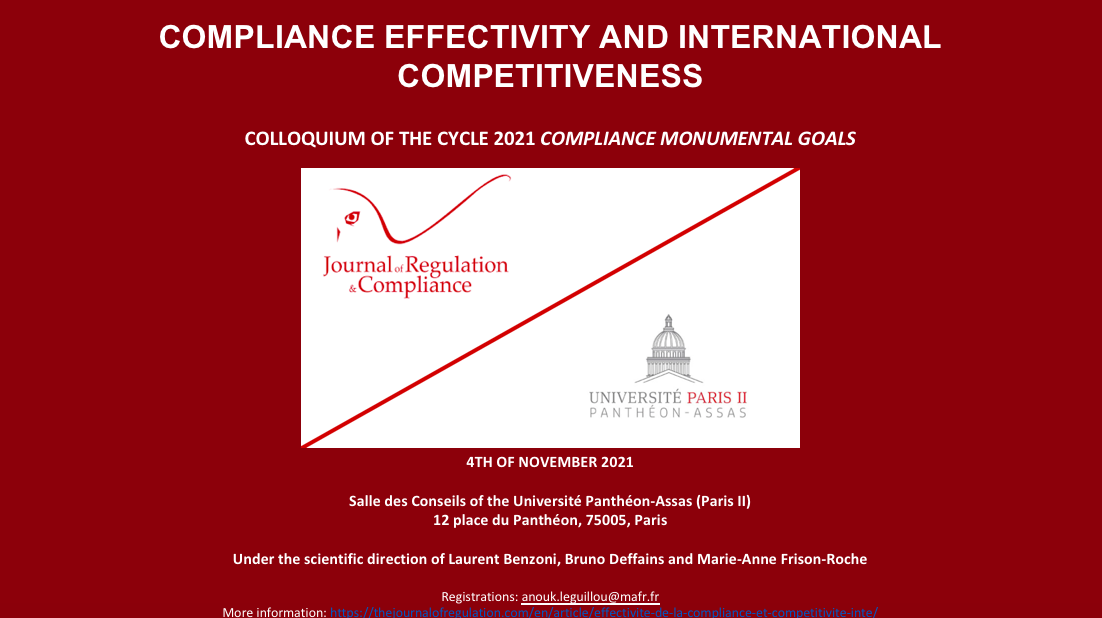
It is organized by the Journal of Regulation & Compliance (JoRC) and by the Paris Center for Law and Economics of the Panthéon-Assas University (Paris II).
This scientific event is placed under the scientific responsibility of Laurent Benzoni, Bruno Deffains and Marie-Anne Frison-Roche.
📅 The colloquium will take place in the Salle du Conseil (Panthéon-Assas University) on Thursday, November 4, 2021 from 1.30pm until 6.30pm.
🎥 The colloquium will be edited on video by the Journal of Regulation & Compliance.
Presentation of the topic :
Speakers:
🎤 Laurent Benzoni, professor of Economics at Panthéon-Assas University (Paris II), Tera Consultants
🎤Bruno Deffains, professor of Economics at Panthéon-Assas University (Paris II), director of the CRED
The different interventions will be then transformed into contributions in the books 📕Les buts monumentaux de la Compliance and 📘Compliance Monumental Goals which will be published in the Regulation & Compliance serie, jointly published by the JoRC and Dalloz for the French edition and by JoRC and Bruylant for the book in English.
Read a detailed presentation of the colloquium below:
The Basel Committee on Banking Supervision approved a package of new proposals to strengthen global capital and liquidity regulations for consultation, as part of its comprehensive response to the international financial crisis.
The implementation of a common repertory of information on Social Security tax payments provides the opportunity to gather real-time information on a vast majority of taxpayers, but is highly criticized for its possible violation of privacy rights.
The translated summaries are done by the Editors and not by the Authors.
ENGLISH
“Global Financial Integration, Thirty Years on. From reform to crisis”
combines many academic contributions on international financial
governance, that each offer original and in-depth analysis of the
financial crisis’ causes. To safeguard the authors’ legal and economic
reasoning, the bibliographical report has been divided in three parts
and will be brought to The Journal of Regulation’s readers in three
successive issues . The following report analyses the third part of the
volume.
The European Commission conducted a competition inquiry on the competitiveness of European energy markets, because it believed that these markets functioned poorly, especially because they are insufficiently open to competition and their prices are too high. Proceedings were begun in December 2009 against E.ON, and were closed by this corporation’s May 4, 2010 legally-binding commitments to the European Commission to improve its competitors’ access to its natural gas transportation network. Access to transportation networks, which are essential facilities, is the heart of any regulatory system, and if access was not organized beforehand (ex ante), it can be arranged afterwards (ex post), as is the case in this affair, via an alliance between Competition Law and Contract Law, wherein the commitments take on the form of a sort of co-regulation (cf. infra brief summary)
FRENCH
Par une décision du 4 mai 2010, la Commission Européenne a accepté le les engagements proposés par la société énergétique allemande E.ON d’ouvrir davantage à ses concurrents l’accès à son réseau de transport de gaz.
La commission européenne a mené en 2007 une enquête sectorielle sur le fonctionnement concurrentiel des marchés énergétiques européens en estimant que ceux-ci fonctionnent mal, notamment puisqu’ils sont peu ouverts et leurs prix trop élevés. Une procédure ouverte en décembre 2009 contre E.ON est ici close par l’engagement de celle-ci envers la commission européenne d’ouvrir à ses concurrents son réseau de transport de gaz. L’accès au réseau de transport, facilité essentielle, est le cœur du système de régulation et s’il ne se fait pas {ex ante} il peut se faire alors {ex post}, comme on le voit dans cette affaire, par une alliance entre le droit de la concurrence et le droit du contrat, l’engagement devenant une sorte de corégulation (voir infra dans le bref commentaire).
GERMAN
Die Europäische Kommission hat am 4. Mai 2010 ein Beschluss veröffentlicht, in dem sie die Zusage des deutschen Energiekonzerns E.ON, der Konkurrenz effektiven Zugang zu seinen Gasleitungen zu öffnen, für verbindlich erklärt.
Die Europäische Kommission hat eine kartellrechtliche Untersuchung im Energiesektor durchgeführt, da sie die europäischen Energiemärkte für ineffizient hielt, vor allem aufgrund mangelnden Wettbewerbs und zu hohen Preisen.Mit dem Beschluss vom 4. Mai 2010 werden die von E.ON angebotenen Verpflichtungen, den Zugang zu den Gasnetzwerken für potentielle Konkurrenten zu öffnen, für rechtlich bindend erklärt. Zugang zu Transportnetzen, die als wesentliche Einrichtungen ({Essential Facilities}) zählen, ist zentral für jedes Regulatierungssystem. Wenn dieser Zugang nicht im Voraus ({ex ante}) organisiert ist, kann er trotzdem im Nachhinein ({ex post}) etabliert werden, wie es hier den Fall ist, durch ein Bündnis zwischen Wettbewerbsrecht und Vertragsrecht, indem das Unternehmen durch seine Verpflichtungen quasi mitregulierend wirkt (siehe unten {Brief Summary})
SPANISH
En una decisión del 4 de mayo 2010, la Comisión Europea acepta los compromisos de la corporación alemana de energía, E.ON, para mejorar el acceso de competidores a la red de transporte del gas natural.
La Comisión Europea llevó a cabo una encuesta sectorial sobre la concurrencia en los mercados europeos de energía, ya que sea cree que estos mercados no funcionan de manera eficaz, especialmente porque no son los suficientemente abiertos a la competencia y sus precios son demasiado altos. Los trámites comenzaron en diciembre del 2009 contra la E.ON y fueron cerrados por ésta ante sus compromisos vinculantes ante la Unión Europea del 4 de mayo 2010 de mejorar el acceso de competidores a la red de transporte de gas natural. El acceso a las redes de transporte, que son facilidades esenciales, se encuentra al centro de cualquier sistema regulatorio, y si el acceso no fue organizado anteriormente (ex ante), puede ser organizado posteriormente (ex post), como en este caso a través de un alianza entre la Ley de la Concurrencia y la Ley de Contrato, donde los compromisos actúan de manera ‘co-regulatoria’ (VER. Infra para resumen breve).