We hardly listen to to sermons. This is probably why Alain Supiot puts us on the table the text of Bossuet only occupying few pages, but since 1659 occupies the minds on "l'éminente dignité des pauves" (the eminent dignity of the poor). When Bossuet speaks of wealth and poverty, economists have interest in reading it. When Bossuet speaks of just order and "rightful place", lawyers must read it.
Alain Supiot comments it by writing to the following "Le renversement de l'ordre du monde" (The reversal of the order of the world).
Bossuet reminds that wealthy people think everything is owed to them while grace is given to the poor. Bossuet contends that rich people have interest to share with the poor, for thus it can alleviate the wealth that overwhelm them and they can enter the community (composed by the Church) in which poor people occupy the first place by natural order.
In his study, Alain Supiot looks back on the very definition of 'poverty', which accounts for the money the individual has. He takes up the theme of Bossuet to assert that, contrary to what the result of statistical methods (how much per person per day), the wealthy are "poor" since the market isolates them, spreading them of solidarity. Yet the natural order should lead them to share, by paying taxes, and other mechanisms through the welfare state. But he notes that the State departs increasingly this function, drawn in by this model only wealthy (the "rich-poor"), the only available model becoming what Alain Supiot calls "le marché total" (total market)!footnote-15.
We can no share this view of the world, for example if it is believed that the rich share (Social Responsibility Company theory), or if one believes that the state - sort of church - was often selfish, but already listen to the first advice: read Bossuet.
Through a decree of 31st of August 2020, the government created a national service, the "Pôle d'expertise de la régulation numérique" (digital regulation expertise pole). It has to furnish to State services a technical expertise in computer science, data science and algorithm processes in order to assist them in their role of control, investigation and study. The aim is to favor information sharing between researchers and State services in charge of regulating digital space.
As its acronym indicates, this pole of expertise aims to represents constance in a changing world. Moreover, more than being a national service, this organism must adopt a transversal dimension, its creation decree being signed by the Prime Minister, Minister of Economy, Minister of Culture and Minister of Digital Transition. The creation of such a pole shows the awareness of the government of the importance of technical competency in the regulation of digital space and of the necessity to centralize these expertises in one organ.
However, as the decree indicates, this pole of expertise could be consulted only by "State services", that excludes regulators which are independent from the State and which could put the pole in conflict of interest, and courts even if they are supposed to play a central role in the regulation of digital space and even if they are allowed to ask the advice of the regulator about some cases. But if regulators cannot size the pole, to whom does it benefit except the legislator and a few officials?
It would therefore have been better for this pole of expertise to be placed under the direction of regulatory and supervisory bodies, which would have enabled it to be able to be consulted both by regulators and by judges, both of whom are key players in digital regulation.
The Libor manipulations successively discovered, led the British Government to request to the Financial Services Authority (FSA) a report to reform the system. On August 10, 2012, a progress report is made public. It proposes not to end self-regulation, but to temper it. Firstly, the declaratory system, too subjective, must be tempered by objective data (real transactions and other reference rate). Secondly, the power of monitoring and sanction of public authorities must be increased. This growing power must be that of the courts... and the Financial Services Authority (FSA). Stakeholders have until September 7, 2012 to respond. The British Government has entrusted in late July 2012 the Financial Services Authority (FSA) a report on the reform that is appropriate to operate concerning the system of Libor. It must be submitted at the end of September. Subsequent events show the method followed.
Summary: By its judgment of September 24, 2020, the Constitutional Court of Belgium released an essential judgment which considers:
- Compliance Law which imposes obligations on entities to fight against money laundering and the financing of terrorism is legal requirements which must be analyzed on the basis of these goals
- the national transposition law is "broader" than the transposed European texts since it is anchored in the Constitution
- the provisions of the law imposing the declaration of suspicion on an employee of the Attorney or on a Compliance Officer concerning information covered by the professional secrecy of the Attorney, the basis of Democracy, must therefore be canceled.
This reasoning is remarkable and very solid.
It is not unique to Belgium.
The activity of money laundering is detrimental not only in itself but also because it permits the development and the sustainability of other criminal activities such as drug trafficking, weapon trafficking or human beings selling. Fighting against money laundering could permit to indirectly fight against these underlying activities, by the way very difficult to fight. Thus, the fight against money laundering has become a "monumental goal", which justifies the adoption of tools sometimes much more powerful than those used by classical criminal Law. For the sake of efficiency, the legal obligation to prevent money laundering is given to every body able to do it, as banks, real estate agents or gaming society, under the penalty of sanction.
On 10th of August 2020, the Luxembourgish financial market supervisor convicts the International Bank of Luxembourg to pay a fine of 4,5 millions of euros because of weaknesses detected in its process of fight against money laundering. However, when the sanction has been pronounced, the bank had already remedied the weaknesses identified. It is important to observe that what is important for Compliance Law, it is not that a non compliant behavior is punished but rather that the crucial firm modifies its behavior in order to being more efficient in the realization of the "monumental goal", only concern of the public authority. Thus, an Ex Post sanction against the crucial operator is not an end in itself and can be justified only if it permits to incite the crucial operator to act or rather to desincite to do anything. Compliance Law is an Ex Ante legal system.
The implementation of a joint service on Insurance, Banking, and Insurance within the ‘Autorité de Contrôle prudential – ACP’ (French Prudential Control Authority), raises questions as to the way in which the service will be coordinated with the ‘Autorité des marchés financiers – AMF’ (French financial markets authority’s) other activities. The signature of the agreement creating the new joint service was the occasion for Jean-Pierre Jouyet, President of the AMF, to clarify that this joint service’s principal goal is consumer protection. The coordination between the AMF and the ACP is intended to improve efficiency and credibility to further this goal.
When one likes the "Financial law," one is delighted to open the second edition of the Droit financier (Financial Law), Frenche book written by Anne-Dominique Merville and publishes at Gualino - Lextenso édition (392 p.).
Indeed, the reader learns the most recent technical rules. If it is difficult to know "Financial law" this is because it doesn't really constitute a "branch of the law." It seems an accumulation of laws, rules, decisions and soft law adopted to serve the financial market.
Significantly way, in the book construction, there is no place especially for the "financial Regulation" while itsTitle II is about " Les régulateurs des marchés financiers" (The financial market regulators). This suggests that the financial regulatory system is primarily due to the regulatory body. This is maybe true.
Reading developments, it is observed that the European Central Bank is listed among "The financial market regulators".
For my part, for several years I do think that a central bank is a regulator. But as it is currently a supervisor and that there is a fundamental distinction between regulation and supervision. It's why it is necessary to demonstrate the transition from one to the other or intimacy between them, to affirm so easily that a central bank, monetary authority, is a financial regulator.
Yet the author assume acquired, showing that the qualification is already in the mind. The development will come after. It will impose yet because this change of qualification has important consequences. It involves jurisdictionalization of Central Banks that we still do not know and have not conceived.
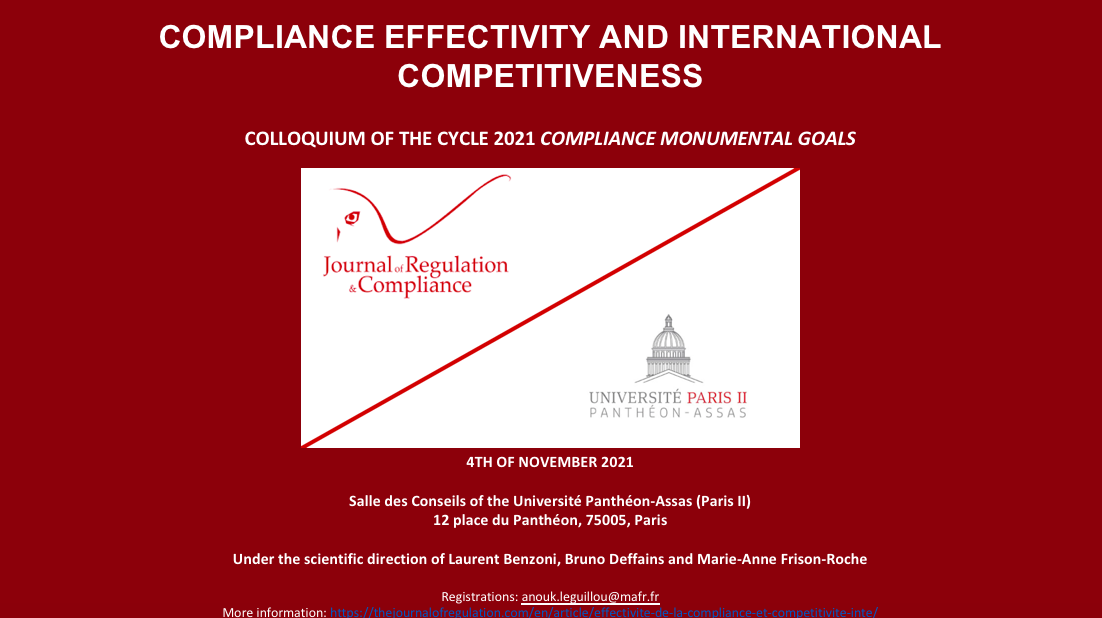
It is organized by the Journal of Regulation & Compliance (JoRC) and by the Paris Center for Law and Economics of the Panthéon-Assas University (Paris II).
This scientific event is placed under the scientific responsibility of Laurent Benzoni, Bruno Deffains and Marie-Anne Frison-Roche.
📅 The colloquium will take place in the Salle du Conseil (Panthéon-Assas University) on Thursday, November 4, 2021 from 1.30pm until 6.30pm.
🎥 The colloquium will be edited on video by the Journal of Regulation & Compliance.
Presentation of the topic :
Speakers:
🎤 Laurent Benzoni, professor of Economics at Panthéon-Assas University (Paris II), Tera Consultants
🎤Bruno Deffains, professor of Economics at Panthéon-Assas University (Paris II), director of the CRED
The different interventions will be then transformed into contributions in the books 📕Les buts monumentaux de la Compliance and 📘Compliance Monumental Goals which will be published in the Regulation & Compliance serie, jointly published by the JoRC and Dalloz for the French edition and by JoRC and Bruylant for the book in English.
Read a detailed presentation of the colloquium below:
The Basel Committee on Banking Supervision approved a package of new proposals to strengthen global capital and liquidity regulations for consultation, as part of its comprehensive response to the international financial crisis.
The implementation of a common repertory of information on Social Security tax payments provides the opportunity to gather real-time information on a vast majority of taxpayers, but is highly criticized for its possible violation of privacy rights.