
Search results (224 cards)

Oct. 15, 2026
JoRC
► Full reference: Journal of Regulation & Compliance (JoRC) and Panthéon-Sorbonne University (Paris I), Institut de Recherche juridique de la Sorbonne -IRJS (Sorbonne Legal Research Institute), Compliance et droit commun des contrats (Compliance and General Contract Law), 15 October 2026.
____
🏗️ This symposium is part of the series of symposiums organised by the Journal of Regulation & Compliance (JoRC) and its partner universities, focusing in 2026 on the general theme of Compliance and Contract.
____
The symposium is under the scientific responsibility of Nicolas Bargue, 🕴️Marie-Anne Frison-Roche and 🕴️Julia Heinich.
____
To register:
____
🧮The event will take place at Panthéon-Sorbonne University (Paris I) on 15 October 2026.
Il will be held in French.
_____
Presentation of the topic: While Contract Law, in its common rules expressed by the "general theory of contracts", is often considered to be the most developed branch of Law in practice and the most studied at university, at first glance it seems to be given little consideration when it comes to compliance matter.
This is undoubtedly due to the fact that the company, which is at the heart of the action expected of it—action that is expected to be powerful (since it affects the collective future) and diversified (since it concerns all systems beyond the company's direct activity)—seems above all to have the status of a subject of law. This is exacerbated if, by mistakenly confusing the latter terms, we only talk about "conformity" and assert that it is simply for businesses a matter of "complying with the regulations that apply to them", which then leaves little room for contractual initiative. This would be associated only with Ethics, a normative order that also differs from a contract, which is a binding legal act.
The relationship between Contract and many sorts of documents, standards and ethical acts that are so numerous in compliance techniques, to which we can add the soft law produced by courts, regulators, supervisors and the companies themselves, is therefore an open question. This delicate reconciliation, which the terms "CSR" and "Governance" express without referring to very precise legal definitions, can cause difficulties in relation to general Contract Law: thus, the "commitments" that punctuate the techniques and behaviours that make up the "culture of compliance" have a central place in Compliance Law. However, their place, if not their equivalence with the contract, is not established, and may even be excluded. This too is an open question.
Based on these initial questions, it appears that in order to gain a firmer footing in the analysis of the practices of companies that include compliance clauses into multiple contracts, we must observe that compliance may consist of a comprehensive service that is the very subject of a specific contract, the "compliance contract, or even assist in the conception that judges may, or must, develop in their office when they are seized of "contractual litigation involving Compliance", we must return to common contract law.
Indeed, if we stop viewing Compliance Law solely through the prism of punishment, if we do not limit it to the "detection and prevention" of fraudulent behaviour which, if it occurred, would be punished, the contract does not have the same place in practice. In this initial restrictive conception of Compliance Law based on sanctions, simply by moving from ex post to ex ante, the company remains subject to the regulations that apply to it, and the contract would be just one of the ways in which it fulfils its legal compliance obligation.
However, the obligation of compliance can also be considered to have its legitimate source in the Contract, which in general termes is based on the autonomy of will and all its consequences (contractual freedom, binding force, effect on third parties, etc.), with the Principle of Compliance fitting into it as a second pillar linked to the first pillar, which is the Principle of free Competition.
It is therefore very useful to better understand practices by comparing the technical principles of general Contract Law with Compliance Principles, such as concern for others that contractors may pursue independently of any regulatory requirement (these others who are distant in space and time), preservation of systems, the obligation to provide evidence, etc.
This is the subject of this symposium which, according to the classic dichotomy of contractual formation and contractual execution, revisits the contractual thread based on the founding principles of autonomy and freedoms, binding force and its relativity, the meeting of consents, groups of contracts, and regulatory contracts often drawn up to implement compliance policies. Enforcement and contractual liability under general Contract Law are themselves coloured in a unique way when a compliance concern or goal has been included in the contract or is implied by it.
_____
Speakers include:
🎤 Nicolas Bargue professor at Panthéon-Sorbonne University,
🎤 Marie-Anne Frison-Roche, university professor, editor-in-chief of the Journal of Regulation & Compliance (JoRC) and the European School of Regulation and Compliance (EeRC)
🎤 Julia Heinich, professor at Panthéon-Sorbonne University
____
The proceedings of this symposium will form the basis of a specific chapter in the following publications:
📕Compliance and Contracts, forthcoming in the series 📚Regulations & Compliance, co-published by the Journal of Regulation & Compliance (JoRC) and Dalloz.
📘Compliance and Contract, to be published in the 📚Compliance & Regulation Serie, co-published by the Journal of Regulation & Compliance (JoRC) and Bruylant.
🔻 Read the schedule for the event below ⤵️

March 3, 2018
JoRC
On 2 March 2018, Koen Lenaerts came to an amphitheater at the University Panthéon-Assas (Paris 2) to inaugurate the series of conferences organized by the Journal of Regulation & Compliance (JoRC), a cycle that has the general title: Pour une Europe de la Compliance (For the Europe of Compliance). The School of Public Affairs of Sciences Po, the Department of Economics of Sciences Po, the Ecole doctorale de droit privé (Doctoral School of Private Law) at the Université Panthéon-Assas- Paris 2 (Panthéon-Assas University - Paris 2) and the School of Law of the University Panthéon-Sorbonne (Paris I), are associated with this cycle. Many personalities will take the floor. They will give contributions for the book that will be published in the Régulations & Compliance Series edited by Marie-Anne Frison-Roche at Éditions Dalloz.
After an admirable lecture offered by Koen Lenaerts, Antoine Garaponfootnote-94, secrétaire générale de l'Institut des Hautes Études pour la Justice (Secretary General of the Institute of Higher Studies for Justice), reacted perfectly in "premier discutant", stressing as everyone his great interest in listening to the demonstration made by the President of the Court of Justice.
He felt that it was hardly possible to speak of "Compliance Law"!footnote-91, because it is above all a Law that ceases to be "prescriptive" to become "relational" ", companies organizing themselves to put goals that are reached in relation with the public authorities. Companies thus develop a "systemic Law" that develops on its own, with alert mechanisms put in place directly by companies that care before the continuity of their economic activities. The notion of third parties disappears, a sort of "direct government" takes the place of the "indirect government" represented by the "third party", the companies having integrated this third party into their own organization, which upsets their relation to time and puts in place a "metajuridic" system.
Antoine Garapon then asks the question of how such a "conversion" could take place, that is to say, this transition of control systeme from the Ex Post mode to the Ex Ante, resulting in companies internalize the task of effective rules!footnote-92. He believes that on the one hand, the system that advocates it has the "market power to impose it and, on the other hand, those who demand it in this system make a" vision of the world "explicit. Antoine Garapon adds the need for a "moral ambition".
However, Antoine Garapon pointed out the United States have met these three conditions.
In his discussion, Antoine Garapon, on the other hand, felt that Europe did not bring them together and that Europe "starts with a handicap", because it does not consider worlwide, because it has no vision of the world, because it has not operated on moral integration.
He insisted that the Court of Justice can carry these three conditions, especially with regard to personal data. Because this is about the digital that Europe has a market power. It is about personal data that the Court of Justice is the place where Europe is both a market and values!footnote-93.
This is why the Court of Justice of the European Union does have a central role for this construction.
______
These very constructed, very instructive remarks of Antoine Garapon, thanks to him, perfectly showed, in mirror of the conference of the President of the Court of Justice, the stake: the future.
Beyond the disputatio around the definitions, it is indeed the question of whether or not Europe will build its own compliance mechanisms.
By finding a vocabulary of its own. Not only in French, because the Law is made of words, but also with new words, which leave us "translated-glued" and which will carry European ambitions, as it was the case for the "right to be forgotten" ", very often quoted in the discussion.
Of course, this presupposes "power". But we must already pretend. And the Law has always claimed to pretend. It is in this that it is an Order. This is probably why President Koen Lenaerts insisted on the "juridicization" of compliance, as does the hand of Law that arises on an object.
Nov. 4, 2021
JoRC
This scientific event is part of the 2021 colloquium cycle, organized by the Journal of Regulation & Compliance (JoRC) and its Universities partners, around the general theme of Compliance Monumental Goals.
It is organized by the Journal of Regulation & Compliance (JoRC) and by the Paris Center for Law and Economics of the Panthéon-Assas University (Paris II).
This scientific event is placed under the scientific responsibility of Laurent Benzoni, Bruno Deffains and Marie-Anne Frison-Roche.
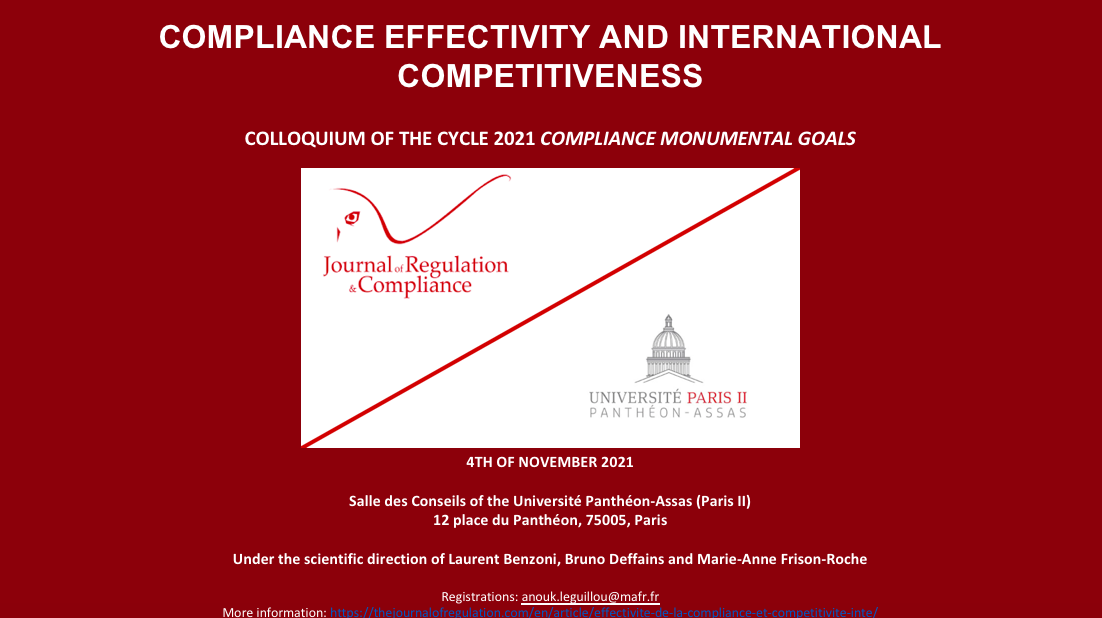
📅 The colloquium will take place in the Salle du Conseil (Panthéon-Assas University) on Thursday, November 4, 2021 from 1.30pm until 6.30pm.
🎥 The colloquium will be edited on video by the Journal of Regulation & Compliance.
Presentation of the topic :
Speakers:
🎤 Laurent Benzoni, professor of Economics at Panthéon-Assas University (Paris II), Tera Consultants
🎤Bruno Deffains, professor of Economics at Panthéon-Assas University (Paris II), director of the CRED
🎤 Marie-Anne Frison-Roche, Law professor at Sciences Po - Paris, director of the JoRC
🎤 Antoine Gaudemet, Law professor at Panthéon-Assas Université (Paris II), director of the Compliance Officer D.U.
🎤 Sabine Lochmann, CEO of Vigeo Eiris, Global Director of Moody’s ESG Solutions
🎤Frédéric Marty, economist, researcher at CNRS, member of GREDEG Côte d'Azur University
🎤 Stanislas Pottier, senior advisor to the General Management, Amundi
🎤 Jean-Christophe Roda, Law professor at Lyon 3 University
The different interventions will be then transformed into contributions in the books 📕 Les buts monumentaux de la Compliance and 📘 Compliance Monumental Goals which will be published in the Regulation & Compliance serie, jointly published by the JoRC and Dalloz for the French edition and by JoRC and Bruylant for the book in English.
Read a detailed presentation of the colloquium below:
June 12, 2026
Events
► Full reference : Journal of Regulation & Compliance (JoRC) and Panthéon-Assas University (Paris II), Le "contrat de compliance (The "compliance contract"') Paris, 12 June 2026.
► The symposium is organised by the Journal of Regulation & Compliance (JoRC) and, within Panthéon-Assas University (Paris II), the Centre de recherche sur la Justice et le Réglement des conflits - CRJ (Centre for Research on Justice and conflict resolution) and the Centre de recherche en économie et droit CRED (Centre for Research in Economics and Law ).
____
🏗️This symposium is part of the 2026 series of symposiums on "Compliance & Contracts" organised by the Journal of Regulation & Compliance (JoRC) and its partner universities."
____
The symposium is under the scientific responsibility of 🕴️Bruno Deffains, 🕴️Marie-Anne Frison-Roche, 🕴️Etienne Maclouf and 🕴️Jean-Baptiste Racine.
This event will be held in French.
To register for in-person: ...
🧮 The event will take place in the auditorium, Rue Notre-Dame-des-Champs, 75006 Paris, on 12 June 2026, between 9.30 a.m. and 1.30 p.m.
_____
► Presentation of the topic : Companies have a legal obligation to put "compliance structures" in place, such as whistleblowing mechanisms, plans, information gathering systems and data security systems. Many adopt a management strategy that leads them to choose to outsource the implementation of this obligation, or even to outsource the compliance structure itself, which then most often takes the form of a platform, even though responsibility cannot be transferred. But the line between structure and behaviour, between responsibility for the decision and its implementation, becomes blurred.
The hypothesis examined here through the "Compliance Contract", which should not be confused with compliance clauses but which is linked to them, is the widespread use by companies of this type of contract, the existence and typology of which was identified in 2022. Corresponding to a very significant share of the "compliance market", perhaps a specific market, it could constitute a special contract, requiring at the very least a specific regime, either under Competition Law, Data Law, particularly Personal Data Law, etc.
____
Speakers will include :
🎤Bruno Deffains, Professor of Economics at the University of Paris Panthéon-Assas (Paris II)
🎤 Marie-Anne Frison-Roche, Professor of Regulatory Law and Compliance, Director of the Journal of Regulation & Compliance (JoRC)
🎤 Dominique de la Garanderie, former President of the Paris Bar Association, Barrister
🎤Etienne Maclouf, professor of management sciences at Panthéon-Assas University (Paris II), co-director of CIFFOP
🎤 Jean-Baptiste Racine, Professor of Law at Paris Panthéon-Assas University (Paris II)
____
The proceedings of this symposium will form the basis of a specific chapter in the following publications:
📕Compliance and Contracts, forthcoming in the series 📚Regulations & Compliance, co-published by the Journal of Regulation & Compliance (JoRC) and Dalloz.
🔻 Read a preview of the Event below ⤵️

Updated: Sept. 25, 2012 (Initial publication: Oct. 7, 2011)
Sectorial Analysis
Translated Summaries
In The Journal of Regulation the summaries’ translation are done by the Editors and not by the authors
ENGLISH
Thematic Report (Energy): The French energy regulator publishes its first unfavorable opinion regarding the government’s proposed natural gas tariffs for residential customers.
The Commission de Régulation de l’Energie (CRE — French energy regulator) published an opinion “regarding the draft executive order regarding the regulated tariffs for natural gas publicly distributed by GDF Suez.” This non-binding opinion was published on September 29, 2011, and claims that it is not acceptable for the Government to leave natural gas prices unchanged because these prices do not cover GDF Suez’s costs and symmetrically prevent newcomers from competing with it.
ITALIAN
Relazione tematica (Energia): L’autorità di regolazione francese nel settore dell’energia ha reso pubblica il suo primo parere sfavorevole a proposito delle tariffe del gaz proposte dal governo per le utenze residenziali
La Commission de Régulation de l’Energie (CRE – l’autorità francese di regolazione nel settore dell’energia) ha reso pubblico un parare « riguardante la bozza di proposte di tariffe per il gaz naturale distribuito da GDF Suez ». Questo parere non vincolante è stato pubblicato il 29 settembre 2011 e afferma che non è possibile per il Governo di lasciare immutati i prezzi del gas naturale poiché questi prezzi non coprono i costi di GDF Suez e, al contempo, impedisce ai nuovi operatori di competere con tali costi.
.....................
Other translations forthcoming.
Updated: Sept. 25, 2012 (Initial publication: Dec. 5, 2011)
Sectorial Analysis
Translated Summaries
In The Journal of Regulation the summaries’ translation are done by the Editors and not by the authors
ENGLISH
The European Commission issued a reasoned opinion on November 24th, 2011, to France and the Czech Republic demanding that those countries modify their legislation in order to comply with European regulation on renewable energies. If the modifications are not implemented in the upcoming two months, the Commission will open a case before the European Court of Justice.
FRENCH
La Commission européenne a émis un avis motivé le 24 Novembre 2011, concernantla France et la République tchèque, exigeant que ces pays modifient leur législation afin de se conformer à la réglementation européenne sur les énergies renouvelables. Si les modifications ne sont pas mises en œuvre dans les deux prochains mois, la Commission ouvrira une procédure devant la Cour de justice de l’Union européenne
ITALIAN
Il 24 novembre 2011, la Commissione europea ha emesso una raccomandazione con cui richiede alla Francia ed alla Repubblica Ceca di modificare le proprie legislazioni in modo tale da conformarle alla regolamentazione europea in materia di energia rinnovabile. Se le modifiche non saranno introdotte entro i prossimi due mesi, la Commissione adirà la Corte di Giustizia Europea.
....................
Other translations forthcoming.
Updated: July 4, 2011 (Initial publication: Feb. 16, 2010)
I. Isolated Articles
Updated: May 7, 2010 (Initial publication: May 5, 2010)
Grey Litterature
Updated: July 21, 2010 (Initial publication: May 5, 2010)
Grey Litterature
April 7, 2023
JoRC
► Full Reference: Journal of Regulation & Compliance (JoRC) and Law Faculty of Perpignan, Le juge face aux clauses et aux contrats de compliance (The Judge facing clauses and contracts of Compliance), Faculty of Perpignan, 7 April 2023.
____
🏗️This symposium takes place in the cycle of symposiums organised by the Journal of Regulation & Compliance (JoRC) and its partner Universities, focusing in 2023 on the general theme of Compliance Obligation.
► This symposium is organised by the Journal of Regulation & Compliance (JoRC) and the Law Faculty of the University of Perpignan.
This symposium is held in French.
This symposium is under the scientific direction of 🕴️Walid Chaiehloudj et 🕴️Marie-Anne Frison-Roche.
🧮The event takes place in the premises of the University of Perpignan, on Friday 7 April 2023, from 9:00 to 18:30. It takes place in a hybrid way.
_____
Presentation of the theme:
The Compliance obligation will increasingly take the form of contracts. This is because the texts unilaterally adopted by Public Authorities oblige economic operators to adopt clauses to give concrete form to the legal obligations of Compliance, for instance active prevention of corruption or effective vigilance in the value chain to avoid environmental or human rights violations. It also comes from the fact that companies, for many reasons, commit themselves to contribute to the efficacy achievement of the Monumental Goals of Compliance, with the contract being the most natural, balanced and flexible way to achieve this.
In this multiple contractual activity, which can manifest itself either in complete contracts, "compliance contracts", or in stipulations that more or less deviate from the regulations, the judge is never far away, because the judge is always, regardless of the legal system and the type of contract, active in this matter.
The general relationship between the Judge and Compliance Law has just been the subject of a series of symposiums and the publication of a book, La juridictionnalisation de la Compliance (Compliance Jurisdictionalisation, to be published in English). The aim here is to refocus the perspective on what happens when the judge is facing a contract that has Compliance issues at stake or, at the very least, contains Compliance stipulations.
The purpose of this symposium and the articles that will follow is to study this hypothesis, which is becoming more and more frequent and could become the standard.
_____
Some speakers:
🎤 Sarah Andjechairi-Tribillac, Senior lecturer at University of Perpignan
🎤 Jean-Baptiste Barbieri, Senior lecturer at University Panthéon-Assas (Paris 2)
🎤 Walid Chaiehloudj, Professor at Perpignan University
🎤 Marie-Anne Frison-Roche, Professor of Regulation and Compliance Law, director of the Journal of Regulation & Compliance (JoRC)
🎤 Thibault Goujon-Bethan, Professer at Lyon 3 University
🎤 Nicolas Ida, Senior lecturer at Aix-Marseille University
🎤 Hania Kassoul, Senior lecturer at Côte d'Azur University
🎤 Rebecca Legendre, Professor at Paris Nanterre University
🎤 Grégoire Leray, Professor at Côte d'Azur University
🎤 Yves Picod, Emeritus Professor at Perpignan University
🎤 Marc Segonds, Professor at Toulouse Capitole University
🎤 Sandrine Tisseyre, Professor at Toulouse Capitole University
🎤 Antoine Touzain, Professor at Rouen University
____
The proceedings of this colloquium will form the basis of a specific part in the books:
📕L'obligation de Compliance, in the collection 📚Régulations & Compliance, copublished by the Journal of Regulation & Compliance (JoRC) and Dalloz.
📘Compliance Obligation, in the collection 📚Regulation & Compliance, copublished by the Journal of Regulation & Compliance (JoRC) and Bruylant.