Provisions of the financial reform bill (Dodd Bill) currently being examined by the United States Congress would empower the Commodities Futures Trading Commission (CFTC) to implement limits on speculation on energy futures and derivatives, as well as to impose a much stricter declaratory and supervision regime for over-the-counter trades in futures and derivatives in general.
FRENCH
Fiche thématique (Energie, Finance) : Une disposition du projet de loi sur la réforme financière (Dodd Bill) qui est en train d’être examiné par le Congrès des Etats-Unis donnerait de façon explicite le pouvoir au {Commodities Futures Trading Commission} (CFTC — autorité de tutelle américaine des bourses de commerce) d’imposer des limites sur la spéculation sur les options énergétiques.
Des dispositions du projet de loi sur la réforme financière (Dodd Bill) qui est en train d’être examine par le Congrès américain donnerait au {Commodities Futures Trading Commission} le pouvoir d’imposer des limites sur la spéculation sur les options et dérivés énergétiques, ainsi que d’imposer un régime de déclaration et de surveillance beaucoup plus exigeant sur les échanges de gré-à-gré de tous les contrats d’options et dérivés.
GERMAN
Thematischer Bericht (Energie, Finanz): Der Gesetzvorschlag bezüglich auf die Finanzreform (Dodd Bill), der gerade vor dem Congress steht, enthält eine Verfügung, die die Commodities Futures Trading Commission (CFTC - die amerikanische Aufischtsbehörde für Futures- und Optionsmärkte) mit der Fähigkeit bevollmächtigen würde, die Spekulation auf energetischen Futures zu beschränken.
Im Gesetzvorschlag über die Finanzreform (Dodd Bill), der gerade vom Congress steht, würde der Commodities Futures Trading Commission (CFTC - die amerikanische Aufsichtsbehörde für Futures- und Optionsmärkte) dazu ermächtigen, die Spekulation auf energetischen Futures und Derivaten einzuschränken, sowie eine strengere Erklärung- und Aufsichtsregulierung für das Schaltergeschäft von Futures und Derivaten durchzuführen.
GREEK
Θεματική Έκθεση (Ενέργεια, Χρηματοδότηση): Διατάξεις του σχεδίου νόμου για την οικονομική μεταρρύθμιση (Dodd Bill), το οποίο εξετάζεται αυτή τη στιγμή από το Κογκρέσο των ΗΠΑ, θα ενίσχυαν την Επιτροπή Προθεσμιακών Συναλλαγών σε Εμπορεύματα (CFTC) ως προς την επιβολή ορίων στην κερδοσκοπία όσον αφορά στις θέσεις των προθεσμιακών προϊόντων ενέργειας
Διατάξεις του σχεδίου νόμου για την οικονομική μεταρρύθμιση (Dodd Bill), τοοποίο εξετάζεται αυτή τη στιγμή από το Κογκρέσο των ΗΠΑ θα ενδυνάμωναν την Επιτροπή Προθεσμιακών Συναλλαγών σε Εμπορεύματα ως προς την επιβολή ορίων όσον αφορά στην κερδοσκοπία για την προθεσμιακή αγορά προϊόντων ενέργειας στις θέσεις των προθεσμιακών πράξεων ενέργειας και παραγώγων. Επίσης, θα επέβαλλε ένα πολύ αυστηρότερο καθεστώς αναγνώρισης και εποπτείας για εξωχρηματιστηριακές συναλλαγές προθεσμιακών πράξεων και παραγώγων γενικότερα.
POLISH
Tematyczny Raport (Energia, Finanse): Projekt ustawy o reformie finansowej (Dodd Bill), obecnie badany przez amerykański Kongres, dałby wyraźną władzę Commodities Futures Trading Commission (CFTC – amerykańska komisjanadzorcza giełd handlowych) do stosowania ograniczeń dotyczących spekulacji opcjami energetycznymi.
Projekt ustawy o reformie finansowej aktualnie badany przez amerykański Kongres dałby Commodities Futures Trading Commission wyraźną władzę nakazującą stosowanie ograniczeń dotyczących spekulacji opcjami i ubocznymi produktami energetycznymi,jak również dałby władzę narzucającą bardziej zaostrzony system deklarowania i nadzoru nad wolną wymianą opcji i produktów ubocznych.
SPANISH
Una disposición del proyecto de ley (Dodd Bill), actualmente siendo examinado por el Congreso de los Estados Unidos, empoderaría la Commodities Futures Trading Commission (CFTC – la Comisión americana de tutelaje de las bolsas de comercio) de imponer límites futuros sobre especulación sobre los futuros de energía
Dispocisiones de la reforma financiera (Dodd Bill), que está siendo examinada por el Congreso americano, empoderaría la Commodities Futures Trading Commission (CFTC – la Comisión americana de tutelaje de las bolsas de comercio) de imponer límites sobre la especulación de opciones y derivados de energía y de imponer un régimen declarativo y de supervisión mucho más estrictos para el comercio extrabursátil en futuros y derivados en general.
The implementation of a joint consumer information service on Insurance, Banking, and Insurance within the ‘Autorité de Contrôle prudential – ACP’ (French Prudential Control Authority), raises questions as to the way in which the service will be coordinated with the ACP’s other activities. The signature of the agreement creating the new joint service was the occasion for Christian Noyer, Governor of the Banque de France (Central Bank of France) and President of the ACP, to clarify that this joint service, whose principal goal is consumer protection, complements the ACP’s other missions.
Like every year since the adoption of the Dodd-Frank Act, the Securities and Exchanges Commission (SEC) and especially its Office of the Whistleblowers (OWB) handed to the Congress of the United-States a report about the success of its program concerning whistleblowers, especially estimated with the amount of financial rewards granted to them during the year. This report especially presents the amount granted to whistleblowers, the quality of the collected information and the efficacy of SEC's whistleblowers' protection process.
If Americans condition the effectiveness of whistleblowing to the remuneration of whistleblowers, Europeans oppose the "ethical whistleblower" who shares information for the love of Law to the "bounty hunter" uniquely motivated by financial reward and favor the former to the later, as it is proven in the French Law Sapin II of 2016 (which do not propose financial reward to whistleblowers) or the British Public Interest Disclosure of 1998 (which just propose a financial compensation of the whistleblower's losses linked to whistleblowing).
However, American and European conceptions are not so far from each other. As United-States, Europe has a real care for legal effectivity, even if, because of their different legal traditions, Americans favor effectivity of rights while European favor effectivity of Law. If it places effectivity at the center of its preoccupations, Europe should conceive with less aversion the possibility to financially incite whistleblowers. Moreover, United-States and Europe share the same common willingness to protect whistleblowers and if rewarding would enable a better protection, then Europe should not reject it, as shows the recent declarations of the French Defenders of Rights. It is not excluded that both systems converges in a close future.
In regulating more than anywhere else, the most important is the time.
Operators can't endure uncertainty. The uncertainty of the litigation is probably the worst weapons that the controller can turn against them. So much so that The Economist, in its issue of August 30, 2014 estimated that US regulators have transformed the repression organized racket, operators to pay for stop procedures, the fact that they are right or wrong is no longer the issue.
Seen in banking and finance, seen here in telecommunications.
In July 2014, the Federal Trade Communication opens proceedings against T-Mobile, a subsidiary of Deutsche Telekom, for charging customers for services provided by external providers, unsolicited services. The company had immediately claimed not to have breached the rules.
Then, a first calculation of the prejudice of consumers has been calculated. Each subscriber aspiring to claim a possibly unwarranted addition of about $ 10 a month for many years, the amount of damages was very high , for example in connection with a class action.
The company chose to stop there and have a settelment for $ 90 million, attributable in part to consumers, but also to different states, also paying a transactional fine to the US federal treasury.
The case is therefore financially resolved. The Federal Communications Commission commented on the agreement stating that overcharging is "a major problem" for consumers.
The case has been conducted for this operator as it has been for AT & T in October 2014, concluding a similar agreement for $ 105 millions.
____
Should we rejoice or not?
One will rejoice if one believes that the key is to close the file and enable the company to return to its business.
The reference may be regrettable if we think:
Punishment must remain a matter for the courts;
The accused persons, even if they are companies, need time for the defense ;
Regulatory Law must issue rules and interpretations of the texts, the law is depleting by agreements that close the litigation, the main objective being ... never reach the judge.
Little is known about how to ‘regulate the Internet’…
Outline solutions, however, do seem to have to be found in ex-post mechanisms since Regulation (broadly speaking) understand ex-ante and ex-post mechanisms as a continuum, and since Regulators increasingly concentrate ex-post mechanisms in their hands as an effective way to ensure execution of the ex-ante prescriptions they themselves elaborated.
Ex-ante mechanisms aim at making algorithms more ‘loyal’.
As long as we hope for devices to be trustworthy and to be held accountable for their ‘loyalty’, we give merits to the idea that we probably should “take liability seriously”.
The applicant based its claim to hold the companies liable on the grounds that they let terrorist groups use their networks: “The suit claims the companies “knowingly permitted” the Islamic State group, referred to in the complaint as “ISIS”, to recruit members, raise money and spread “extremist propaganda” via their social-media services”.
Conversely, the defendants unanimously claimed that they had actively implemented ‘policies’ against extremist material, and that they were working with law enforcement entities to improve regulations on the matter. Self-regulation and ethics versus common liability law.
The companies also pointed out the fact that they were not publishers, hence they could not face liability for the material users post on their networks. This is not, however, the issue at stake: the complaint concerns the use of the network not as a mere way to broadcast messages, but as a way to recruit murderers, provide them with convenient tools to communicate and to prepare criminal operations—allegations for which law does not exempt social media companies from liability.
These allegations are worth being ‘taken seriously’, should the law be unclear on whether the companies could be charged indeed, and should the total exemption from liability of such companies pleading for their ‘neutrality’ be the exception rather than the norm.
The question of principle is thus as follows: is exemption from liability of those who hold the ‘digital space’ together really the norm?
If so, their exemption from liability needs to be extended to a scenario that had not been covered by the law yet. If not, then common liability law is the rightful legal basis to assess whether the companies can be found liable or not—provided that a direct causal link between the unlawful act and an actual harm suffered by the applicant can be demonstrated.
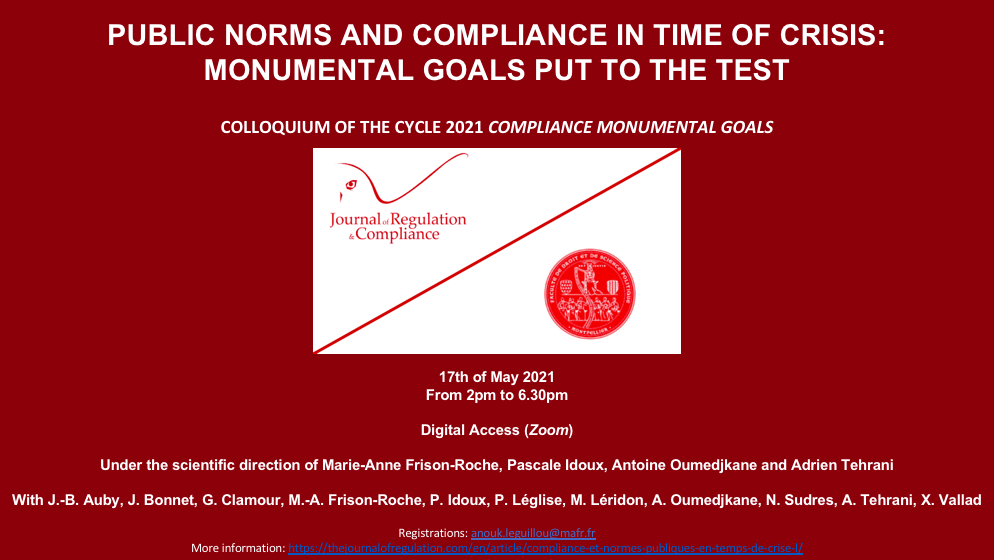
This manifestation took place on Zoom on 17th of May 2021.
Registrations: anouk.leguillou@mafr.fr
Assistance to this event may be validated as part of the continuing education of lawyers.
In addition, scientific videos will be extracted and disseminated later.
Presentation of the topic: In the overall problematic of "Monumental goals", this conference retains a particular case: that of the crisis and the emergency situation that it generates.
First of all, in general, does the importance of public norms in the emergency context engendered by a crisis situation imply a marginalization of Compliance? Don't private actors also have their place in these circumstances, at the service of the "monumental goals" that the public authorities want to maintain, or even which appear specifically?
Secondly, more concretely, we have been living for many months in a health crisis. By taking it as a framework and, within it from particular cases, how public and private actors react, act, adjust? and how do the courts assess these movements?
Going from the most general to the most specific, this conference aims to identify criteria, limits, of what could be specific rules when the emergency of a crisis meets Compliance, and will examine specific situations.
Working method: The conference is therefore built on a general issue, which was the subject of a "working paper", written by Antoine Oumedjkane, Adrien Tehrani and Pascale Idoux, on which the speakers will have thought in advance and from which they are intended to study the question from their particular perspective.
The conference, which is essentially interactive, therefore begins with an outline of the main lines of this general work. It is followed by the examination of concrete practical cases.
They are as follows:
1️⃣ hydro-alcoholic gel, its manufacture, price, availability,
2️⃣ information and regulation on all media in Covid period
3️⃣ the use of the bicycle during the state of health emergency
A first conclusion, thematically limited, will relate to Revealed by the crisis situation, the place of private initiative in Compliance Law.
A second, more general, undoubtedly open-ended conclusion is drawn from this confrontation between general reflection and concrete cases which must be resolved in a particular crisis.
🎤 Marie-Anne Frison-Roche, agrégée des Facultés de droit, Professor of Regulation and Compliance Law at Sciences Po (Paris) and Director of the Journal of Regulation & Compliance (JoRC)
🎤 Pascale Idoux, Professor at Montpellier University
🎤 Pascale Léglise, adjointe au directeur des libertés publiques et des affaires juridiques (Deputy Director of Civil Liberties and Legal Affairs) of the Ministère de l'intérieur (Home Ministry)
🎤 Michèle Léridon, Member of the Conseil supérieur de l'audiovisuel (French Media Regulator), President of the working group Pluralisme, déontologie, supervision des plateformes en ligne (Pluralism, Deontology, Supervision of Online Platforms)
🎤 Antoine Oumedjkane, Researcher of the Centre de recherche et d'études administratives (Research and Administrative Studies Center) of Montpellier University
🎤 Nelly Sudres, Maître de conférences at Montpellier University and member of the Centre de Recherches et d'Etudes Administratives (Research and Administrative Studies Center) of Montpellier University
🎤 Adrien Tehrani, Professor at Montpellier University and member of the Centre du Droit de l'Entreprise (Company Law Center)
From January 1st, 2011, Joëlle Toledano, a member of the College of the Autorité de Régulation des Communications Electroniques et des Postes (ARCEP – the French Postal and Telecommunications Regulatory Authority) will serve for one year as President of the recently created European Regulators Group for Post.
SPANISH
Informe temático (Telecomunicaciones y servicios postales): Joëlle Toledano es nominado a la Presidencia del Grupo Europeo de Reguladores de Servicios Postales
El 21 de enero del 2011, Joëlle Toledano, miembroo de la Autorité de Régulation des Communications Eelctroniques et des Postes (ARCEP – La Autoridad francesa de la regulación de telecomunicaciones y servicios postales) servirá por un año más como Presidente del reciente Grupo Independiente de Reguladores Europeos de servicios postales.
The implementation of a joint consumer information service on Insurance, Banking, and Insurance within the ‘Autorité de Contrôle prudential – ACP’ (French Prudential Control Authority), raises questions as to the way in which the service will be coordinated with the ACP’s other activities. The signature of the agreement creating the new joint service was the occasion for Christian Noyer, Governor of the Banque de France (Central Bank of France) and President of the ACP, to clarify that this joint service, whose principal goal is consumer protection, complements the ACP’s other missions.



 to be published in the Series Regulations & Compliance , co-published par the Journal of Regulation & Compliance (JoRC) and Dalloz.