The European Commission published a Green Paper in September 2010 on Audit Policy, in order to give its opinion on the Lessons from the Crisis.From a systemic perspective of financial markets' stability, the Commission analyzes the role of the auditor, the internal structure of audit firms, the concentration of the audit market, and the possibility of a European market for auditing. But, what the Commission presents as a neutral description is actually a series of ideological stances, which are tenable, but also debatable. Thus, the Green Paper makes auditing out to be a structural element of financial markets, which shatters auditing's uniqueness, while attributing it a structural and systemic role, which is questionable. It then requires regulatory tools to open the auditing market to more competition, which will, in reality, expose it to the pressures of demand and lower the efficiency of auditing missions. It would be better to reinforce regulatory mechanisms towards security and conflicts of interest, rather than towards competition, which corresponds to the traditional French model of audit regulation.
FRENCH
La Commission européenne a lancé en septembre 2010 un Livre vert la Politique de l’audit, pour que soient tirée à son propos les Leçons de la Crise. C’est donc dans une perspective systémique de stabilité des marchés financiers que les questions sont posées par la Commission, concernant l’auditeur, l’organisation des sociétés d’audit, la concentration du marché de l’audit et l’hypothèse d’un marché européen de l’audit. Mais ce que la Commission présente comme une description neutre est une réalité une série de prises de positions idéologiques, soutenables mais aussi discutables. Ainsi, le Livre Vert présente l’audit comme un élément structurel des marchés financiers, ce qui brise l’unicité de l’audit, tandis qu’elle lui confère un rôle structurel et systémique, ce qui est discutable. Elle requiert ensuite des outils de régulations pour ouvrir à une plus forte concurrence le marché de l’audit, ce qui va en réalité l’exposer à la pression de la demande et abaisser l’effectivité des missions de l’audit, alors qu’il faut renforcer les outils de régulations, non pas par rapport à la concurrence mais par rapport à la sécurité et aux conflits d’intérêts, ce à quoi correspond le modèle traditionnel français.
GERMAN
Artikel: Kritische Analyse des Grünbuches der Europäischen Kommission im Bereich Abschlussprüfung: Eine problematische Definition vom systemrelevanten Agent und eine Illustration des Gegensatzes zwischen Regulierung und Wettbewerb.
Die Europäische Kommission hat im September 2010 ein Grünbuch zur Rolle der Abschlussprüfung veröffentlicht, um ihre Stellungnahme über die Lehre der Krise zu verbreiten. Die Kommission analysiert die Rolle des Abschlussprüfers, die innere Struktur von Abschlussprufüngsunternehmen, die Marktkonzentration des Prüfungsmarktes und die Möglichkeiten der Entstehung eines europäischen Abschlussprüfungsmarktes aus der systemischen Perspektive der Finanzmarktstabilität. Aber was die Europäische Kommission als eine neutrale Schilderung darstellt trägt eher mit sich eine Reihe von ideologischen Einstellungen, die zwar haltbar aber auch strittig sind. So stellt das Grünbuch die Abschlüssprufung als Strukturelement für die Finanzmärkte, was die Einheit der Abschlussprüfung zerbricht. Laut des Grünbuches spielt sie auch eine systemische und strukturelle Rolle, was auch fragwürdig ist. Der Prufüngsmarkt sollte auch zu mehr Wettbewerb durch Regulierungsmassnahmen eröffnet werden, was in der Tat dem Markt dem Drück der Anfrage aussetzen wird, und die Effizienz von Abschlussprüfungsaufträgen einschränken wird. Es wäre besser, Regulierungsmechanismen mit Hinsicht auf Sicherheit und Interessenkonflikten, eher als Wettbewerb, zu verfestigen, was eigentlich dem französichen Modell der Prüfungsregulierung entsprechen würde.
ITALIAN
Articolo: Analisi critica del Libro verde della Commissione europea sulla politica in materia di revisione dei conti: una definizione problematica dell'agente sistemico ed un'illustrazione dell'opposizione tra regolazione e concorrenza.
Nel mese di settembre 2010, la Commissione europea ha pubblicato un libro verde sulla politica in materia di audit (revisione dei conti) per emettere il suo parere sulle "Lezioni dalla crisi". Con una prospettiva sistemica della stabilità dei mercati finanziari, la Commissione analizza il ruolo del revisore dei conti, la struttura interna degli studi di revisione dei conti, la concentrazione del mercato dell'audit e la possibilità di strutturare un mercato europeo della revisione dei conti. Tuttavia, quello che la commissione presenta come un dato di fatto, in realtà è il frutto di una riflessione ideologica, sostenibile ma sicuramente discutibile. Il Libro verde rende la revisione dei conti, un'attività strutturale dei mercati finanziari, la cui unicità è quindi frazionata, e gli attribuisce un ruolo strutturale e sistemico, di per sé discutibile. Inoltre auspica con l'intervento di meccanismi di regolazione, un'apertura del mercato dell'audit al fine di garantire una concorrenza maggiore, che sarà esposta alle pressioni della domanda e diminuirà l'efficienza degli incarichi di revisione dei conti. Sarebbe meglio rafforzare i meccanismi di regolazione al fine di raggiungere una sicurezza maggiore ed evitare conflitti d’interessi, invece di auspicare una maggiore concorrenza, cosa che corrisponde al modello francese tradizionale della regolazione del mercato della revisione dei conti.
SPANISH
Artículo: Análisis crítico del Libro Verde de la Comisión Europea sobre su política de auditoría: una definición problemática sobre el agente del sistema y una ilustración sobre la oposición entre regulación y competencia.
En septiembre del 2010, la Comisión Europea publicó El Libro Verde sobre la política de auditoría para proveer su opinión sobre Las Lecciones de la Crisis. Desde una perspectiva sistemática de la estabilidad de los mercados financieros, la Comisión analiza el papel del auditor, la estructura interna de empresas de auditoría, la concentración del mercado de auditoría y la posibilidad de un mercado europea de auditoría. Pero, lo que la Comisión presenta como una descripción neutral es, de hecho, una serie de declaraciones ideológicas, que son defendibles, pero también discutibles. Por lo tanto, el Informe Verde describe a la auditoría como un elemento estructural de los mercados financieros, lo cual destruye la cualidad única de la auditoría, mientras que le atribuye un rol estructural y sistemático, lo cual es cuestionable. También requiere de instrumentos regulatorios para abrir el mercado de auditoría a una competencia más substancial, lo cual, en realidad, lo expone a las presiones de demanda y disminuye la eficacia de las misiones de auditoría. Sería mejor reforzar los mecanismo regulatorios hacia la seguridad y conflicto de intereses, y no hacia la competencia, lo cual corresponde al modelo tradicional francés de la regulación de auditoría.
Complete reference : Idot, Laurence, La notion d'entreprise en droit de la concurrence, révélateur de l'ordre concurrentiel, in Mélanges en l'honneur d'Antoine Pirovano, L'ordre concurrentiel, Éditions Frison-Roche, Paris, 2003, p.523-545.
The implementation of a joint consumer information service on Insurance, Banking, and Insurance within the ‘Autorité de Contrôle prudential – ACP’ (French Prudential Control Authority), raises questions as to the way in which the service will be coordinated with the ACP’s other activities. The signature of the agreement creating the new joint service was the occasion for Christian Noyer, Governor of the Banque de France (Central Bank of France) and President of the ACP, to clarify that this joint service, whose principal goal is consumer protection, complements the ACP’s other missions.
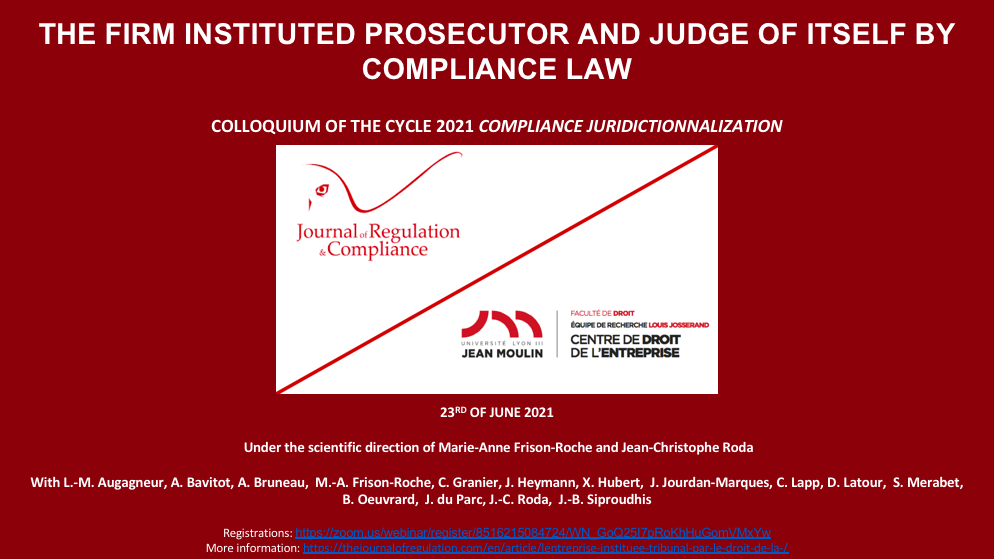
►This scientific manifestation is placed under the scientific responsibility of Marie-Anne Frison-Roche and Jean-Christophe Roda. It is organized by the Journal of Regulation & Compliance (JoRC) and the Centre de Droit de l'Entreprise of Lyon 3 University.
► Presentation of the topic: Initially, it was through Criminal Law, inseparable from the trial, which forced companies to take charge of monitoring within themselves behavior likely to be deviant, the requirement of Ex Ante to be designed by the 'Ex Post of the jurisdictional. From this reversal of things, there has always remained this presence of the judge and the prosecution bodies in a Compliance Law which is nevertheless defined by its concern for the future and the Ex Ante tools within the company.
In doing so, the company becoming on the one hand a judge of itself, on the other hand a prosecutor of itself, it splits up, taking in reverse the most established procedural principles. Moreover, because of the monumental goals which constitute Compliance Law, companies become attorneys and judges of the others, or for the others, the cutting machines and the "supreme courts" being by name instituted to regulate in Ex Ante all different before that it does not become litigation. The Ex Ante of Compliance would then make the Ex Post disappear.
► Method:
The colloquium which had to take place initially on 8th of April has been postponed to 23rd of June to enable speakers to meet and talk in face to face, with a limited audience.
These exchanges will be captured so that third parties can benefit from them, even before the publication of the works, La Juridictionnalisation de la Compliance and Compliance Juridictionalization, within which this work constitutes the basis for the development of a specific chapter.
Five practical cases will first be examined in five specific sectors, where this institution of the firm as prosecutor and judge of itself is particularly observable before both specific and more cross-sectoral themes are examined and discussed.
Before the rules called Basel III shall apply in Switzerland in 2015, the "Département Fédéral de Finance" (Swiss Federal Department of Finance) of the "Conseil Fédéral Suisse" (Swiss Federal Council) has developed a draft of an ordinance that was subject to public consultation on August 28, 2012. Another text will present later rules about systemic banks. The order will be applicable on the 1st January 2013. But banks, like any anticipator market agent, have not already internalized the rules of Basel III ? In addition, it seems that the criterion of systemic continues to be the size of the agent, but it is not so evident.
Rapport thématique (Télécommunications, Internet) : La première Chambre Civile de la Cour de cassation française, par une décision du 19 novembre 2009, affirme que l'obligation du fournisseur d'accès d'offrir les services à l'abonné est une obligation de résultat.
Dans un contrat entre un usager et le fournisseur d’accès Free, une clause avait prévu l’accès au service audiovisuel, sous réserve de l’éligibilité de sa ligne téléphonique à un tel service. La Cour de cassation estime qu’en dehors d’un cas de force majeure, une telle clause ne peut dispenser le fournisseur d’offrir un tel accès car il s’agit pour lui d’une obligation de résultat. Cette solution, originale en droit traditionnel des contrats illustre le rôle central que la notion d’accès, et de droit d’accès, joue en matière de régulation
GERMAN
Thematischer Bericht (Telekommunikation, Internet): Die erste Zivilkammer der Cour de Cassation (Französischer Kassationshof) hat in einer Entscheidung vom 19. Dezember 2009 behauptet, dass der Internetdienstanbieter dazu verpflichtet ist, seine Kunden Dienste zur Verfügung zu stellen. Dieses gilt als Pflicht.
Ein Vertrag zwischen Free (ein französischer Internetdienstanbieter) und einer seinen Kunden enthielte einer Klausel, die behauptete, dass der Zugang zum Fernsehdienst der Kundenslinie unterworfen war. Der Gerichtshof hat dieser Klausel als ungültig erklärt.
SPANISH
La Primera Cámara Civil de la “Cour de Cassation” (la corte francés de casación) afirma una decisión el 19 de diciembre del 2009 que dicta que la obligación de un proveedor de servicio de Internet de proveer servicios a sus clientes es una responsabilidad objetiva.
Un contrato entre Free (un proveedor francés de servicios de Internet) y uno de sus abonados contenía una clausula que estipulaba que el acceso a servicios audiovisuales dependía sobre la elegibilidad de la línea telefónica para estos servicios. La Corte de casación que excepto en casos de “force majeur” (fuerzas mayores) dicha clausula no excluye los proveedores de servicios de su responsabilidad objetiva de proveer dichos servicios.



 to be published in the Regulation & Compliance series, jointly published by the Journal of Regulation & Compliance (JoR)C and Dalloz