In a letter to the U.S. Senate Banking Committee Chairman Christopher Dodd, Mr. Cox said that “soft-dollar arrangements create a conflict between a money manager and its clients, compromise a money manager’s fiduciary responsibility by inducing the manager to direct trades to broker-dealers that offer research the manager wants, instead of to the broker-dealer that could best execute the client’s transactions, and encourage overtrading of client portfolios in an effort to generate soft-dollar credits.”
FRANCAIS
Article: Commissions en nature: une pratique génératrice de conflits d'intérêts?
Dans une lettre adressée au Président de la Commission Bancaire du Sénat américain Christopher Dodd, M. Cox écrit que "les pratiques de commission en nature créent un conflit entre le gérant de portefeuille et ses clients ; compromettent la responsabilité fiduciaire du gérant de portefeuille en le conduisant à privilégier les courtiers en valeurs qui fournissent des recherches qui lui sont favorables, au lieu de préférer les courtiers en valeurs qui pourraient exécuter au mieux les transactions de ses clients ; et favorisent une démultiplication des transactions (overtrading) dans le portefeuille géré afin de générer des crédits provenant des accords de commission en nature."
GERMAN
Artikel: Soft-Dollar-Vereinbarungen: verursachen sie Interessenkonflikte?
In einer Brief am Vorsitzender der Bankenkommission des Senates der Vereinigten Staaten Christopher Dodd schreibt Herr Cox: "Soft-Dollar-Vereinbarungen verursache Konflikte zwischen dem Vermögensverwalter und seinen Kunden; Sie gefährden die Verantwortung des Vermögensverwalters, da sie stiften ihm dazu, Brokers zu günstigen, die für ihn vortheilhafte Ergebnisse haben können, anstatt diejenigen, die am besten die Transaktionen seinen Kunden erfüllen würden. Dazu noch fördern solche Vereinbarungen die Überspekulation in Kunden-Portfolios, da durch Soft-Dollar-Vereinbarungen der Vermögensverwalter Profit erzielen kann."
SPANISH
Arreglos de caja de ahorro común en dólares: ¿representan conflictos de intereses?
En una carta al presidente de la Comisión bancaria del Senado americano Christopher Dodd, M. Cox dijo que “los arreglos de caja de ahorro común en dólares crea conflictos entre el administrador del dinero y el cliente, comprometiendo la responsabilidad fiduciaria del administrador al inducir el administrador a privilegiar los agentes en valores que a cambio ofrecen servicios de investigación solicitados por el gerente, en vez de a aquel que está mejor dispuesto para ejecutar el trabajo y las transacciones de los clientes, lo cual motiva la multiplicación de las transacciones (overtrading) de los portafolios de los clientes en un esfuerzo de generar estos ahorros de común en dólares.”
Athene Chanter is an associate at Allen & Overy Paris. She holds an LLB in Law and a degree in German and Italian. She trained as a solicitor in London before joining the Paris EU & Competition team in 2010. (...)
A "Chambre régionale de discipline des commissaires aux comptes" (Auditors’ regional chamber of discipline) had imposed a penalty on one of these professionals, who formed a retrial before this chamber. His action is dismissed for lack of text, that confirms the "Haut Conseil du Commissariat aux Comptes (French High Council of the Commissioner of Account). The "Conseil d’Etat" (French Council of State) invalidates the decision, demanding that retrial is open, even without special text, if the applicant claims that the decision was not adopted on the relevant documents.
FRENCH
Une chambre régionale de discipline des commissaires aux comptes avait infligé une sanction à un de ces professionnels, qui forme un recours en révision devant cette chambre. Le recours est rejeté faute de texte, ce que confirme le Haut Conseil du Commissariat aux Compte. Le Conseil d’Etat invalide la décision, en posant qu’un recours en révision est ouvert, même sans texte spécial, si le requérant prétend que la décision n’a pas été adoptée sur des pièces pertinentes.
Germany is characterized in that in Europe generally has refused liberalization of the gambling industry. For this, it will incur remonstrance’s from the European Commission. But this issue is the responsibility of the Länder. That is why, when the Land of Schleswig-Holsteing decided in April 2011 to open the sector to competition online games, Everyone saw a sign of liberalism and compliance with European lines.
But the government of this land has changed in May 2012 to make way for a coalition, it seems more favorable to a closure of that activity or, at lesse, should be left to public monopolies.
However, on September 2, 5 licenses are to be given by that Government to the major operators of online games, which shows that the line previously adopted market-opening games online is maintained, unlike the rest of the Germany.
Laurent Benzoni is a Doctor of Economics. He has been a Professor of Economics at the Université Panthéon-Assas (Paris 2) since 1996. At Paris 2, he is a member of the Equipe de Recherche sur les Marché, l'Emploi et la Simulation (ERMES). (...)
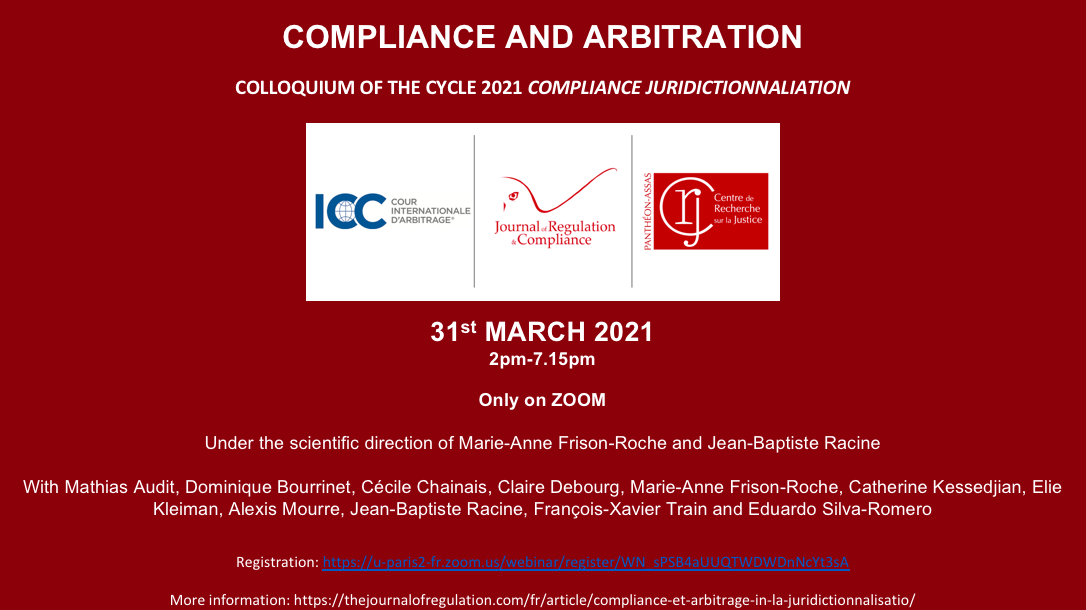
This colloquium took place the 31st of March 2021.
The manifestation was live broadcasted on Zoom.
Presentation of the theme:
The arbitrator is the ordinary judge of international trade. It was natural that he or she encountered Compliance: by definition Compliance Law takes hold of the whole world and follows the paths of international trade while it can only be deployed with the help of institutions which, by nature are spreading around the world and need authorities like the Courts.
The conference is based on the already perceptible connection points between Compliance and Arbitration to better identify what is emerging for tomorrow: contradiction or convergence between the two; weakening or consolidation. We are already seeing the impact that Compliance can have on the arbitrator's treatment of corruption or the consideration of money laundering. More generally, where do we stand with the arbitrator's knowledge of the many technical issues related to compliance? Beyond these, will the courts and arbitrators be able to achieve the goals, themselves new, sometimes monumental, pursued by Compliance Law?
Through this joint exploration of these avenues, the fate of compliance clauses inserted in contracts, the relevance in the matter of private codes of conduct, etc. will be examined.
Tomorrow, as of today, is the arbitrator a full and complete judge of Compliance Law?
How, with what specificities and what controls?
Notably will speak:
Mathias Audit, professeur à l'Université Panthéon-Sorbonne - Paris I (full professor at Sorbonne - University - Paris)
Cécile Chainais, director of the Centre de Recherche sur la Justice et le Règlement des Conflits (CRJ) and professeur à l'Université Panthéon-Assas (Paris II) (Full professor at Panthéon-Assas (Paris II) University)
Claire Debourg, professeure à l'Université Paris X- Nanterre (Full professor at Paris X - Nanterre)
Marie-Anne Frison-Roche, professeur à Sciences Po - Paris (Full Professor at Sciences Po - Paris)) and Director of the Journal of Regulation & Compliance (JoRC)
Catherine Kessedjian, professeur émérite de l'Université Panthéon-Assas (professor emeritus of Panthéon-Assas - Paris II University)
René Sève is a graduate of the Ecole Normale Supérieure, holds an agrégation in philosophy, and a doctorate degree in Law. He also has advanced postgraduate degrees in Philosophy, Social Psychology, and Law. (...)
The Royal Bank of Scotland (RBS) is a British Bank controlled to 80% by the State. It is said involved in the case of the Libor. On August 24, 2012, Reuters news agency reported links between the Royal Bank of Scotland (RBS) and the British and North American regulators to stop the intended prosecution through a settlement. The interest is not in the subject of the announcement, but in the formulation. Indeed, the Bank denies the existence of this mutual understanding. Less than a month ago, it claimed that it would face prosecution and a few weeks ago, it claimed that it could be actions of traders and not its own, taken as operators. Today, these are lawyers who reveal the strategy of negotiations with the regulator. Thus, what made the right hand of the Bank, the left hand of the Bank ignores it and can do something else; the essential was to reassure the market.
Libor is the rate of Exchange on the interbank market, important in that and also in what it's on the Libor rate that thousands of external financial transactions in interbank relations are based. In this manipulations on the Libor operated by banks are properly catastrophic. What can therefore be a disaster was opened with the sanction of Barclays on 27 June 2012 by the British Financial Services Authority (FSA) for manipulation. Investigations are underway, on multiple grounds, by many authorities on multiple grounds.
The statement made on August 3, 2012 by the Royal Bank of Scotland is interesting in that, in the same time that it dismiss them, it said that manipulations that could discover in it are attributable to individuals and only to them. The system was thus not fraudulent. Therefore the declaratory system could be saved.
Michel Prada is a graduate of the Institut d’Etudes Politiques de Bordeaux (Sciences Po Bordeaux) and the Ecole Nationale d’Administration (ENA). From 1966 to 1970, he was an Inspecteur des Finances. (...°


 to be published in the Compliance & Regulation Series , co published by the Journal of Regulation & Compliance (JoRC) and Bruylant.