In The Journal of Regulation the summaries’ translation are done by the Editors and not by the authors
ENGLISH
The French Loi de finance rectificative pour 2011 (Rectified Budget for 2011) was censured by the Conseil constitutionnel (French Constitutional Council) after being adopted by Parliament, but before it was published in the Journal officiel de la République Française (Official Journal of the French Republic), as a simple law can not limit the power available to the independent regulator of hiring. The "Conseil constitutionnel" does not allow the "Loi de Finances" to ask a general limit of the Regulator workforce, paid by the State. Consequently, the "Loi de Finances 2012" will not give up the will of Parliament to limit the numbers but will do in a precise and quantitative way.
FRENCH
LaLoi definancesrectificativepour 2011a été censuré parle Conseil constitutionnel,après avoir étéadoptée par le Parlement, mais avantd’avoir été publiéeau Journal officielde la République française, car une loi simple ne peut limiter le pouvoir autonome d’embauche du régulateur. Le Conseil constitutionnel n’admet pas que la loi de finance puisse poser d’une façon générale la limite des effectifs du régulateur, payés par l’Etat. En conséquence, la loi de finance pour 2012 ne renoncera pas à la volonté du Parlement de limiter ces effectifs mais le fera d’une façon précise et chiffrée.
SPANISH
El Loi de finances rectificative pour 2011 (presupuesto rectificado de 2011) fue censurado por el Conseil Constitutionnel (Consejo Constitucional francés) después de haber sido aprobada por el Parlamento, pero antes de su publicación en el Journal Officiel de la République Française (Diario Oficial de la francesa República), como una simple ley no puede limitar la potencia disponible para el regulador independiente de la contratación.
ITALIAN
La loi de finance rectificative pour 2011 (legge finanziaria per il 2011) è stata modificata dal Conseil Constitutionnel (la Corte costituzionale francese) dopo essere stata votata in parlamento e prima di essere stata pubblicata alla Gazzetta ufficiale della Repubblica francese.
This book is written in French. Its topic is about New Regulations in Electricity Sector
Complete reference : LAPEYRE, M. (dir.), Les nouvelles régulations électriques, 2 tomes, Lavoisier, Paris, 2012, 314 p.
Released in 2011, this special issue focuses on "Supervision" in terms of systemic risk, while the last was on "Regulation" under the same theme.
In order to prevent the next crisis, the will appears to extend the supervision, including on "non-banks", such as insurance companies, and to strengthen it, particularly with regard to the means of control, surveillance and punishment powers of supervisory Authorities.
Complete reference: Revue d'Économie Financière, Le risque systémique - 2. Repenser la supervision, n° 101, mars 2011, Paris, 288 p.
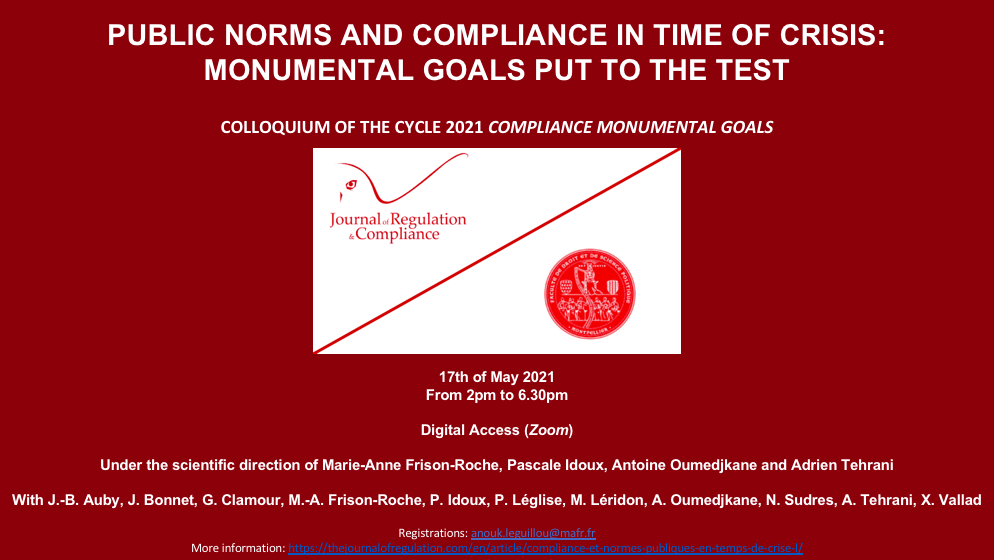
This manifestation took place on Zoom on 17th of May 2021.
Registrations: anouk.leguillou@mafr.fr
Assistance to this event may be validated as part of the continuing education of lawyers.
In addition, scientific videos will be extracted and disseminated later.
Presentation of the topic: In the overall problematic of "Monumental goals", this conference retains a particular case: that of the crisis and the emergency situation that it generates.
First of all, in general, does the importance of public norms in the emergency context engendered by a crisis situation imply a marginalization of Compliance? Don't private actors also have their place in these circumstances, at the service of the "monumental goals" that the public authorities want to maintain, or even which appear specifically?
Secondly, more concretely, we have been living for many months in a health crisis. By taking it as a framework and, within it from particular cases, how public and private actors react, act, adjust? and how do the courts assess these movements?
Going from the most general to the most specific, this conference aims to identify criteria, limits, of what could be specific rules when the emergency of a crisis meets Compliance, and will examine specific situations.
Working method: The conference is therefore built on a general issue, which was the subject of a "working paper", written by Antoine Oumedjkane, Adrien Tehrani and Pascale Idoux, on which the speakers will have thought in advance and from which they are intended to study the question from their particular perspective.
The conference, which is essentially interactive, therefore begins with an outline of the main lines of this general work. It is followed by the examination of concrete practical cases.
They are as follows:
1️⃣ hydro-alcoholic gel, its manufacture, price, availability,
2️⃣ information and regulation on all media in Covid period
3️⃣ the use of the bicycle during the state of health emergency
A first conclusion, thematically limited, will relate to Revealed by the crisis situation, the place of private initiative in Compliance Law.
A second, more general, undoubtedly open-ended conclusion is drawn from this confrontation between general reflection and concrete cases which must be resolved in a particular crisis.
🎤 Marie-Anne Frison-Roche, agrégée des Facultés de droit, Professor of Regulation and Compliance Law at Sciences Po (Paris) and Director of the Journal of Regulation & Compliance (JoRC)
🎤 Pascale Idoux, Professor at Montpellier University
🎤 Pascale Léglise, adjointe au directeur des libertés publiques et des affaires juridiques (Deputy Director of Civil Liberties and Legal Affairs) of the Ministère de l'intérieur (Home Ministry)
🎤 Michèle Léridon, Member of the Conseil supérieur de l'audiovisuel (French Media Regulator), President of the working group Pluralisme, déontologie, supervision des plateformes en ligne (Pluralism, Deontology, Supervision of Online Platforms)
🎤 Antoine Oumedjkane, Researcher of the Centre de recherche et d'études administratives (Research and Administrative Studies Center) of Montpellier University
🎤 Nelly Sudres, Maître de conférences at Montpellier University and member of the Centre de Recherches et d'Etudes Administratives (Research and Administrative Studies Center) of Montpellier University
🎤 Adrien Tehrani, Professor at Montpellier University and member of the Centre du Droit de l'Entreprise (Company Law Center)
Traditionally regulated sectors, such as energy and telecommunications, have a very strong local roots, which made them at first dominated by the States even if they were developed by companies, because of the link between the State and territory. Furthermore, the market, which is a space defined by the activities and not necessarily by a territory, was superimposed on the overall economic. When observing the phenomena taking place in new territories, for example the euro area, but more what looks like spaces without territoriality, such as the Internet, or finance, geography seems to disappear. The dynamism of operators led by its own strength to the formation of new geographies which owe nothing to the kind or normative power of the States, as in energy infrastructure. However, to date, there have been in a regulatory report with respect to geography or based on geography. Could we diagnose the disappearance of geography or processing thereof such that the regulations themselves must be radically transformed? It is this question which is the subject of this symposium.
FRENCH
Les secteurs régulés traditionnellement, par exemple l’énergie ou les télécommunications, ont un ancrage territorial très fort, ce qui les a rendus à première vue dominés par les Etats même s’ils étaient développés par des entreprises, en raison du lien entre l’Etat et le territoire. En outre, les Etats ont avec l’espace aérien un rapport consubstantiel car le contrôle de l’air par l’Etat assure la sécurité de celui-ci et de la population ; pourtant, l’Etat vend aujourd’hui des fréquences à des opérateurs privés. En outre, à la notion de territoire, le marché, qui est un espace défini par des activités et non plus nécessairement par un territoire, s’est superposé sur l’ensemble du droit économique, bouleversant notamment la notion et le rôle des frontières. Lorsqu’on observe les phénomènes en cours dans de nouveaux territoires, par exemple la zone euro, mais plus encore ce qui semble être des espaces sans territorialité, comme Internet, voire la finance, la géographie semble disparaître. Le dynamisme des opérateurs conduit par sa seule force à la constitution de nouvelles géographies qui ne doivent rien à la nature ni au pouvoir normatif des Etats, comme en matière d’infrastructure énergétique. Or, jusqu’ici, il n’y a eu de régulation que dans un rapport à l’égard d’une géographie ou s’appuyant sur une géographie. Pourrait-on diagnostiquer la disparition de la géographie ou une transformation telle de celle-ci que les régulations elles-mêmes doivent se transformer radicalement ? C’est cette interrogation même qui est l’objet de ce colloque.
SPANICH
Los sectores regularmente regulados, por ejemplo los de energía y telecomunicaciones, poseen un anclaje muy fuerte, por lo que parecen ser a primera vista dominados por el Estado aunque fueron desarrollados por empresas, por el lazo que existe entre el Estado y el territorio. Los Estados tienen una relación substancial en lo que concierne el espacio aéreo, ya que el control del aire por el Estado asegura la seguridad de él mismo y de la población; y por consiguiente, el Estado vende frecuencias a operadores privados. En cuanto a la noción del territorio, el mercado, que es un espacio definido por actividades y no necesariamente por un territorio, se ha superpuesto sobre el conjunto del derecho económico, y ha transformado la noción y el rol de las fronteras. Mientras que uno observa los fenómenos en marcha en diferentes territorios, por ejemplo la euro zona, pero más aún lo que semeja ser espacios sin territorio, como el Internet y la finanza, la geografía parece desaparecer. El dinamismo de los operadores conducidos por su propia fuerza hacia la constitución de nuevas geografías, que no responden ni a la naturaleza ni al poder normativo de los Estados, como en materia de infraestructura energética. Hasta el presente, la regulación se había limitado a la geografía o se había apoyada en ella de una forma u otra. ¿Podríamos diagnosticar la desaparición de la geografía o una transformación tal que las regulaciones mismas también tendrían que transformarse radicalmente? Esta interrogación será el objetivo del coloquio.
ARABIC
القطاعات المنضمة تقليديا مثل الطاقة والاتصالات السلكية، لديها جذور قوية جدا التي جعلتهم تحت سيطرة الدولة في البداية حتى لو تم تطويرها من قبل مع الشركات، وذلك بسبب الارتباط بين الدولة و الإقليم. وبالإضافة إلى ذلك، الدول التي لديها مع المجال الجوي تقرير الجوهر لأن سيطرة الدولة عليه يضمن سلامته و سلامة الشعب، ومع ذلك فإن الدولة تبيع ترددات إلى المشغلين القطاع الخاص وعلى ذلك، تم فرضه على مفهوم الأرض، والسوق، الذي هو مساحة محددة من خلال الأنشطة وليس بالضرورة من الأراضي، في القانون الاقتصادي العام ، بما في ذلك فكرة مروعة وحدود الدور. عندما نلاحظ الظواهر التي تحدث في مناطق جديدة، على سبيل المثال في منطقة اليورو، ولكن أكثر ما يشبه الأماكن دون الإقليمية، مثل شبكة الإنترنت، أو التمويل، الجغرافية تبدو أنها تختفي. نشاطية المشغلين تقيد قوة خاصة بها لتشكيل مناطق جغرافية جديدة والتي لديها أي شيء لهذا النوع أو القوة المعيارية للدول، كما هو الحال في البنية التحتية للطاقة. لكن، حتى هناك، كان تقريرا تنظيميا فيما يتعلق بالجغرافية أو على أساس الجغرافية. هل يمكننا تشخيص اختفاء الجغرافية أو تحولها مثل ذلك يجب أن الانضمة تتغير كليا ؟ هذا هو سؤال الموضوع لهذه الندوة.


 to be published in the Series Regulations & Compliance , co-published par the Journal of Regulation & Compliance (JoRC) and Dalloz.