Search results (607 cards)

Feb. 21, 2025
JoRC
► Référence complète : Journal of Regulation & Compliance (JoRC) and Institut de Recherche Juridique de la Sorbonne (André Tunc - IRJS), Durabilité de l’Internet : le rôle des opérateurs du système des noms de domaine. Compliance et Régulation de l’espace numérique (Sustainability of the Internet: the role of the operators of the domain name system. Compliance and regulation of the digital space), Paris 1 Panthéon Sorbonne University, 21 February 2025
____
____
► The symposium is organised by the Journal of Regulation & Compliance (JoRC) and the Institut de Recherche Juridique de la Sorbonne (André Tunc - IRJS) of Paris 1 Panthéon-Sorbonne University.
The symposium is held under the scientif supervision of 🕴️Marie-Anne Frison-Roche and 🕴️Grégoire Loiseau.
____
► Presentation ot the theme: The digital space has been built on and as a system. Its primary interest is of a negative nature: it consists of to be preserved against the prospect of systemic failure, of not collapsing. Like all other systems, this 'Monumental Goal' specific to the digital system justifies resources that incorporate this concern for the future. As with all systems, it integrates and relies on the specific technical nature of this system.
The digital space is largely based on the invention, technology and architecture of domain names. Domain names, as an addressing system, enable users to enter the digital space and find other Internet users. The uniqueness and solidity of the domain name system, entrusted to a single root and decentralisation, makes this community possible for those who use the digital space and ensures the technical durability required, without which the digital space would be compromised.
The architecture, operation, operators and what they do under the control of legislators, regulators, judges and legal subjects are therefore examined from a dual technical and legal perspective, in the light of the imperative of sustainability.
This allows to progress in 4 stages.
Firstly, to examine the permanence in time and space of the domain name system, insofar as it is the foundation of the Internet and the digital system. This technical construction gives rise to legal qualifications, not only for the present but also for the future, since the Web3 offers new technical solutions.
Secondly, this technical sustainability is an imperative that is built into the operators of the domain names themselves, which are inter-linked not only at national level but also at global level, this cross-linking being necessary for the security of the system. The State is present through public law techniques that enable surveillance, control and possible recovery.
Thirdly, it imposes constraints on the operators subject to them in order to serve this monumental goal of technical sustainability, and these constraints themselves generate as many powers as they need to usefully achieve this mission. This proportionality must be at the heart of the method and the requirements. The relationship between constraints and powers also stems from it.
Fourthly, this imperative of technical sustainability, which is global in nature, gives way to imperatives of societal sustainability, more localised in space and time, when domain name operators are called upon by the legitimate authors of binding standards, legislators in the first instance, to express concerns such as the protection of people involved in the digital space and whose rights are compromised or who are in danger.
This second type of sustainability, which is more localised and less inherent in the architecture of the Internet, is justified by the available power of the operators concerned and their adherence to social imperatives. The resulting constraints and powers are therefore not the same.
The 2 sustainabilities must then be articulated in a conception that is both teleological and pragmatic.
____
To register for a physical presence: Cliquer HERE
To register for an online presence: Cliquer HERE
🧮The event will take place at the Paris 1 Panthéon-Sorbonne University, 12 place du Panthéon 75005, in Room 6, on 21 February 2025.
____
► Speakers:
🎤Pierre Bonis, Chief Executive Officer of the Association française pour le nommage Internet en coopération (Afnic)
🎤Lucien Castex, Adviser of the Afnic Chief Executive Officer for Research internet and society and Internet governance
🎤Marie-Anne Frison-Roche, Full Professor of Regulatory and Compliance Law, Director of the Journal of Regulation & Compliance (JoRC)
🎤Claire Leveneur, Senior Lecturer at Paris-Est Créteil University
🎤Grégoire Loiseau, Full Professor at Paris 1 Panthéon-Sorbonne University
🎤Samir Merabet, Full Professor at the University of West Indies
🎤Antoine Oumedjkane, Senior Lecturer at Lille University
🎤Frédéric Sardain, attorney at law, Jeantet law firm
____
🔻Read a detailed presentation of the event below:
June 14, 2023
JoRC
► Full Reference: Journal of Regulation & Compliance (JoRC), Centre de recherche sur la justice et le règlement des conflits (CRJ) and Centre de recherche en économie (CRED) of University Paris Panthéon-Assas (Paris II), Compliance: Obligation, devoir, pouvoir, culture, ("Compliance: obligation, duty, power, culture"), Salle des Conseils, University Panthéon-Assas, Place du Panthéon, 12, Paris, June 13 & 14, 2023.
____
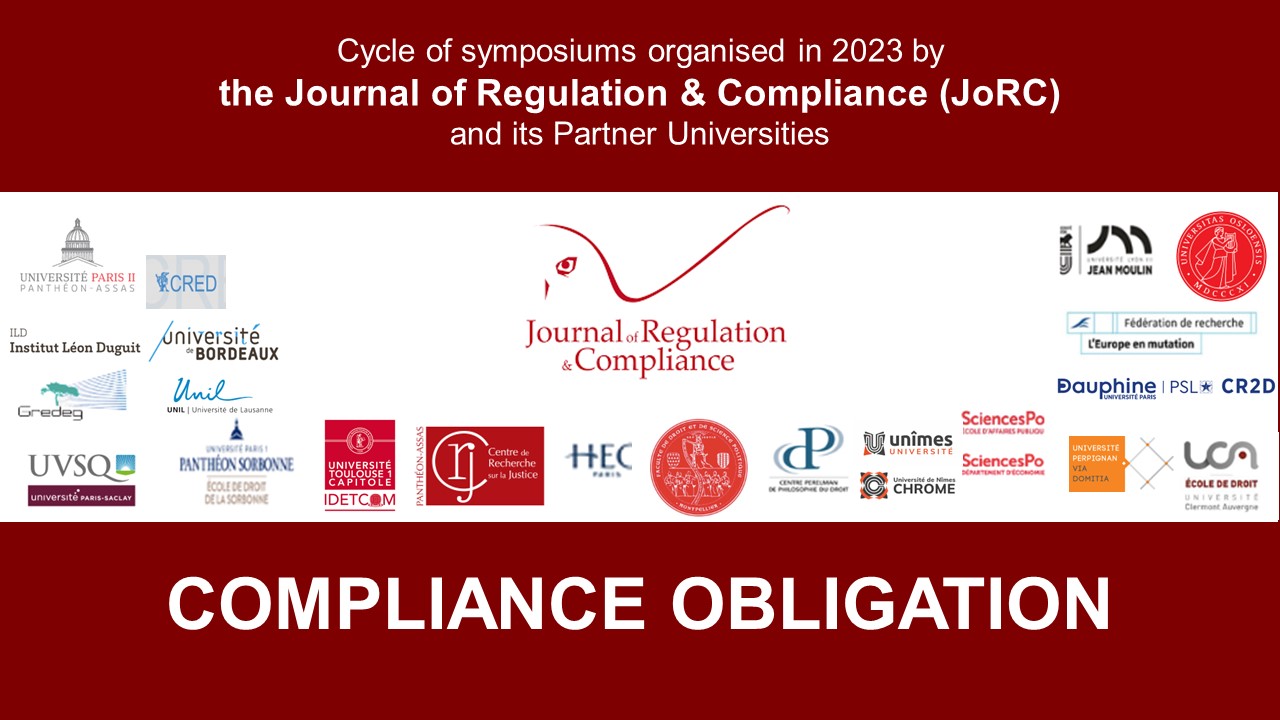
🏗️ This symposium takes place in the cycle of symposiums organised by the Journal of Regulation & Compliance (JoRC) and its partner Universities, focusing in 2023 on the general theme of Compliance Obligation.
► This symposium is organised by the Journal of Regulation & Compliance (JoRC) and the University of Panthéon-Assas (Paris II), through its Centre de recherche sur la justice et le règlement des conflits (CRJ) and its Centre de recherches en économie et droit (CRED).
This symposium is held in French.
the symposium is under the scientific direction of 🕴️Bruno Deffains,🕴️Marie-Anne Frison-Roche and 🕴️Jean-Baptiste Racine.
To registrer for a physical presence: anouk.leguillou@mafr.fr (the number of places is limited, you will be asked to confirm 48 hours before).
To register for a online presence: Click HERE
🧮The event takes place in the buildings Salle des Conseils of the Panthéon-Assas University (Paris II), Place du Panthéon, 12, 75005 Paris, on 14 June 2023 from 9:00 to 18:30.
____
► Presentation of the theme: "The "Obligation" is at the heart of many disciplines. Compliance techniques very often take the form of obligations. But to mention only the first questions that come to mind and in cases, especially those that are referred to the courts, it is paradoxically not so much Contract Law and Tort Law that have been used, since Compliance Law is on the one hand often assimilated to the mass of applicable regulations and its unilaterality characteristic of Regulatory Law, the branch of Law that Compliance Law extends, and on the other hand it is often associated with ethics, morality, a shared culture, everything that seems to distance it from Obligation.
The notions of "duty" and "commitment" are increasingly taking their place in Compliance Law, although their scope is still uncertain. This is why, beyond the multiplicity of "compliance obligations", one may ask whether there is an "obligation to comply", what its definition would be and its relationship with everything that, in Compliance Law, is not one obligation.
It is the topic of this conference and the articles that will follow to identify what will be this hypothesis, which is becoming more and more frequent and could become the standard.
____
Method chosen to deal with the topic: For contributing to what will later become the book on the Compliance Obligation, constituting its first chapter aimed at identifying what could be a definition of Compliance Obligation, the method is not to start from the legal instruments of compliance but rather for each of the contributors to draw on their discipline, which they has mastered technically, in order to project it and formulate what, on the basis of this previous mastery and according to his or her own conception, is or should be, or should not be, the Compliance Obligation.
Each speaker gives a half-hour presentation on his topic, which is followed by a 15-minute debate.
____
The proceedings of this colloquium will form the basis of the first chapter in the books:
📕L'obligation de Compliance, in the collection 📚Régulations & Compliance, copublished by the Journal of Regulation & Compliance (JoRC) and Dalloz.
📘Compliance Obligation, in the collection 📚Compliance & Regulation, copublished by the Journal of Regulation & Compliance (JoRC) and Bruylant.
____
Speakers:
🎤Jean-Sébastien Borghetti, professor of Law at the Panthéon-Assas University (Paris II)
🎤Louis d'Avout, professeur à l'Université Paris Panthéon-Assas (Paris II)
🎤Bruno Deffains, professor of Law & Economics at the Panthéon-Assas University (Paris II)
🎤Benoît Frydman, professor at the Université Libre de Bruxelles (ULB)
🎤Marie-Anne Frison-Roche, professor of Regulation & Compliance Law, director of the Journal of Regulation & Compliance (JoRC)
🎤Daniel Gutmann, professor at the Law School of the Panthéon-Sorbonne University (Paris I)
🎤Anne-Valérie Le Fur, professor at the Saclay University
🎤Gilles Lhuilier, professor at the ENS of Rennes, director of the department Droit, Economie, Gestion
🎤Etienne Maclouf, professor of gestion at the Panthéon-Assas University (Paris II)
🎤Stéphane Mouton, professor of Law at the Toulouse 1-Capitole University
🎤Jean-Baptiste Racine, professor of Law at the Panthéon-Assas University (Paris II)
🎤René Sève, director of the Association française de philosophie du droit - AFPD and of the Archives de Philosophie du Droit - APD
🎤Marta Torre-Schaub, director of research at the CNRS, Institute of legal and philosophical sciences of the Sorbonne, University Panthéon-Sorbonne (Paris I)
____
🔻 read a detailed presentation of the manifestation below:
Feb. 9, 2024
JoRC
► Full Reference: Journal of Regulation & Compliance (JoRC) and Institute of World Business Law of the ICC (Institute), L'arbitrage international en renfort de l'obligation de Compliance (International Arbitration in support of the Compliance Obligation, Conseil Économique Social et Environnemental, Paris, February 9, 2024
____
____
🏗️ This symposium takes place in the cycle of symposiums organised by the Journal of Regulation & Compliance (JoRC) and its Partner Universities, focusing in 2023-2024 on the general theme of Compliance Obligation.
____
► The symposium is organised by the Journal of Regulation & Compliance (JoRC) and the Institute of World Business Law of the ICC (Institute).
The manifestation is under the scientific coordination 🕴️ Laurent Aynès🕴️Marie-Anne Frison-Roche, 🕴️Jean-Baptiste Racine. and🕴️Eduardo Silva-Romero.
It will be held in French and in English.
To registrer for following on site and online: anouk.leguillou@mafr.fr (please specify in your e-mail whether you wish to attend the event on site or online)
As places are limited, you will be asked to confirm 48 hours in advance
🧮The event will take place at the Conseil Économique Social et Environnemental, 9, place d’Iéna, 75116 Paris, on February 9, 2024, between 9 am and 12.45 pm.
_____
► Presentation of the topic: "Compliance Obligation" appears to be far from International Arbitration if Compliance Law is only understood in terms of binding regulations or even Criminal Law. Arbitration would only have contact with Compliance Obligation in a repulsive way, when a person claims to have enforced a contract before an arbitration court that disregards a compliance prohibition, e.g. corruption or money laundering. It is therefore from a negative angle that the cross-over has taken place.
The fact that Arbitration Law respects the requisite of Criminal Law is nothing new. Moreover, the power of Compliance in its detection and prevention tools, particularly in terms of evidence, no doubt increases the global efficiency.
But Compliance Obligation is based on Monumental Goals, notably linked to global human rights and active ambitions about environment and climate which, particularly in the value chain economy, take the legal form of compliance clauses, or even compliance contracts, or various commitments and plans, which the parties can ask the international arbitrator to enforce. They will do so even more as arbitrators are often the only international, or even global, judges available.
The use they will do of Contract Law, Quasi-Contract Law, Enforcement Law, Tort Law, reinforces Compliance Law in a global dimension.
____
The symposium, and the articles following, will expose the crucial global movement that starts. l
_____
Speakers:
🎤 Laurent Aynès, emeritus professor of Law at Paris 1 Panthéon-Sorbonne University, attorney, Darrois Villey Maillot Brochier law firm (Paris)
🎤 Marie-Anne Frison-Roche, professor of Law, director of the Journal of Regulation & Compliance (JoRC)
🎤 Jean-François Guillemin, former General Secretary of the Bouygues Group
🎤 Christophe Lapp, attorney, Advant Altana (Paris)
🎤 Jean-Baptiste Racine, professor of Law at Paris Panthéon-Assas University (Paris 2)
🎤 Eduardo Silva-Romero, president of the Institute of World Business Law of the ICC (Institute), attorney, Wordstone (Paris)
____
The symposium work will be the basis of complete chapters in the books:
📕 L'obligation de compliance, to be published in the collection 📚Regulations & Compliance, copublished by the Journal of Regulation & Compliance (JoRC) and Dalloz.
📘Compliance Obligation, to be published in the collection 📚Compltiance & Regulation, copublished by the Journal of Regulation & Compliance (JoRC) and Bruylant.
🔻 read une first presentation of the manifestation below ⤵️
June 12, 2026
Events
► Full reference : Journal of Regulation & Compliance (JoRC) and Panthéon-Assas University (Paris II), Le "contrat de compliance (The "compliance contract"') Paris, 12 June 2026.
► The symposium is organised by the Journal of Regulation & Compliance (JoRC) and, within Panthéon-Assas University (Paris II), the Centre de recherche sur la Justice et le Réglement des conflits - CRJ (Centre for Research on Justice and conflict resolution) and the Centre de recherche en économie et droit CRED (Centre for Research in Economics and Law ).
____
🏗️This symposium is part of the 2026 series of symposiums on "Compliance & Contracts" organised by the Journal of Regulation & Compliance (JoRC) and its partner universities."
____
The symposium is under the scientific responsibility of 🕴️Bruno Deffains, 🕴️Marie-Anne Frison-Roche, 🕴️Etienne Maclouf and 🕴️Jean-Baptiste Racine.
This event will be held in French.
To register for in-person: crj@assas-universite.fr
🧮 The event will take place in the auditorium, Rue Notre-Dame-des-Champs, 75006 Paris, on 12 June 2026, between 9.30 a.m. and 1.30 p.m.
_____
► Presentation of the topic : Companies have a legal obligation to put "compliance structures" in place, such as whistleblowing mechanisms, plans, information gathering systems and data security systems. Many adopt a management strategy that leads them to choose to outsource the implementation of this obligation, or even to outsource the compliance structure itself, which then most often takes the form of a platform, even though responsibility cannot be transferred. But the line between structure and behaviour, between responsibility for the decision and its implementation, becomes blurred.
The hypothesis examined here through the "Compliance Contract", which should not be confused with compliance clauses but which is linked to them, is the widespread use by companies of this type of contract, the existence and typology of which was identified in 2022. Corresponding to a very significant share of the "compliance market", perhaps a specific market, it could constitute a special contract, requiring at the very least a specific regime, either under Competition Law, Data Law, particularly Personal Data Law, etc.
____
Speakers will include :
🎤Bruno Deffains, Professor of Economics at the University of Paris Panthéon-Assas (Paris II)
🎤 Marie-Anne Frison-Roche, Professor of Regulatory Law and Compliance, Director of the Journal of Regulation & Compliance (JoRC)
🎤 Dominique de la Garanderie, former President of the Paris Bar Association, Barrister
🎤Etienne Maclouf, professor of management sciences at Panthéon-Assas University (Paris II), co-director of CIFFOP
🎤 Jean-Baptiste Racine, Professor of Law at Paris Panthéon-Assas University (Paris II)
____
The proceedings of this symposium will form the basis of a specific chapter in the following publications:
📕Compliance and Contracts, forthcoming in the series 📚Regulations & Compliance, co-published by the Journal of Regulation & Compliance (JoRC) and Dalloz.
🔻 Read the programme of the Event below ⤵️

Updated: Sept. 19, 2012 (Initial publication: May 19, 2010)
Sectorial Analysis
Main information
PeruRail, the operator of Peru’s famous railway line, providing service between Cuzco and Machu Picchu, was sanctioned USD$800,000 on May 10, 2010 by the {‘Instituto Nacional de Defensa de la Competencia y de la Protección de la Propiedad Intelectual’} (INDECOPI- Peru’s national institute for the defense of competition and protection of intellectual property) for having restricted competitors’ market entry. An appeal is underway.
Updated: June 12, 2010 (Initial publication: May 24, 2010)
Grey Litterature
Updated: Dec. 24, 2011 (Initial publication: Dec. 24, 2011)
Doctrine
Updated: April 27, 2010 (Initial publication: April 26, 2010)
Books
Updated: Sept. 15, 2010 (Initial publication: Sept. 2, 2010)
I. Isolated Articles
ENGLISH
It is believed that the lexical distinction between two words necessarily involves the allusion to two different things. In this view, economic regulation differs from financial regulation. Based on what financial regulation is, which is not reduced to an addition of rules and regulations but is a set of mechanisms, institutions, decisions, principles and rules revolving around risk, competition law could be used as a means for financial regulation, although it is usually solely applied to ordinary markets of goods and services. But a new ambiguity has surfaced between financial regulation and economic regulation. Therefore, a wall between economic regulation and financial regulation cannot be built on the single difference between the “economic sector” such as the market of goods and services, and the “financial sector”. A more sophisticated partition could take into account the notion of « individual risk ».
GERMAN
Der Unterschied zwischen wirtschaftliche und finanzielle Regulierung.
Normalerweise weist ein lexikalischer Unterschied zwischen zwei Wörter darauf hin, dass man von zwei verschiedene Sachen spricht. Also sind die wirtschaftliche und die finanzielle Regulierung unterschiedlich. Die finanzielle Regulierung ist nicht eine ledigliche Addition von Gesetzen und Anordnungen, sondern eine Zusammenstellung von Mechanismen, Institutionen, Entscheidungen, Prinzipien und regeln, die sich mit dem Thema Risiko beschäftigen. Anhand dieser Tatsache könnte das Wettbewerbsrecht, das normalerweise erst für gewöhnlichen Waren- und Dienstleistungenmärkte gebraucht ist, auch im finanziellen Bereich Anwendung finden. Jetzt aber hat sich eine neue Zweideutigkeit zwischen wirtschaftlicher und finanzieller Regulierung entwickelt. Infolgedessen kann eine Begrenzung zwischen beide Regulierungen nicht nur aufgrund den Unterschied zwischen dem wirtschaftlichen (wie z.B. der Güter- und Dienstleistungensmarkt) und dem finanziellen Sektor. Eine anspruchsvollere Unterscheidung könnte den Begriff "individuellen Risiko" integrieren.
SPANISH
La distinción entre la Regulación económica y la Regulación financiera.
Se cree que la distinción léxica entre dos palabras necesariamente involucra la alusión a dos cosas. Teniendo esto en cuenta, la regulación económica difiere de la regulación financiera. Basándonos en lo que es la regulación financiera, lo cual no se reduce a una simple adición de reglas y regulaciones pero por lo contrario está compuesta por una serie de mecanismos, instituciones, decisiones, principios y reglas que dependen del riesgo, se podría decir que la ley de la competencia puede ser utilizado para la regulación financiera, aunque normalmente solo se aplica a mercados ordinario de bienes y servicios. Pero una nueva ambigüedad se ha dado entre la regulación financiera y la regulación económica. Por lo tanto, es imposible construir una pared entre la regulación económica y la regulación financiera basado simplemente en la diferencia entre el ‘sector financiero’ como lo es el mercado de bienes y servicios y el sector financiero. Una partición más sofisticada podría tomar en cuenta la noción del “riesgo individual.”
Other translations (to come)
May 17, 2021
JoRC
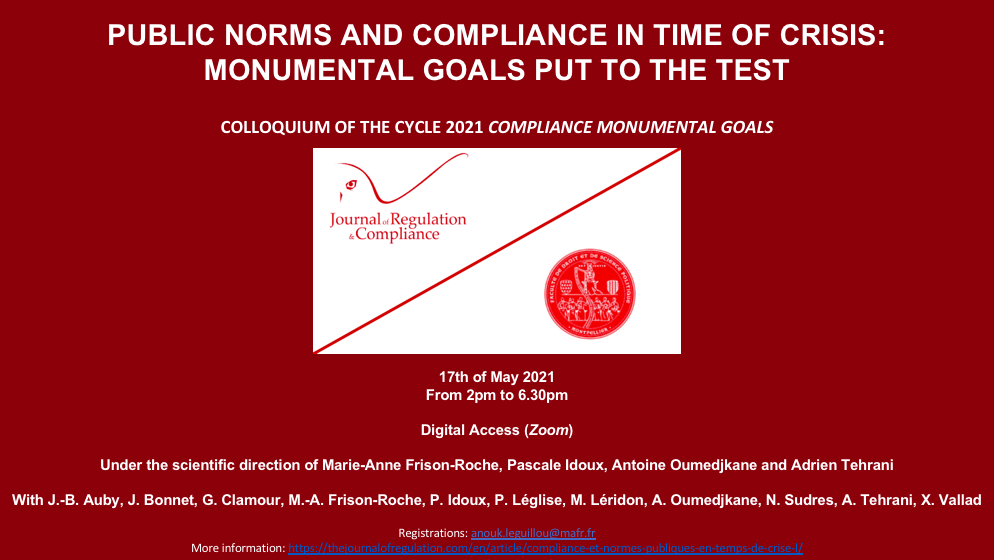
This scientific manifestation is placed under the scientific direction of Marie-Anne Frison-Roche, Pascale Idoux, Antoine Oumedjkane and Adrien Tehrani. It is organized by the Journal of Regulation & Compliance (JoRC) and by the Faculté de Droit et de Science Politique de l'Université de Montpellier (Centre de Recherches et d'Etudes Administratives de Montpellier and Centre du Droit de l'Entreprise).
📅 This manifestation is part of the cycle of colloquia organized in 2021 around the general topic of Compliance Monumental Goals.
The interventions will give rise to the production of articles which will be part of
📕 Les bus monumentaux de la Compliance,  to be published in the Series Regulations & Compliance , co-published par the Journal of Regulation & Compliance (JoRC) and Dalloz.
📘Compliance Monumental Goals, dans la Série Compliance & Regulation , co-published by par le Journal of Regulation & Compliance (JoRC) and Bruylant.
This manifestation took place on Zoom on 17th of May 2021.
Registrations: anouk.leguillou@mafr.fr
Assistance to this event may be validated as part of the continuing education of lawyers.
In addition, scientific videos will be extracted and disseminated later.
Presentation of the topic: In the overall problematic of "Monumental goals", this conference retains a particular case: that of the crisis and the emergency situation that it generates.
First of all, in general, does the importance of public norms in the emergency context engendered by a crisis situation imply a marginalization of Compliance? Don't private actors also have their place in these circumstances, at the service of the "monumental goals" that the public authorities want to maintain, or even which appear specifically?
Secondly, more concretely, we have been living for many months in a health crisis. By taking it as a framework and, within it from particular cases, how public and private actors react, act, adjust? and how do the courts assess these movements?
Going from the most general to the most specific, this conference aims to identify criteria, limits, of what could be specific rules when the emergency of a crisis meets Compliance, and will examine specific situations.
Working method: The conference is therefore built on a general issue, which was the subject of a "working paper", written by Antoine Oumedjkane, Adrien Tehrani and Pascale Idoux, on which the speakers will have thought in advance and from which they are intended to study the question from their particular perspective.
The conference, which is essentially interactive, therefore begins with an outline of the main lines of this general work. It is followed by the examination of concrete practical cases.
They are as follows:
1️⃣ hydro-alcoholic gel, its manufacture, price, availability,
2️⃣ information and regulation on all media in Covid period
3️⃣ the use of the bicycle during the state of health emergency
A first conclusion, thematically limited, will relate to Revealed by the crisis situation, the place of private initiative in Compliance Law.
A second, more general, undoubtedly open-ended conclusion is drawn from this confrontation between general reflection and concrete cases which must be resolved in a particular crisis.
speakers:
🎤 Jean-Bernard Auby, Emeritus Professor of Sciences po (Paris)
🎤 Julien Bonnet, Professor at Montpellier University and member of the CERCOP
🎤 Guylain Clamour, Dean of Montpellier Law School
🎤 Marie-Anne Frison-Roche, agrégée des Facultés de droit, Professor of Regulation and Compliance Law at Sciences Po (Paris) and Director of the Journal of Regulation & Compliance (JoRC)
🎤 Pascale Idoux, Professor at Montpellier University
🎤 Pascale Léglise, adjointe au directeur des libertés publiques et des affaires juridiques (Deputy Director of Civil Liberties and Legal Affairs) of the Ministère de l'intérieur (Home Ministry)
🎤 Michèle Léridon, Member of the Conseil supérieur de l'audiovisuel (French Media Regulator), President of the working group Pluralisme, déontologie, supervision des plateformes en ligne (Pluralism, Deontology, Supervision of Online Platforms)
🎤 Antoine Oumedjkane, Researcher of the Centre de recherche et d'études administratives (Research and Administrative Studies Center) of Montpellier University
🎤 Nelly Sudres, Maître de conférences at Montpellier University and member of the Centre de Recherches et d'Etudes Administratives (Research and Administrative Studies Center) of Montpellier University
🎤 Adrien Tehrani, Professor at Montpellier University and member of the Centre du Droit de l'Entreprise (Company Law Center)
🎤Xavier Vallad, Group Legal Director, Intermarché
⤵️Read a more detailed presentation of the manifestation below: