On December 20, 2011, the European Commission adopted a decision based on the Almark ruling that expounds upon the four conditions necessary so that compensation paid by a State to any state-owned or private company entrusted with the operation of a public service not require prior notification of the European Commission, despite the general prohibition on State Aids. Each state has a wide margin of discretion in the definition of services that could be classified as being services of general economic interest. A communication and de minimis regulation will complete this decision.
Référence complète : MARTUCCI, Francesco, Programme OMT de la BCE : voici venu le temps des juges, Revue Banque, n°779-780, janvier 2015, p.60-62.
Les étudiants de Sciences Po peuvent accéder au texte de l'article par le Drive de Sciences Po (dossier MAFR, Régulation)
Dans cet article publié avant que ne soit connues les conclusions déposées par l'avocat général, l'auteur affirmé que la question préjudicielle posée par le Tribunal constitutionnel allemande est une question "existentielle" pour la monnaie européenne et pour la zone euro. En effet, le programme d'achat de titres souverains sur les marchés secondaires (OMT) est, contrairement au programme de soutien précédent (SMP) présenté par le président de la BCE comme pouvant être "illimité".
L'auteur souligne que lorsqu'on lit la décision par laquelle le Tribunal constitutionnel allemande a renvoyé la question préjudicielle à la CJUE, on y perçoit sa propre conception, à savoir la non-conformité du programme OMT au traité de fonctionnement de l'Union européenne (TFUE), sauf à interpréter ce programme de façon très restrictive, notamment par la renonciation à son caractère "illimité" (ce qui revient à lui ôter sa puissance même ...).
Plus encore, le Tribunal constitutionnel allemand considère que si la CJUE ne le suivait pas, alors elle porterait atteinte à "l'identité constitutionnelle" de l'Allemagne (ce que l'auteur de l'article conteste, notamment au nom de la hiérarchie des normes).
L'auteur de l'article évoque plusieurs positions possibles de la CJUE (la dernière correspondant à celle suggérée par la suite par l'avocat général).
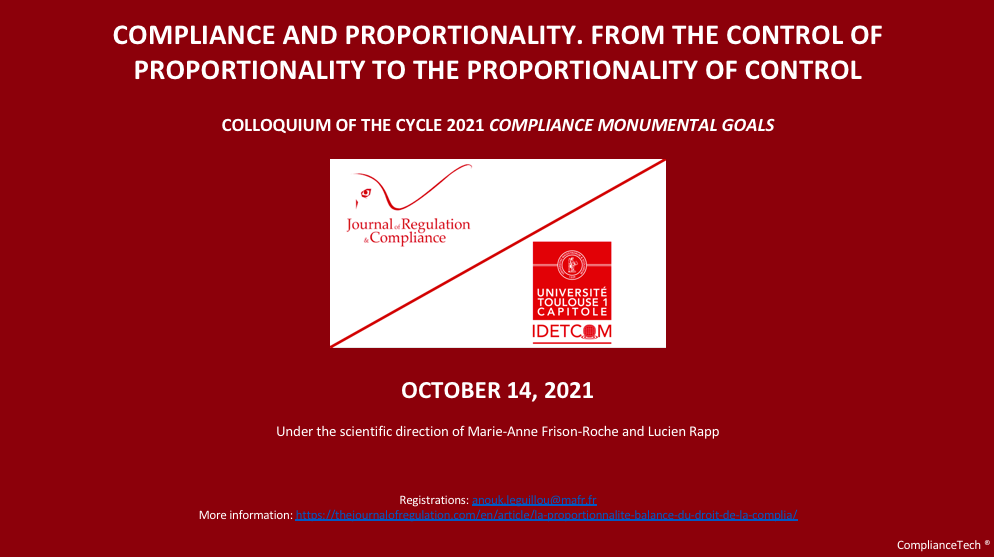
The colloquium will take place, a priori, on site in Toulouse, on October 14, 2021.
It will be broadcasted in live online.
🎥 Videos will be extracted.
► Presentation of the topic :
Compliance Law tends towards "Monumental Goals". This puts the concern, the calculation and the control of proportionality at the center. Proportionality is one of the most common references for compliance practices and strategies, but paradoxically, one of the least well defined. Perhaps even one of the most elusive.
For the German Federal Constitutional Court in Karlsruhe, the principle of proportionality allows the quantitative easing policies of the European Central Bank (ECB) to be monitored. This principle is linked to nothing less than the principle of democracy and is the basis of the control of ultra vires. In French law, proportionality refers to the provisions of Article 8 of the Déclaration des droits (Bill of Rights) of 1789, according to which the law should only establish penalties that are strictly and obviously necessary. In many areas of civil or business life, the compliance of behavior and the consequences of non-compliance are assessed on the basis of a graded assessment by the censor (competitor, regulator or judge).
Proportionality calls for action, which opens up a margin of appreciation to take into account the facts or circumstances. It also allows for the exercise of control over abuse of rights or excess of power. It goes beyond the office of the judge or the censor to forge one of its tools: the control of proportionality, which is obviously not the proportionality of the control.
How to integrate proportionality into compliance practices and strategies?
Does it introduce a certain tolerance in the assessment of situations and is it thus a factor of rediscovered freedom in the development of risk matrices?
Conversely, is it not synonymous with increased vigilance on the part of compliance officers, by leaving open the possibility of a reinforced control of their acts or decisions, by the evaluation of their advisability and not of their conformity alone?
► Working method:
🚧 The colloquium is built around 4 topics, which would be prepared in 4 working papers.
🚧 The writing of each working paper will have been entrusted by experts.
Secondly, these working papers will be available to be criticized by two practionners of Compliance technics.
For each topic, there will be these three sequences:
Presentation of the topic by the author of the working paper ;
Discussion by the two discussants, who will have read the working paper previously ;
Discussion with the public onsite and online.
The four topics chosen are:
1️⃣ Proportionality and Conformity
2️⃣ Proportionality and Evaluation
3️⃣ Proportionality and Normativity
4️⃣ Proportionality and Sanction
► registrations and information :
attendance to the manifestation is free, onsite or online
every registration for an attendance onsite will be supported by Toulouse-I-Capitole University
information will be available on a website opened by Toulouse-I-Capitole University
____
►Will speak, notably :
🎤 Marie-Anne Frison-Roche, professor of Regulation and Compliance Law, director of the Journal of Regulation & Compliance
🎤 Alexandra Mendoza-Carminade, professor at Toulouse-I-Capitole University
🎤Lucien Rapp, professor at Toulouse-I-Capitole University
🎤 Marc Segonds, professor at Toulouse-I-Capitole University
The implementation of a joint consumer information service on Insurance, Banking, and Insurance within the ‘Autorité de Contrôle prudential – ACP’ (French Prudential Control Authority), raises questions as to the way in which the service will be coordinated with the ACP’s other activities. The signature of the agreement creating the new joint service was the occasion for Christian Noyer, Governor of the Banque de France (Central Bank of France) and President of the ACP, to clarify that this joint service, whose principal goal is consumer protection, complements the ACP’s other missions.
This shows that the document is primarily intended for investors and financial markets, the document being placed on the company website in the section for the "investors".
This illustrates the evolution from the traditional "contrats de plan" (plan contracts). But then, who are the parties to these types of contract?
Indeed, the very term "Regulatory contract" is new in public Law. It appears as a sort of modernization of "plan contract." The Conseil d'État (French State Council) finally admitted the contractual nature of these planning contracts. In these contracts, are parties were the State and the company in charge of a public service.
Because here the contract is an instrument of "economic regulation" the open public consultation draft rather expresses a global conception of ADP, the company which manages the Paris airports, for the future of the development of critical infrastructure that is the airport as the heart of global development of air transport.
The enterprise manager of the airport in the heart of the contract (rather than the State) in setting objectives for the coming four years is the letter and spirit of the French law of 20 April 2005 about Airports, which put the apparatus of this "Contrat de Régulation Economique" in place.
In this, the infrastructure manager is set by law as a "regulator of second degree", as can be a financial market enterprise. The company that manages and develops the Paris airports undoubtedly belongs to the category of " critical firms", as well it manages the future of the sector and helps to keep France a place in the world.
More, A.D.P. behaves like a Regulator, since it is carrying out the "public consultation", the consultation paper prepared by it, being placed on its site and developing its ambitions for the sector and for France. But A.D.P. also expressed as a financial and economic actor, emphasizing the competitive environment, demanding in passing more stability and clarity in the regulation in which it moves ...
That is why the consultation mechanism provided by the law must be more complex. Indeed, ADP can not be judge and jury. Therefore if the project raises observations, they must be formuled not to ADP but to the Ministries of Aviation and Economy, within a month. They shall communicate theiir content to ADP . Then the Commission consultative aéroportaire (French Airport Consultative Committee) will be consulted. At the end of this process, the "Contrat de Régulation Economique" will be signed.
Seing the end of the process, it remains in line with the plan contracts, since it remains the Economic Regulatory Contract is signed between the State and the essential infrastructure manager. But the consultation process shows firstly investors are the first recipients of the statements made by a privatized company presenting its draft primarily in terms of competitive context and international development and secondly the airlines that use daily services of the airports are also directly involved by theses questions of tarification.
Airlines protest against the increase in the money that will be asked. This will be imposed, since it is tarification and princing public policy. We are in unilateral rules. But it is indeed a "price" they feel to pay, they also heard a speech referring to competition in what the mechanism is presented as a "contract".
But then, does it take to admit that these "contracts for economic regulation" are not between two parties that are the state and the regulator of second degree that is the infrastructure manager but must be three, the State, the infrastructure manager and "stakeholders" that are mainly airlines?
This practical difficulty is much to the fact that the qualification of "contract" is difficult to justify in proceeding in which prevail unilateral mechanisms.
Nomination of the members of the Haute autorité pour la diffusion d’oeuvres et la protection de droits sur Internet (Hadopi – High Authority for the Dissemination of Works and the Protection of Rights on the Internet).
In February 2011, the "Autorité de régulation des jeux en ligne" (ARJEL – French Online Gambling Regulatory Authority) has asked Pokerstars to shut down its Home Games, which the online gambling site has agreed to do. After that,the regulator has written to all operators to remind them that any modification of their platforms must be submitted to it for prior approval. This appoval has been given on may, 12, 2011. The Home Game is reserved to players, which account member has been validated by Pokerstar.
ITALIAN
Relazione tematica (Scommesse): L’autorità francese di regolazione dei giochi on line (ARJEL) ha omologato il The Home Games’ Pokerstars, dopo aver annullato
Durante il mese di febbraio 2011, la "Autorité de régulation des jeux en ligne" (ARJEL – l’Autorità francese di regolazione delle scommesse online) ha richiesto alla società Pokerstars di interrompere il suo Home Games e la società si è conformata a tale richiesta. Successivamente, l’Autorità di regolazione ha scritto a tutti gli operatori ricordando che ogni modificazione della loro piattaforma dovrà essere sottoposta alla sua autorizzazione. Il 12 maggio 2011, è stata concessa questa autorizzazione. The Home Game è dunque riservato a degli utenti, il cui account è stato controllato e confermato da Pokerstars.
Two and a half years after having been established by the LME, the French Competition Authority has uncontestably acquired its “place in the sun” amongst the competition authorities of other countries, as demonstrated by multiple indicators.
ITALIAN
Articolo: L’Autorità garante della concorrenza tra “regolazione” e politica in materia di concorrenza
Due anni e mezzo dopo l’instaurazione da parte del LME, l’Autorità francese garante della libera concorrenza ha trovato il suo posto tra le diverse autorità degli altri paesi, così come è stato dimostrato da diversi indicatori.
SPANISH
Artículo: La Autoridad de la competencia, entre “regulación” y política competitiva.
Después de dos años y medio de haber sido establecido por el LME, la Autoridad francesa de la competencia ha incontestablemente adquirido su “lugar bajo el sol” entre las autoridades de la competencia de otros países, como demostrado por varios indicadores.
The implementation of a common repertory of information on Social Security tax payments provides the opportunity to gather real-time information on a vast majority of taxpayers, but is highly criticized for its possible violation of privacy rights.
The September 8th 2010 decision of the European Court of Justice rules that any national law on gambling restraining freedom of establishment and freedom to provide services, if not consistent and systemic in its purpose, violates EU Law.
SPANISH
La Corte Europea de Justicia restringe a los Estados Miembros la habilidad de dificultar la libre provisión y establecimiento de servicios de juego en su territorio nacional.
El 8 de septiembre del 2010, una decisión de la Corte Europea de Justicio juzga que cualquier ley nacional sobre los juegos que restrinjan la libertad de establecimiento y la liberad de proveer servicios, a menos de que sea consistente y sistémica en su propósito, viola la Ley de la Unión Europea.
ITALIAN
Relazione tematica (scommesse): La Corte di giustizia europea riduce la possibilità per gli Stati membri di ostacolare la libera circolazione ed il libero stabilimento dei servizi di scommesse sul proprio territorio.
La Corte di giustizia, con una sentenza dell’8 settembre 2010, ha deciso che ogni legislazione nazionale in materia di scommesse che riduce il diritto di libero stabilimento e la libera prestazione di servizi viola il diritto europeo, qualora tale legislazione non contribuisca a limitare l’attività di scommesse in maniera coerente e sistematica.



 forthcoming in the series Regulations & Compliance, co-published by the Journal of Regulation & Compliance (JoRC) with Dalloz.