
Search results (680 cards)

Updated: July 21, 2010 (Initial publication: May 5, 2010)
Grey Litterature
Updated: Sept. 19, 2012 (Initial publication: Oct. 14, 2010)
Sectorial Analysis
ENGLISH
The Nigerien Minister for Communication, New Technologies, Information, and Culture, Mrs. Takoubakoye Amina Boureima, announced at the 3rd African Telecommunications Union plenipotentiary conference in Brazzaville, on September 26, 2010, that her country would implement a system for the regulation of international telecommunications similar to the Congolese system.
FRENCH
Fiche Thématique (Télécommunications): la Républque du Niger a annoncé la mise en place d'un système de régulation des télécommunications en suivant le modèle mis en place par la République Démocratique du Congo.
Le ministre de la Communication, des Nouvelles Technologies, de l'Information et de la Culture du Niger, Mme Takoubakoye Amina Boureima, a annoncé, au cours de la 3e conférence plénipotentiaire des télécommunications de l'Union Africaine à Brazzaville, le 26 septembre 2010, que son pays allait mettre en place un système de régulation des communications internationales similaire à celui du Congo.
GERMAN
Thematischer Bericht (Telekom): die Republik Niger wird ein Regulierungssystem für Telekommunikation in Anlehnung am kongolesischen Modell einführen.
Die Ministerin für Kommunikation, Neue Technologien, Information und Kultur der Republik Niger, Frau Takoubakoye Amina Boureima, hat am 26. September 2010, im Lauf der 3. Telekomkonferenz der Afrikanischen Union in Brazzaville, den Wille ihrer Land verkündigt, ein Regulierungssystem für Telekommunikation in Anlehnung am kongolesischen Modell einzuführen.
SPANISH
La República de Níger ha anunciado que implementará sistemas regulatorias de telecomunicaciones siguiendo el modelo establecido por la República del Congo.
El Ministro Nigerino de Comunicación, Nuevas Tecnologías, Información y Cultura, la Señora Amina Boureima, anunció en el 3er conferencia plenipotenciaria de la Unión africana de telecomunicaciones en Brazzaville el 26 de septiembre el 2010, que su país implementaría un sistema para la regulación de telecomunicaciones internacionales similar al que se encuentra en el sistema congolesa.
CHINESE
主题性报告(电信):尼日尔共和国宣布实行与民主刚果共和国相类似的电信监管系统。
尼日尔通信信息和新技术文化部部长Mrs. Takoubakoye Amina Boureima在Brazzaville召开的第三次非洲联盟电信机构代表大会中宣布自2010年9月26日起,尼日尔共和国已经实行了与刚果共和国相类似的国际通信监管系统

Oct. 14, 2021
JoRC
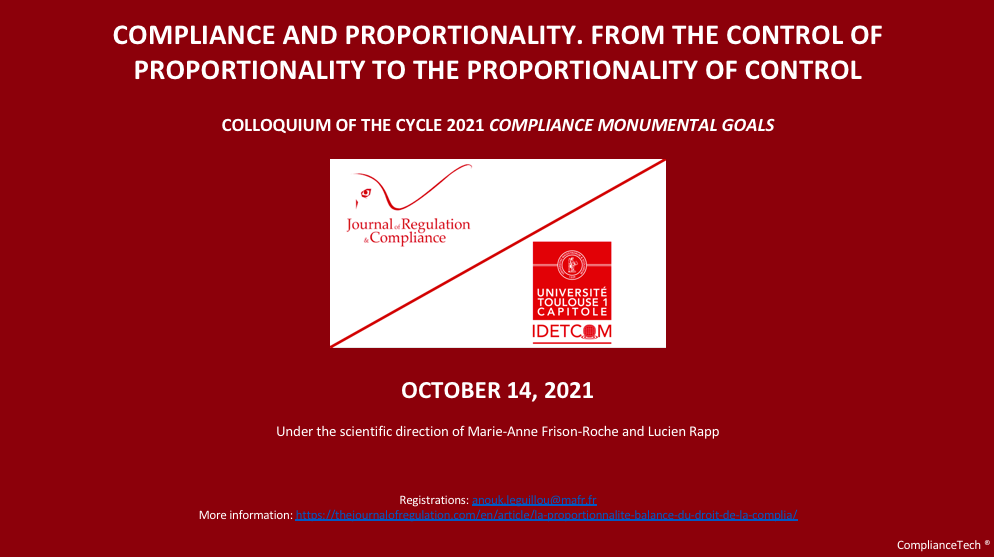
►This scientific manifestation is placed under the scientific responsibility of Marie-Anne Frison-Roche and Lucien Rapp.
This manifestation is organized by the Journal of Regulation & Compliance (JoRC) and by the IDETCOM of Toulouse-I-Capitole University.
📅 This colloquium is part of the cycle of colloquia organized in 2021 around the general topic about Compliance Monumental Goals

____
► Interventions during this colloquium will be the base for a specific chapter in :
📕 Les buts monumentaux de la Compliance,  forthcoming in the series Regulations & Compliance, co-published by the Journal of Regulation & Compliance (JoRC) with Dalloz.
📘Compliance Monumental Goals, forthcoming in the series Compliance & Regulation, co-published by the Journal of Regulation & Compliance (JoRC) and Bruylant.
____
The colloquium will take place, a priori, on site in Toulouse, on October 14, 2021.
It will be broadcasted in live online.
🎥 Videos will be extracted.
► Presentation of the topic :
Compliance Law tends towards "Monumental Goals". This puts the concern, the calculation and the control of proportionality at the center. Proportionality is one of the most common references for compliance practices and strategies, but paradoxically, one of the least well defined. Perhaps even one of the most elusive.
For the German Federal Constitutional Court in Karlsruhe, the principle of proportionality allows the quantitative easing policies of the European Central Bank (ECB) to be monitored. This principle is linked to nothing less than the principle of democracy and is the basis of the control of ultra vires. In French law, proportionality refers to the provisions of Article 8 of the Déclaration des droits (Bill of Rights) of 1789, according to which the law should only establish penalties that are strictly and obviously necessary. In many areas of civil or business life, the compliance of behavior and the consequences of non-compliance are assessed on the basis of a graded assessment by the censor (competitor, regulator or judge).
Proportionality calls for action, which opens up a margin of appreciation to take into account the facts or circumstances. It also allows for the exercise of control over abuse of rights or excess of power. It goes beyond the office of the judge or the censor to forge one of its tools: the control of proportionality, which is obviously not the proportionality of the control.
How to integrate proportionality into compliance practices and strategies?
Does it introduce a certain tolerance in the assessment of situations and is it thus a factor of rediscovered freedom in the development of risk matrices?
Conversely, is it not synonymous with increased vigilance on the part of compliance officers, by leaving open the possibility of a reinforced control of their acts or decisions, by the evaluation of their advisability and not of their conformity alone?
► Working method:
🚧 The colloquium is built around 4 topics, which would be prepared in 4 working papers.
🚧 The writing of each working paper will have been entrusted by experts.
Secondly, these working papers will be available to be criticized by two practionners of Compliance technics.
For each topic, there will be these three sequences:
- Presentation of the topic by the author of the working paper ;
- Discussion by the two discussants, who will have read the working paper previously ;
- Discussion with the public onsite and online.
The four topics chosen are:
1️⃣ Proportionality and Conformity
2️⃣ Proportionality and Evaluation
3️⃣ Proportionality and Normativity
4️⃣ Proportionality and Sanction
► registrations and information :
- attendance to the manifestation is free, onsite or online
- every registration for an attendance onsite will be supported by Toulouse-I-Capitole University
- information will be available on a website opened by Toulouse-I-Capitole University
____
►Will speak, notably :
🎤 Marie-Anne Frison-Roche, professor of Regulation and Compliance Law, director of the Journal of Regulation & Compliance
🎤 Alexandra Mendoza-Carminade, professor at Toulouse-I-Capitole University
🎤Lucien Rapp, professor at Toulouse-I-Capitole University
🎤 Marc Segonds, professor at Toulouse-I-Capitole University
____
See the program below:

Aug. 27, 2020
Newsletter MAFR - Law, Compliance, Regulation
Full reference: Frison-Roche, M.-A., "Interregulation" between Payments System and Personal Data Protection: how to organize this "interplay"?, Newsletter MAFR - Law, Compliance, Regulation, 27th of August 2020
Read by freely subscribing the other news of the Newsletter MAFR - Law, Compliance, Regulation
Summary of the news
Regulation Law, in order to recognize and draw the consequences from the specificities of some objects, has been build, at the start, around the notion of "technical sector" although their delimitation is partially related to a political choice. But, in facts, there are multiple points of contacts between sectors, actors moving from one to another as objects. The regulatory solution is so to climb over some technical borders through the methodology of interregulation which is by the way the only one to enable the regulation of some phenomena going beyond the notion of sector and related to Compliance Law.
This news takes the exemple of companies furnishing new payment services. In order to they can provide these services, these firms needs to access to banking accounts of concerned people and so to very sensitive personal data. Regulation of such a configuration needs a cooperation between the banking regulator and the personal data regulator. Legislation being not sufficient to organize in Ex Ante this interregulation, the European Data Protection Board has published some guidelines on 17th of July 2020 about the way it conceives the articulation between the PSD2 (European directive about payment services) and GDPR and has announced that it intended to expand the circle of its interlocutors to do this interregulation. Such an initiative from EDPB can be justified by the uncertainty about how interpreting both texts and articulating them.
Updated: Dec. 8, 2011 (Initial publication: Sept. 23, 2011)
Sectorial Analysis
Translated Summaries
ENGLISH
Corporate officers that had provided financial markets with false information, as well as their auditors, were under investigation by the Autorité des Marchés Financiers (AMF—French financial markets authority) for failure to provide information. On March 31, 2011, the AMF’s Enforcement Commission punished the corporate officers, but decided to innocent the auditors, on the grounds that they had obeyed professional standards.
FRENCH
Lorsque les dirigeants d’une société cotée ont manqué à leur obligation d’informer le marché, l’auditeur, quant à lui, est selon le régulateur exempt de responsabilité, dès l’instant qu’il a respecté les normes professionnelles
SPANISH
Informe Temático (Finanza): Según el AMF, auditores no son responsables cuando una compañía falla en su obligación a proveer el mercado con información, siempre y cuando hayan obedecido los estándares profesionales.
Tanto los oficiales corporativos que habían proveído a los mercados financieros con información falsa, como sus auditores, estuvieron bajo investigación del Autorité des Marchés Financiers (AMF – la Autoridad francesa de mercados financieros) por no haber proveído información. El 31 de marzo del 2011, el AMF castigó a los oficiales corporativos, pero declaró inocentes a los auditores, atestando que ellos habían obedecido los estándares profesionales.
.....................
Other translations forthcoming.
Updated: Jan. 5, 2012 (Initial publication: Jan. 5, 2012)
Doctrine
Updated: Dec. 21, 2011 (Initial publication: Dec. 21, 2011)
Doctrine

July 15, 2016
Breaking news
In Senegal, the Autorité de régulation des télécommunications et des postes (ARTP ; English translation: Telecommunications and Posts Regulatory Authority) has, just like all regulators, inherent powers to impose sanctions. In general, the important thing is not only to exercise this sanctioning power but to exercise it in a way that reinforces the authority of the Regulator. In this perspective, the new Sonatel sanction decision is important.
As a sanctions always carry a heavier weight when people are made aware of it, the Director General of the Artp issued a press release, that has been flagged as particularly important, and held a press conference (in French) on a particularly serious sanction imposed following what the Regulator considers as the non-fulfilment of obligations stemming from formal notices (which, by the way, the telecom operator challenges on the merits).
On 21 November 2014 indeed, the Sonatel was given a formal notice from the Artp to respect consumer rights. As the code of telecommunications provides since its modification in 2014, operators shall "prendre les mesures appropriées de dimensionnement de leurs réseaux de nature à garantir à leurs clients un accès ininterrompu à leur service client commercial ou technique en respectant un taux d’efficacité minimal" (translation: "take appropriate measures to size their networks in a way that provides their consumers with an uninterrupted access to their customer service (sales service and technical support) which would respect a minimum efficiency rate") set by the Regulator itself- as to, namely, ensure that the right of consumers to be informed is satisfied (as regards billing mechanisms) and that their calls to consumer services remain free of charge. As the Regulator estimated that the Sonatel was not complying with such regulations, it conducted a formal investigation and notified a statement of objections to the operator, before sending on 28 January 2015 a second formal notice for the same reasons.
On 14 July 2016, the Regulator imposed a sanction on Sonatel since the it still estimated that the operator's behavior still was not leading to a compliant situation as regards the consumer right to be informed. The sanction, as stated in the Sonatel decision, is 13 billion 959 million FCfa (c. €20m), i.e., 15% of Sonatel's 2015 turnover. The sanction decision also provides that if the operator does not enforce it, an additional penalty of 10m FCfa (c. €15,000) per day will be charged.
The operator, however, challenges this sanction insofar as it estimates that its behavior is not to be blamed. To support its claim, Sonatel avails itself from the fact that upon reception of the first formal notice, it undertook a 'progressive compliance' with the requirements process as regards its network, then let the Regulator know about it, etc. It is henceforth to lodge an appeal.
The issue at stake, therefore, is to know whether the obligations on operators are obligations regarding the means used (that is to say, means obligations), or, conversely, if they are obligations to produce results (performance obligations). If they are means obligations, then the operator is right. However, considering the efficiency and effectivity principes that are closely linked with the teleological nature of Regulation, it is more likely that such obligations are performance obligations.
For instance, in France, the Commission Informatiques et Libertés (French Data Protection Authority- CNIL) considered on 1 March 2016!footnote-42 that the obligations on operators to have accurate and complete data are performance obligations and not mere means obligations.
Thus, there is probably more to follow with this Sonatel decision. The day the press release was issued, the operator stated it intended to lodge a hierarchical appeal before the Minister.
The next day, the Director General of the Artp stated in the press (in French) that under the Senegal law, the appeal could only be lodged before a jurisdiction, or before... the Regulatory Authority itself (request for reconsideration - in French : "recours gracieux").
This situation is thus a great reminder that new illustrations of the interplays between Regulation and Politics can always be found.

June 22, 2016
Breaking news
It is sometimes argued that the competitive freedom will destroy the "old regulated world", platforms being the perfect example of this fresh wind, the invention of the adjective "disruptive" which could express a "novelty" before which it is only suitable to bow.
It would be therefore necessary to smile or even laugh, what would be a "rearguard battle" when the Conseil Constitutionnel (French Constitutional Council) in a decision of 22 May 2014 had limited the expansion of Uber, protecting the correspondingly monopoly holders of a municipal taxi license.
But in the US, cities adopt regulations. So on the next city council of the city of Chicago, will be proposed the vote of an order to compel the rideshare drivers.
In 2014, the French Constitutional Council justified its decision by referring to "the public order of parking", which the municipality is mistress... The justification given here is to protect the occupant.
Indeed all rideshare drivers will be obliged provide proof that they are subject to health checks, especially on drugs and provide criminel check also.
This is justified because Regulation of an activity implies control of those who exercise it and equal competitors can justify that for the same activity some are removed, especialy in view of the protection of the person transported.
The third new requirement is of a different nature: the driver must prove that it is not in debt to the municipality. Why not, since the infrastructure of the city allows them to exercise the economic activity in question. This is another underlying objective, which lies rather in the idea of an exchange between the city and the one who transports people, the beneficiary of infrastructure should not be otherwise debtor that it enjoys public infrastructure.
The latter provision shows that the "contract" is increasingly not between the carrier and transported - via the virtual platform - but between the very concrete public space and one that circulates and do not live there.
July 30, 2019
Breaking news
Europe is definitely the zone of the world in which the protection of persons is thought.
Elle le fait par des textes, dont le très fameux Réglement adopté en 2016 relative à la protection des personnes physiques à l'égard du traitement à caractère personnel et à la libre circulation de ces données, dit "RGPD", recopié par exemple en Californie par la loi du 12 juillet 2018, par des initiatives nationales, comme la prochaine loi française contre les discours de haine dans l'espace numérique, par de nombreuses études et rapports - le droit souple étant aussi importante que le Droit pénal en Droit de la Compliance, mais encore par des décisions de justice.
Europe does this by texts, including the very famous Regulation adopted in 2016 relating to the treatment of personal data for their free circulation and the protection of peope concerned by them ( known as General Data Protection Regulation - GDPR ), copied for example in California by the Act of 12 July 2018, by national initiatives, such as the next French law against hate speech in the digital space, by numerous studies and reports - Soft Law being as important as Criminal Law in Law of Compliance system -, but also by court decisions.
Indeed, judicial decisions were at the origin of the movement of the person protection, with the creation of a "right to be forgotten" by the 2014 Google Spain decision of the Court of Justice of the European Union.
The judgment of the CJEU on 29 July 2019, Fashion ID, is just as important. Like the previous one, it clearly settles an essential question: who must police consents in the digital space?
And the answer is: all the digital players who benefit from it.
As a result, there is an "intermesh" (on this notion which is the future of Compliance Law in the digital world, see Frison-Roche, M.-A., The contribution of Compliance Law in the Governance of Internet, 2019 ).
See below the analysis of the judgment.