The British Advertising Standards Authority (ASA) announced on September 1st, 2010 a revision to the Committee of Advertising Practice Code (the CAP Code), in order to handle consumer complaints and sanction non-compliant advertising on British websites. These new rules will be effective from March 1st 2011.
FRANCAIS
Le British Advertising Standards Authorithy (ASA — organisme britannique d'autorégulation de la publicité) a annoncé le 1er septembre 2010 une révision au Committee of Advertising Practice Code (The CAP Code — le Code des bonnes pratiques dans la publicité), afin de pouvoir répondre aux plaintes des consommateurs relatives aux publicités non-conformes sur les sites Internet britanniques, et de les sanctionner. Ces nouvelles règles entreront en vigueur le 1er mars 2011.
GERMAN
Die British Advertising Standards Authority (ASA - die britische Selbstregulierungsbehörde für die Werbebranche) hat am 1. September 2010 verkündigt, dass der Committee of Advertising Practice Code (the CAP Code - die Richtlinien für Qualitätsregeln in der Werbewirtschaft) so verändert wird, dass er für das Empfängnis und die Behandlung von Verbrauchersklagen gegen Internet-Werbungen zuständig wird. Diese Regel wird erst am 1. März 2011 im Kraft treten.
SPANISH
El British Advertising Standards Authority (la Autoridad británica de la autorregulación publicitaria) extiendo el CAP Code (el código des buenas prácticas publicitarias) para cubrir las publicidades que se encuentran en sitios de web británicos
El British Advertising Standards Authority (la Autoridad británica de la autorregulación publicitaria) anunció el 1 de septiembre 2010 una revisión al Committee of Advertising Practice Code (the CAP Code – el código des buenas prácticas publicitarias), para poder responder a las quejas y sanciones sobre las prácticas publicatarias no-conformes sobre los sitios de web británicos. Estas nuevas reglas entrarán en vigor el primero de marzo del 2011.
In The Journal of Regulation the summaries’ translation are done by the Editors and not by the authors
ENGLISH
Thematic Report (Media): The French Competition Authority orders the separation of TPS / Canalsatellite and VIVENDI / Canal + following infringement of the terms of their prior merger clearance
On September 20, 2011, the Autorité de la Concurrence (French Competition Authority) examined whether VIVENDI, Universal, and Canal + had respected the remedies they had made in order to obtain merger clearance during their acquisition of TPS and Canalsatellite. This clearance had been granted by the Minister of the Economy on August 30, 2006, on the condition that remedies be made by the acquirers. In 2009, the Competition Authority unilaterally decided to review whether these remedies were kept. Its decision of 2011 ruled that certain remedies were not kept and ordered the breakup of the new entity and the payment of a fine. In doing so, the Competition Authority behaves as though it were a regulator.
ITALIAN
Relazione tematica (Mass-media): L’autorità francese garante della concorrenza ha ordinato la separazione di TPS/Canalsatellite e VIVENDI/Canal + per violazione degli impegni presi nella precedente autorizzazione di fusione
Il 20 settembre 2011 la “Autorité de la Concurrence” (l’autorità francese garante della concorrenza) ha verificato se VIVENDI, Universal e Canal + avevano rispettato gli impegni presi per ottenere la precedente autorizzazione di fusione durante l’acquisto di TPS e Canalsatellite. Questa autorizzazione era stata concesso dal Ministro dell’Economia durante il mese di Agosto 2006, sulla base degli impegni presi dalle società. Nel 2009, l’autorità garante della concorrenza ha unilateralmente deciso di verificare se questi impegni erano stati rispettati. Nella sua decisione del 2011, l’autorità ha deciso che alcuni di questi impegni non erano stati rispettati ed ha ordinato lo scioglimento della nuova entità ed il pagamento di una multa. Così facendo, l’autorità garante della concorrenza si comporta come un’autorità di regolazione.
Three terms almost unknown to legal systems. Or at least considered as peculiar to Anglo-American legal systems: Regulation, Supervision, Compliance. So many expressions that would constitute Trojan horses by which the Common Law and american mechanisms would seize the other legal traditions to better bend European companies, especially banks, appropriating institutions, imposing strange methods.
Three words by which the invasion is carried out. Through the violence of repression and penalties of compliance, by the mildness of codes of conduct and corporate social responsibility. By laws as new as strange such as in France the law known as "Sapin 2" or the law instituting a "duty of vigilance" to companies whose failure would be to have successfully deployed internationally their activities.
One can have this defensive conception of Compliance, generating a "Compliance Law", produced by internalization in global economic operators of the Regulation Law, which are then subject to Supervision by Regulators, even though these firms are not regulated, as the Compliance does extend beyond supervised sectors (banks and insurance companies).
We can (and maybe must) have a more welcoming, and therefore more offensive, concept of Compliance. This can be the crucible of a relationship of supra-national Trust between these operators and regulators, the former being able to contribute as the latter to serving goals that all exceed them and whose fight against corruption and money laundering are only examples.
In this way, the issue is the construction of the European Compliance Law.
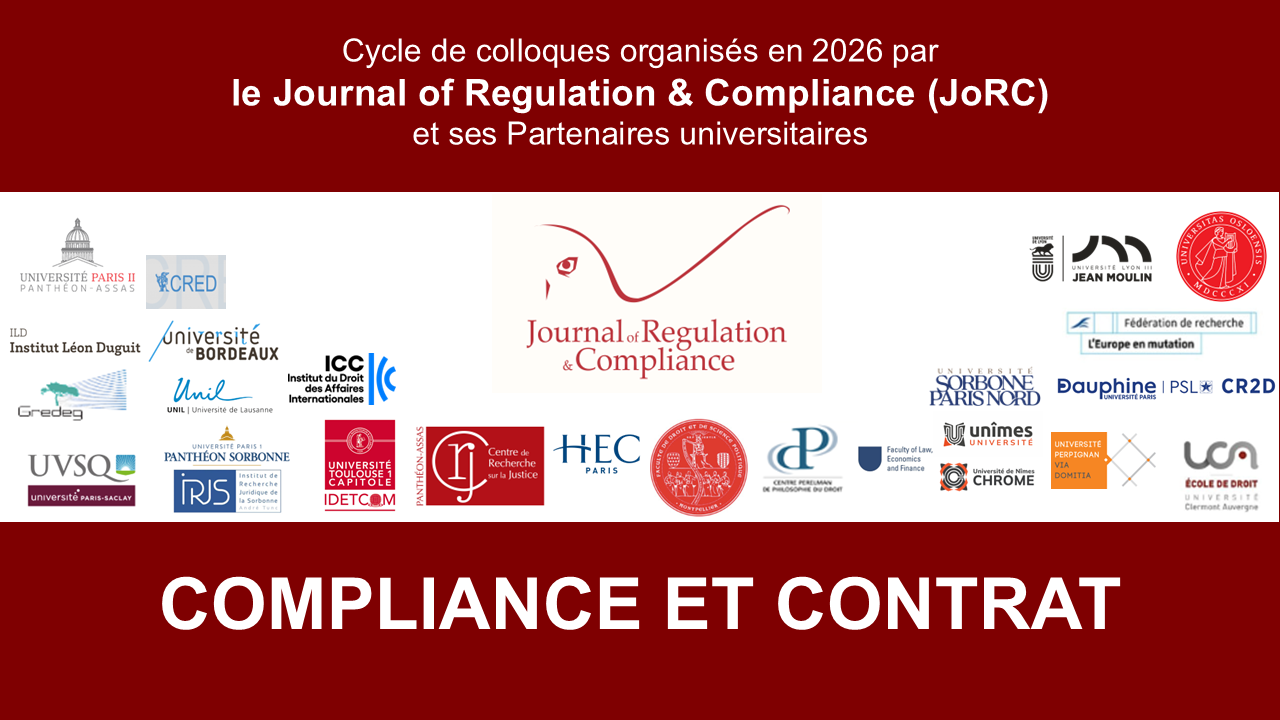
►Full reference : Journal of Regulation & Compliance(JoRC) and Jean Moulin University (Lyon 3), Contractual litigation in compliance: procedural and jurisdictional aspects, Jean Moulin University (Lyon 3), 29 May 2026.
Furthermore, compliance techniques are increasingly giving way to contractual mechanisms, either through "compliance contracts" or through "compliance clauses". This therefore gives rise to contractual disputes. These are also influenced by Compliance Law, notably its norative Monumental Goals, albeit indirectly rather than directly.
Thus, in various new ways, a new field of "contractual litigation involving compliance" is emerging. This field involves procedural and jurisdictional aspects, which will be examined during this event.
Firstly, it is necessary to define this contractual dispute involving compliance (I), which has only recently emerged, because although we have always been familiar with contractual disputes on the one hand, dispute over regulation and compliance in the second instance, their entanglement with the contractualisation of justice is new. This may even come as a shock, in that Compliance Law, because it is not at all simply an obligation to obey applicable regulations, carries with it systemic ambitions for the future and thus finds itself, through contracts, brought before judges who are more accustomed to disputes between two individual parties.
This opens up the topics of judges hearing cases and judges of nature (II), the parties to the dispute and the parties to the proceedings (III), procedural treatment (IV), judgement and its enforcement (V).
____
🕴️🕴️🕴️🕴️🕴️Speakers:
🎤Anaïs Danet, Professor at the University of Reims
🎤 Marie-Anne Frison-Roche, Professor of Regulatory Law and Compliance, Director of the Journal of Regulation & Compliance (JoRC)
🎤Nicolas Ida, Professor at the University of Haute-Alsace
🎤Alex Nicollet, Barrister at the Paris Bar, PhD student at Jean Moulin Lyon 3 University
🎤Cyril Nourissat, Professor at Jean Moulin Lyon 3 University
🎤Romain Raine, Senior Lecturer at Jean Moulin Lyon 3 University
🎤Fabrice Vert, First Vice-President of the Paris First Instance Court of Justice
🎤Liza Veyre, Professor at the University of Paris 8
____
The proceedings of this symposium will form the basis of a specific chapter in the following publications:
📕Compliance et Contrat, to be published in French in the collection 📚Regulations & Compliance, co-published by the Journal of Regulation & Compliance (JoRC) and Lefebvre-Dalloz.
📘Compliance and Contract, to be published in English in the 📚Compliance & Regulation Serie, co-published by the Journal of Regulation & Compliance (JoRC) and Bruylant (Larcier-Intersentia).
The European Directive of September 16th 2009 introduces a clear definition of electronic money and establishes a new prudential supervisory regime of the business of electronic money institutions.
In The Journal of Regulation the summaries’ translation are done by the Editors and not by the authors
ENGLISH
The European Commission issued a reasoned opinion on November 24th, 2011, to France and the Czech Republic demanding that those countries modify their legislation in order to comply with European regulation on renewable energies. If the modifications are not implemented in the upcoming two months, the Commission will open a case before the European Court of Justice.
FRENCH
La Commission européennea émis unavis motivéle 24 Novembre2011,concernantla Franceet la République tchèque,exigeant queces paysmodifientleur législationafin de se conformerà la réglementationeuropéennesur les énergies renouvelables.Si les modificationsne sont pasmises en œuvre dansles deuxprochainsmois, la Commissionouvrira uneprocédure devant la Courde justice de l’Union européenne
ITALIAN
Il 24 novembre 2011, la Commissione europea ha emesso una raccomandazione con cui richiede alla Francia ed alla Repubblica Ceca di modificare le proprie legislazioni in modo tale da conformarle alla regolamentazione europea in materia di energia rinnovabile. Se le modifiche non saranno introdotte entro i prossimi due mesi, la Commissione adirà la Corte di Giustizia Europea.