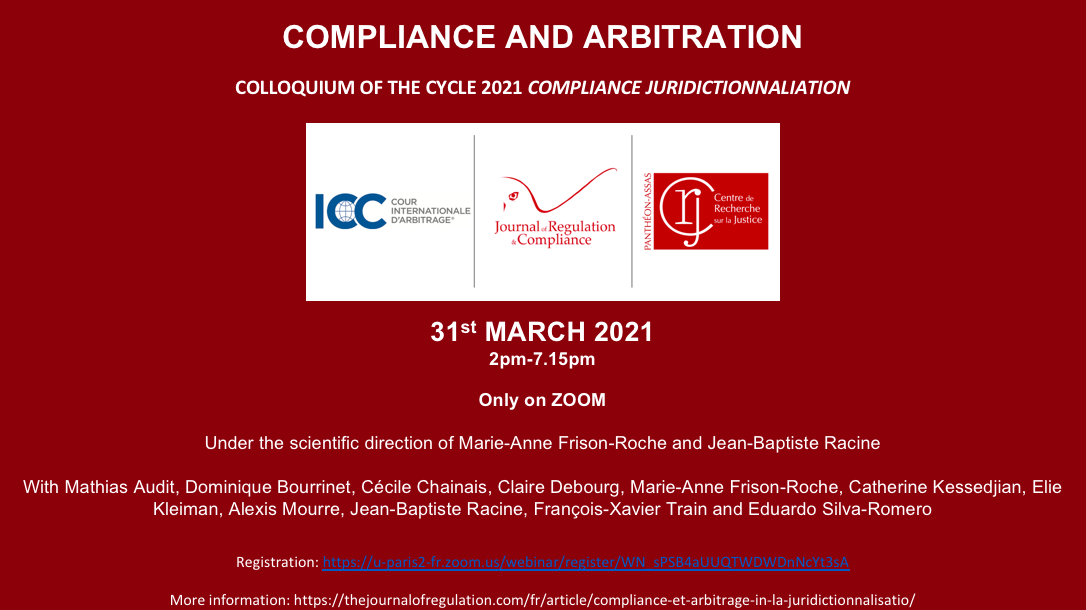
This colloquium took place the 31st of March 2021.
The manifestation was live broadcasted on Zoom.
Presentation of the theme:
The arbitrator is the ordinary judge of international trade. It was natural that he or she encountered Compliance: by definition Compliance Law takes hold of the whole world and follows the paths of international trade while it can only be deployed with the help of institutions which, by nature are spreading around the world and need authorities like the Courts.
The conference is based on the already perceptible connection points between Compliance and Arbitration to better identify what is emerging for tomorrow: contradiction or convergence between the two; weakening or consolidation. We are already seeing the impact that Compliance can have on the arbitrator's treatment of corruption or the consideration of money laundering. More generally, where do we stand with the arbitrator's knowledge of the many technical issues related to compliance? Beyond these, will the courts and arbitrators be able to achieve the goals, themselves new, sometimes monumental, pursued by Compliance Law?
Through this joint exploration of these avenues, the fate of compliance clauses inserted in contracts, the relevance in the matter of private codes of conduct, etc. will be examined.
Tomorrow, as of today, is the arbitrator a full and complete judge of Compliance Law?
How, with what specificities and what controls?
Notably will speak:
Mathias Audit, professeur à l'Université Panthéon-Sorbonne - Paris I (full professor at Sorbonne - University - Paris)
Cécile Chainais, director of the Centre de Recherche sur la Justice et le Règlement des Conflits (CRJ) and professeur à l'Université Panthéon-Assas (Paris II) (Full professor at Panthéon-Assas (Paris II) University)
Claire Debourg, professeure à l'Université Paris X- Nanterre (Full professor at Paris X - Nanterre)
Marie-Anne Frison-Roche, professeur à Sciences Po - Paris (Full Professor at Sciences Po - Paris)) and Director of the Journal of Regulation & Compliance (JoRC)
Catherine Kessedjian, professeur émérite de l'Université Panthéon-Assas (professor emeritus of Panthéon-Assas - Paris II University)
In The Journal of Regulation the summaries’ translation are done by the Editors and not by the authors
ENGLISH
Bibliographic Report (Book): Libéralisation et services publics : économie postale [Liberalization and Public Services: Postal Economics] by François Boldron, Claire Borsenberger, Denis Joram, Sébastien Lecou, and Bernard Roy.
The authors of Liberalization and Public Services: Postal Economics set out to provide a complete and comprehensive economic study of the challenges and possibilities engendered by the liberalization of the French Postal Service. Using experiences from other countries and industries, as well as taking into account the specificities of France’s postal service, the authors have used economic studies to provide an exhaustive account of what the contours of the postal service of the future may be.
ITALIAN
Relazione bibliografica (Libri) : Libéralisation et services publics : économie postale [Liberalizzazione e Servizi pubblici: economia postale] di François Boldron, Claire Borsenberger, Denis Joram, Sébastien Lecou, and Bernard Roy.
Gli autori di “Libéralisation et services publics : économie postale” (Liberalizzazione e Servizi pubblici: economia postale) cercano di predisporre uno studio economico completo e comprensivo delle sfide e delle possibilità generate dalla liberalizzazione del servizio postale francese. Utilizzando le esperienze di altri paesi e di altre industrie, e prendendo in considerazione le specificità del servizio postale francese, gli autori hanno usato studi economici per definire il possibile futuro del sevizio postale.
The cycle of conferences Les outils de la Compliance(The Compliance tools) began in November 2019 and runs until June 2020. It is organized by The Journal of Regulation & Compliance (JoRC) and all of its partner universities. It includes a conference more particularly devoted to the theme of "Les expertises requises dans l'Ex Ante de la Compliance" ("The expertises required in the Ex Ante of Compliance").
in the amphitheater of the Paris Chamber of Commerce and Industry
Friedland Avenue, 27, 75008 Paris
General Presentation
After examining various specific tools, such as Risk mapping or Incentives, these showing that the tools only have their efficiency through their use designed and carried out by human beings, endowed themselves with the required expertise. But it is often because it is very difficult to identify and define these "skills" that operators subject to the Ex Ante Compliance obligations end up entrusting this observance to machines, via Compliance by Design ...
The mass of what should actually be observed leads to favoring massification expertise, as the "Regtech" handle it. But the rules being a living thing, Company Law adjoins Governance and one must know both. In the same way as the mastery of Ex Ante supposes that one always thinks of Ex Post (sanction for failure in the Ex Ante), so that this Ex Post does not appear, under its unwelcome face of Repressive Law which therefore must be anticipated and therefore present in Ex Ante.
In the same way, Tax Compliance presupposes that the State must be present in the good technical conception of Compliance. Compliance being the means by which States internalize their "monumental goals", or even confront each other under the mask of companies, it is then international policies in question, and this political expertise is required in Ex Ante.
_________
under the scientific direction of Marie-Anne Frison-Roche, professor fo Regulatory Law Compliance Law at Sciences Po.
Summary of the news: Through its decision of 22nd of October 2020, the Autorité de la concurrence (French Competition Authority) accepted the commitments proposed by retail sector's firms Casino, Auchan, Metro and Schiever so that their agreement by which a common body centralizes purchases from numerous retailers, allowing each to offer these products under private label, is admissible with regard to competitive requirements.
In this particular case, the Authority had self-sized in July 2018, estimating that such a purchase center could harm competition, opening immediately a large consultation on the terms of the contract. In October 2018, the law Egalim permitted to the Authority to take temporary measures to suspend such a contract, what the Authority did from September.
The convention parties' firms committed on the one hand to update their contract limiting the power on suppliers, especially small and very small suppliers, excluding totally of the field of the contract some kind of products, especially food products and reducing the share of bought products volume dedicated to their transformation in distributor brand.
The Autorité de la concurrence accepts this proposal of commitments, congratulates itself of the protection of small suppliers operating like that and observe the similarity with the contract consisting in a purchase center between Carrefour and Tesco, which will be examined soon.
_____
We can draw three lessons of this innovating decision, which could be a model for after:
1. The technique of Compliance Law permits to the Autorité de la concurrence to find a reasonable solution for the future.
Indeed, rather than punishing much later by a simple fine or to annihilate the performing mechanism of the purchase center, the Authority obtains contract modifications.
The contract is structured and the obtained modifications are also structural.
The commitments are an Ex Ante technique, imposed to operators, for the future, in an equilibrium between competition, operators and consumers protection and the efficacy of the coordination between powerful operators.
The nomination of a monitor permits to build the future of the sector, thanks to the Ex Ante nature of Compliance Law.
2. The retail sector finally regulated by Compliance technics.
"Distribution law" always struggle to find its place, between Competition law and Contract Law, especially because we cannot consider it as a common "sector".
The Conseil constitutionnel (French constitutional court) refused a structural injunction power to the authority because it was contrary to business freedom and without any doubt ethics of business is not sufficient to the equilibrium of the sector.
Through commitments given against a stop of pursuits relying on structuring contracts, it is by Compliance law that a Regulation law free of the condition of existence of a sector could leave.
3. The political nature of Compliance law in the retail sector
As for digital space, which is not a sector, Compliance law can directly impose to actors imperatives that are strangers to them.
In the digital space, the care for fighting against Hate and for protecting private life; here the care for small and very small suppliers.
First of all, the Turkey and Niger signed June 12, 2012 a cooperation agreement for the development of telecommunications in Niger. It includes a program of cooperation between the two national authorities of regulation and provision of expertise on the part of the Turkish authority to the authority of the Niger. Secondly, it provides a system of training, so that operators entering the telephone and Internet market. Thirdly, the Turkey provides financial assistance to Niger that infrastructures are built, required for the deployment of a national telecommunications market.
In The Journal of Regulation the summaries’ translation are done by the Editors and not by the authors
ENGLISH
On July 28, 2011, the European Court of Justice rejected an appeal by an Italian digital terrestrial broadcaster against a ruling of the European General Court, which had also rejected an appeal against the European Commission’s condemnation of Italy for having subsidized the purchase or rental by consumers of equipment for the reception of digital terrestrial television broadcast signals, since this was an indirect provision of state aid to the broadcasters.
FRENCH
Le 28 juillet2011,la Cour de Justice de l’Union Européenne a rejetéun appel interjeté parun radiodiffuseuritaliennenumérique terrestrecontre une décisionde la Cour européennede première instance, qui avaitégalement rejetéun recours contrela condamnationprononcée par la Commission européennede l’Italiepour avoirsubventionné l’achatou la locationpar leconsommateurs d’équipementspour la réception detélévision numérique terrestredes signaux de télédiffusion, puisque cefutuneprestation indirecte, constitutived’aides d’Etat au bénéfice des radiodiffuseurs.
SPANISH
El 28 de juliode 2011, elTribunal Europeode Justiciarechazó una apelación deunemisor italianodigital terrestrecontra una resolucióndel Parlamento Europeo ydel Tribunal General,que había rechazadotambiénun recurso de apelacióncontra la condenade la Comisión Europeade Italia por habersubvencionado lacompra o el alquilerdelos consumidoresde los equipospara la recepción deseñales digitales terrestresde televisión, ya que estaera una disposiciónindirecta delas ayudas estatalesa las emisoras.
DEUTSCH
Am28. Juli 2011hatder Gerichtshofder EuropäischenUnioneine Beschwerdevon einem italienischendigitalen terrestrischenSenderzurückgewiesengegen eine Entscheidungdes EuropäischenGerichts Erster Instanz, die auchabgelehnthatteEinspruch gegen der Überzeugung,inder Europäischen KommissionItalien nachdemKauf oder Leasingvon derConsumer-Gerätenzum digitalen terrestrischenFernsehsignaleempfangensubventionierthaben, da es einindirekter Nutzenwar,um eine staatliche Beihilfefür Broadcaster.
ITALIAN
Il 28 luglio 2011, la Corte di Giustizia Europea ha respinto un appello di emittente italiana di digitale terrestre promosso contro una decisione della Corte generale europea. Anche tale Corte aveva respinto l’appello promosso contro la decisione della condanna dello Stato italiano per aver sovvenzionato l’acquisto o l’affitto da parte dei consumatori di un decoder, in quanto costituirebbe un aiuto statale indiretto alle emittenti.
On November 15, 2010, the Autorité de la Concurrence (the French Competition Authority) hosted a meeting on the theme of online gambling and the opening of the market to competition. The first debate concerned sports federations and betting rights.
FRENCH
Rapport bibliographique (Symposium): Symposium de l'Autorité de la Concurrence sur la régulation des jeux en ligne.
Le 15 novembre 2010, l'Autorité de la Concurrence a organisé un colloque sur le thème de la régulation des jeux en lignes et l'ouverture du marché à la concurrence. Le premier débat concernait les fédérations sportives et le droit au pari.
GERMAN
Bibliographischer Bericht (Symposium): Symposium der französischen Wettbewerbsbehörde über die Regulierung von Online-Wetten.
Am 15. November 2010 hat die Autorité de Concurrence (die französische Wettberwerbsbehörde) ein Symposium über die Regulierung von Online-Wetten und die Wettbewerseröffnung dieses Marktes veranstaltert. Im ersten Gespräch wurde das Thema Sportverbände und Wetterecht behandelt.
ITALIAN
Relazione bibliografica (Convegno): Il convegno dell’Autorità francese garante della concorrenza sulla regolazione delle scommesse on-line.
Il 15 novembre 2010, la Autorité de Concurrence (la Autorità francese garante della concorrenza) ospiterà un convegno sul tema delle scommesse on-line dell’apertura del mercato alla libera concorrenza. Il dibattito porterà sulle federazioni sportive e sul diritto a scommettere.
SPANISH
Informe bibliográfico (Simposio): El Simposio francés de la Autoridad de la competencia sobre la regulación del juego en la red.
El 15 de noviembre del 2010, la Autorité de la Concurrence (la Autoridad francesa de la competencia) organizó una reunión sobre el tema del juego en la red y el abrimiento de este mercado a la competencia. El primer debate se centraba en las federaciones deportivas y los derechos de juego.
CHINESE
书目报告(专题论丛):法国竞争监管机构对于网络游戏监管的讨论。
2010年11月15日,Autorité de la Concurrence(法国反垄断机构竞争事务监察总署)举办了一场以网络游戏监管及开放市场竞争为主题的研讨会。第一期讨论内容涉及与体育协会和赌博活动及其相关权利。


 to be published in the Compliance & Regulation Series , co published by the Journal of Regulation & Compliance (JoRC) and Bruylant.
