
Search results (624 cards)

March 5, 2020
JoRC
The cycle of conferences Les outils de la Compliance (The Compliance tools) began in November 2019 and runs until June 2020. It is organized by The Journal of Regulation & Compliance and all of its partner universities. It includes a conference more particularly devoted to the theme of "Measuring the effectiveness of Compliance Tools (Mesurer l'effectivité des outils de la Compliance)".
Conference and Debate
March, 5, 2020, 18h30-20h
in the Amphitheater of Panthéon-Assas (Paris 2) University,
391, rue de Vaugirard 75015 Paris
General presentation of the Conference
After having examined various specific tools, such as Risk mapping or Incentives, and before tackling others such as those falling under a "Compliance by Design", it also deserves to be examined with some distance in its claim to be the solution to any compliance issue, it is worth looking at how we measure the effectiveness of all these Compliance Tools. Indeed, since all techniques are "tools", they only take on meaning with regard to a purpose that they must effectively achieve. This effectiveness must be measured, and this immediately in Ex Ante, the company constantly having to show the effectiveness of the performance of the Compliance tools.
But at the same time as the standards proliferate, the discourses multiply, the commitments are made, the techniques for measuring the effectiveness of the whole seem quite weak. The subjects of law obliged by Compliance obligations or freely wishing to achieve the systemic or common good goals targeted by Compliance do wish to have these measurement instruments. But they seem still little built, often declarative or discursive, or too mechanical. Therefore, is it starting from the goal of Compliance that we must measure the effectiveness of the Compliance tools, without by this way transforming the tasks weighing (willingly or by force) on operators in obligation to result? Or is it by staying upstream, by a single "conformity" to what is asked of them, as behavior and as structural organization, that companies show that they have effectively fulfilled their task, without worrying about the effects products about the reality, this reality that those who designed the Compliance norms and standards had in mind?
This question has major implications in terms of burden of proof and responsibility, involving organizations which place Trust, the heart of Compliance, rather in technological instruments - only but so efficiency connecting data - or rather in people with a sense of common good. This question is now open.
Inscription : anouk.leguillou@mafr.fr
_________
Under the scientific direction of Marie-Anne Frison-Roche, full professof de Regulatory & Compliance Law at Sciences Po (Paris).
Articulate the instruments for measuring Effectiveness with the purposes of the Compliance tools (Articuler les instruments de mesure de l'effectivité avec les finalités des outils de la compliance)
Laurent Benzoni, full professor of Economics at Panthéon-Assas University (Paris 2) Paris Center for Law & Economics, president of TERA Consultants.
Freedom and constraints of the company in its implementation of measures of the effectiveness of compliance tools (Liberté et contraintes de l’entreprise dans sa mise en place des mesures de l’effectivité des outils de compliance)
Bertrand Bréhier, deputy head, Banking and Finaical Regulation Departement, Société Générale Group, associate professor Paris I University, Groupe Société Générale
Control by the Regulator of the effectiveness of compliance instruments implemented by the company (The contrôle par le Régulateur de l’effectivité des instruments de compliance mis en place par l’entreprise)
Maxime Galland, Director - Legal and International Cooperation at the Autorité des Marchés financiers - AMF (French Financial Markets Authority)
________
Read the registration procedure for this conference.
Consult the calendar of precedent and upcoming events.
Consult the presentation of the book to be published: Compliance Tools.
Go back to general presentation of the Conferences' cycle "Compliance Tools".
Inscription : anouk.leguillou@mafr.fr
_________

Updated: July 19, 2011 (Initial publication: July 1, 2011)
Books
Updated: Sept. 10, 2012 (Initial publication: June 28, 2012)
Sectorial Analysis

France
The Conseil d'État advises the Government on the preparation of bills, ordinances and certain decrees. It also answers the Government's queries on legal affairs and conducts studies upon the request of the Government or through its own initiative regarding administrative or public policy issues.
The Conseil d'État is the highest administrative jurisdiction - it is the final arbiter of cases relating to executive power, local authorities, independent public authorities, public administration agencies or any other agency invested with public authority.
In discharging the dual functions of judging as well as advising the Government, the Conseil d'État ensures that the French administration operates in compliance with the law. It is therefore one of the principal guarantees of the rule of law in the country.
The Conseil d'État is also responsible for the day-to-day management of the administrative tribunals and courts of appeal.

Feb. 20, 2015
Breaking news
Internet needs to be regulated, but by whom and from what criteria?
The high speed building of very different cases shows the urgency of reflections on the principles.
Consider the case in which just entered the British Regulatory Authority Advertising Standards Authority (ASA). Thiss Authority isn't specific to the Internet but the fact the behavior takes place on the Internet doesn't stop the Regulator, the ASA applying its control on "all media".
An Irish betting company organized bets about a future event: conviction or acquittal of Oscar Pistorus for the death of his fiancée. The latter doesn't deny being the author of the fatal blow but claims that he isn't responsible legally.
The website reproduces the accused of a very recognizable way in the form of an Oscar statuette. This is due to the homonymous first name and the statue of the reward. But this is also a triple ambiguity created by the company.
Secondly the statue can't walk as the athlete si one takes off his prosthetic that made him win races.
Thirdly and more than that, if convicted, he remains in prison, Oscar Pistorum would continue to be deprived of his freedom to come and go, and therefore still unable to "walk" freely, the betting firm indicating that it will reimburses money if the accused will "walk" (out of prison - as a sort of miracle ...).
_____
Watching that, more than 5,000 people protested. But before whom? In this excess of regulators, people turn to perhaps the most dynamic: in the UK it is probably the Advertising Standards Authority (ASA) .
But what to blame?
One could have said that it is illegal to bet on the outcome of a trial.
One could argue that you can't bet about a terrible history, whose center is the death of a young woman.
But it's rather toward the disability side and "minority rights" that the case is taking shape. Indeed, associations see it as primarily a mockery of people who can't walk.
Without further developed if the ASA takes a position on this advertising that the company has since removed, it will take a strong position in the regulation of the Internet and could for example clarify and prioritize the interests that must be respect in the virtual world.
Updated: Sept. 25, 2012 (Initial publication: March 2, 2010)
Sectorial Analysis
Main information
The Law of 9 February 2010 transforms the status of La Poste (the French Postal Service) into a Public Limited Company ({Société Anonyme}) from 1st March 2010 and organises postal activities, especially as relates to national and regional development programmes.
Updated: Sept. 19, 2012 (Initial publication: July 12, 2012)
Sectorial Analysis
Translated summaries
ENGLISH
France and Italy had subsidized rail alpine highway, but the project was behind schedule. Thus, an prolongation of governments support was necessary. The European Commission admittedit in its decision of 11 June 2012, because States are committed the concession will be effective on June 30, 2013 and mostly because this mode of transport will be an alternative to transporting goods.
FRENCH
La France et l’Italie avaient subventionné l’autoroute ferroviaire alpine, mais le projet a pris du retard. Ainsi, une prolongation du soutien des gouvernements était nécessaire. La Commission européenne l'a admis dans sa décision du 11 Juin 2012, parce que les États se sont engagés et que la concession sera effective le 30 juin, 2013, surtout parce que ce mode de transport sera une alternative au transport routiers par camions des marchandises.
Oct. 14, 2021
JoRC
►This scientific manifestation is placed under the scientific responsibility of Marie-Anne Frison-Roche and Lucien Rapp.
This manifestation is organized by the Journal of Regulation & Compliance (JoRC) and by the IDETCOM of Toulouse-I-Capitole University.
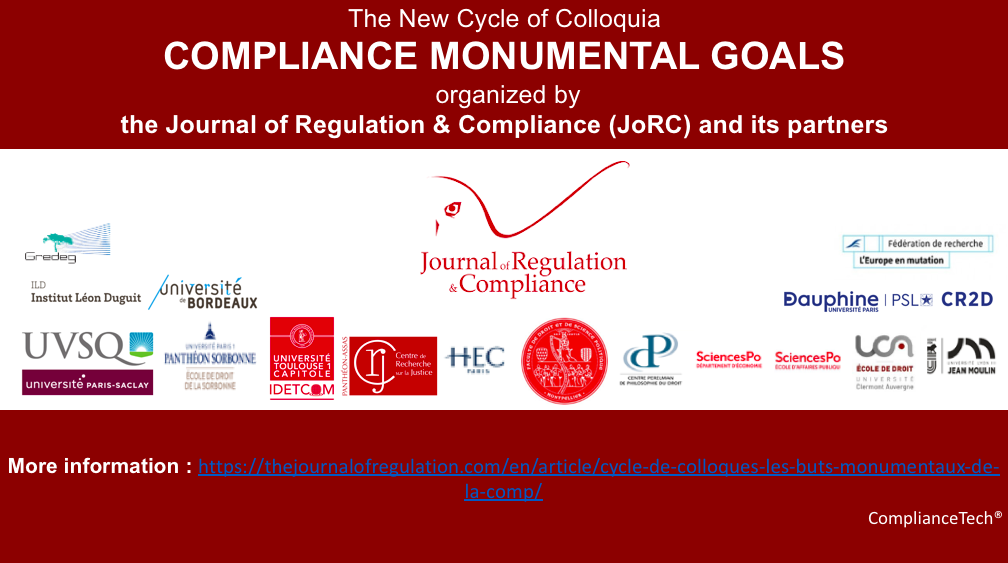
📅 This colloquium is part of the cycle of colloquia organized in 2021 around the general topic about Compliance Monumental Goals
____
► Interventions during this colloquium will be the base for a specific chapter in :
📕 Les buts monumentaux de la Compliance,  forthcoming in the series Regulations & Compliance, co-published by the Journal of Regulation & Compliance (JoRC) with Dalloz.
📘Compliance Monumental Goals, forthcoming in the series Compliance & Regulation, co-published by the Journal of Regulation & Compliance (JoRC) and Bruylant.
____
The colloquium will take place, a priori, on site in Toulouse, on October 14, 2021.
It will be broadcasted in live online.
🎥 Videos will be extracted.
► Presentation of the topic :
Compliance Law tends towards "Monumental Goals". This puts the concern, the calculation and the control of proportionality at the center. Proportionality is one of the most common references for compliance practices and strategies, but paradoxically, one of the least well defined. Perhaps even one of the most elusive.
For the German Federal Constitutional Court in Karlsruhe, the principle of proportionality allows the quantitative easing policies of the European Central Bank (ECB) to be monitored. This principle is linked to nothing less than the principle of democracy and is the basis of the control of ultra vires. In French law, proportionality refers to the provisions of Article 8 of the Déclaration des droits (Bill of Rights) of 1789, according to which the law should only establish penalties that are strictly and obviously necessary. In many areas of civil or business life, the compliance of behavior and the consequences of non-compliance are assessed on the basis of a graded assessment by the censor (competitor, regulator or judge).
Proportionality calls for action, which opens up a margin of appreciation to take into account the facts or circumstances. It also allows for the exercise of control over abuse of rights or excess of power. It goes beyond the office of the judge or the censor to forge one of its tools: the control of proportionality, which is obviously not the proportionality of the control.
How to integrate proportionality into compliance practices and strategies?
Does it introduce a certain tolerance in the assessment of situations and is it thus a factor of rediscovered freedom in the development of risk matrices?
Conversely, is it not synonymous with increased vigilance on the part of compliance officers, by leaving open the possibility of a reinforced control of their acts or decisions, by the evaluation of their advisability and not of their conformity alone?
► Working method:
🚧 The colloquium is built around 4 topics, which would be prepared in 4 working papers.
🚧 The writing of each working paper will have been entrusted by experts.
Secondly, these working papers will be available to be criticized by two practionners of Compliance technics.
For each topic, there will be these three sequences:
- Presentation of the topic by the author of the working paper ;
- Discussion by the two discussants, who will have read the working paper previously ;
- Discussion with the public onsite and online.
The four topics chosen are:
1️⃣ Proportionality and Conformity
2️⃣ Proportionality and Evaluation
3️⃣ Proportionality and Normativity
4️⃣ Proportionality and Sanction
► registrations and information :
- attendance to the manifestation is free, onsite or online
- every registration for an attendance onsite will be supported by Toulouse-I-Capitole University
- information will be available on a website opened by Toulouse-I-Capitole University
____
►Will speak, notably :
🎤 Marie-Anne Frison-Roche, professor of Regulation and Compliance Law, director of the Journal of Regulation & Compliance
🎤 Alexandra Mendoza-Carminade, professor at Toulouse-I-Capitole University
🎤Lucien Rapp, professor at Toulouse-I-Capitole University
🎤 Marc Segonds, professor at Toulouse-I-Capitole University
____
See the program below:

July 23, 2016
Breaking news
On 20 July 2016, the Conseil Supérieur de l'Audiovisuel (CSA- French "Independant Authority to Protect Audiovisual Communications Freedom") issued a press release in which it directly addresses to its Turkish counterpart.
Read the 20 July 2016 press release from the CSA.
The press release is short. Here is what it says: "Le Conseil supérieur de l'audiovisuel exprime sa vive inquiétude à la suite de la décision du Conseil suprême de la radio et de la télévision (RTÜK), le régulateur des médias en Turquie, de retirer leurs droits d'émission à de nombreuses radios et télévisions. Le Conseil appelle son partenaire de longue date au sein de la Plateforme européenne des instances de régulation (EPRA) et du Réseau des institutions de régulation méditerranéennes (RIRM) à ne pas mettre en cause la liberté de communication et le pluralisme des médias, garanties fondamentales d'une société démocratique." (courtesy translation: "The Conseil supérieur de l'audiovisual expresses its deep concerns following the decision of the Supreme Council for Radio and Television (RTÜK), the Turkish Media Regulator, to withdraw the broadcasting rights of numerous radios and televisions. The Conseil calls upon its long-time partner within the European Platform of Regulatory Authorities (EPRA) and the Mediterranean Regulation Authorities Network (RIRM) not to jeopardize the freedom of communication and media pluralism, which are fundamental guarantees in a democratic society").
The press release is entitled "Le CSA s'inquiète du retrait par le régulateur turc des droits d'émission de radios et de télévision" (courtesy translation: "The CSA worries about the decision of the Turkish Regulator to withdraw broadcasting rights to radios and televisions").
____
Isn't this surprising?
One would understand that the members of a Regulatory Authority, just as many people, would worry about what has been happening lately in Turkey. One can also share the view that these events might cause them to fear for the sake of public liberties and democracy in the country.
Should a Regulatory Authority express its "worry" though?
Shouldn't it be the Government's role instead, within the framework of its 'diplomatic relations' with the state and with the use of an appropriate vocabulary, to express any 'worry'?
First of all, this is a salient example of the ambiguity of the Audiovisual Regulator. Indeed, while it itself insists on the fact that it acts as an economic regulator of a sector whose development and innovation falls under its watch and monitoring (which namely justifies the fact that he reviews candidacies to the presidency of public televisions channels), the Conseil Supérieur de l'Audiovisuel had initially been created to preserve public liberties.
As such, people who still embrace the distinction that was previously assumed between public liberties regulation and economic regulation still consider the CSA - along with the CNIL - as the prototype of the former type of regulatory body.
Here the CSA expresses its "deep concern" and sends a request not to "jeopardize liberties", which is the polite version of an injunction, to a foreign regulatory authority upon which it has no authority whatsoever.
One can understand that the Regulator develops soft law about operators on which he has actual authority. But what about here? Shouldn't the adage Nemo plus juris apply?
How is the Regulator competent to issue 'releases' in which he formulates desiderata towards a foreign body whose behavior is unappealing to him? Shouldn't the Quai d'Orsay (French Ministry for Foreign Affairs) be in charge?
The Regulator took a political stance here, while it is known that a Regulatory Authority can only be legitimate when it stands as a technical authority; emphasizing on the political features of its job actually jeopardizes this legitimacy, all the more when international politics are involved (which is the case here).
However, the Regulator does preempt criticism in its press release:
It starts indeed by stating that it only expresses this sort of 'feeling' because of the old ties that exists between the French and the Turkish Regulators: it essentially considers that friends can be true to one another, express a few criticism and expect changes. Friendship in the digital media and in politics would allow for many things.
Besides, the CSA recalls the solidarity that prevails between the two regulators. Because they are "long-time partner within the European Platform of Regulatory Authorities (EPRA) and the Mediterranean Regulation Authorities Network (RIRM)", the French Regulator is enabled to express the Turkish Regulators its view on how it is jeopardizing democracy and how it should consequently stop.
Maybe the many ties that exists between the Regulators now enable them to give more or less stringent advice to one another, whereas diplomatic embassies now play an increasing economic role: how blur do the lines get!
Nov. 4, 2021
JoRC
This scientific event is part of the 2021 colloquium cycle, organized by the Journal of Regulation & Compliance (JoRC) and its Universities partners, around the general theme of Compliance Monumental Goals.
It is organized by the Journal of Regulation & Compliance (JoRC) and by the Paris Center for Law and Economics of the Panthéon-Assas University (Paris II).
This scientific event is placed under the scientific responsibility of Laurent Benzoni, Bruno Deffains and Marie-Anne Frison-Roche.
📅 The colloquium will take place in the Salle du Conseil (Panthéon-Assas University) on Thursday, November 4, 2021 from 1.30pm until 6.30pm.
🎥 The colloquium will be edited on video by the Journal of Regulation & Compliance.
Presentation of the topic :
Speakers:
🎤 Laurent Benzoni, professor of Economics at Panthéon-Assas University (Paris II), Tera Consultants
🎤Bruno Deffains, professor of Economics at Panthéon-Assas University (Paris II), director of the CRED
🎤 Marie-Anne Frison-Roche, Law professor at Sciences Po - Paris, director of the JoRC
🎤 Antoine Gaudemet, Law professor at Panthéon-Assas Université (Paris II), director of the Compliance Officer D.U.
🎤 Sabine Lochmann, CEO of Vigeo Eiris, Global Director of Moody’s ESG Solutions
🎤Frédéric Marty, economist, researcher at CNRS, member of GREDEG Côte d'Azur University
🎤 Stanislas Pottier, senior advisor to the General Management, Amundi
🎤 Jean-Christophe Roda, Law professor at Lyon 3 University
The different interventions will be then transformed into contributions in the books 📕 Les buts monumentaux de la Compliance and 📘 Compliance Monumental Goals which will be published in the Regulation & Compliance serie, jointly published by the JoRC and Dalloz for the French edition and by JoRC and Bruylant for the book in English.
Read a detailed presentation of the colloquium below: