The Hungarian Parliament voted a law on December 21st, 2010, which came into force on January 1st, 2011, according to which indirect government control over the media is made very tight. This intervenes at the exact same time that Hungary overtakes the rotating Presidency of the European Council. Hungary has now two weeks to put the law in conformity with European standards, otherwise, the European Commission will start legal proceedings against the country.
FRENCH
Fiche thématique (Media): la Hongrie vote une nouvelle loi sur les media qui pourrait violer la Charte des droits fondamentaux de l'Union Européenne.
Le Parlement hongrois a voté une loi le 21 décembre 2010, entrée en vigueur le 1er janvier 2011, qui rend le contrôle indirect des media par le gouvernement très strict. Cela intervient exactement au moment où la Hongrie prend la Présidence tournante de l’Union Européenne. La Hongrie dispose dorénavant de deux semaines pour mettre la loi en conformité avec les standards européens, sans quoi la Commission Européenne commencera une procédure contre le pays.
GERMAN
Thematischer Bericht (Medien) : Ungarn wählt ein neuen Mediengesetz, das gegen die Charta der Grundrechte der Europäischen Union verstoßen könnte.
Das ungarische Parlament hat am 21. Dezember 2010 ein Gesetz abgestimmt, das am 1. Januar 2011 in Kraft getreten ist, und das die indirekte Medienstaatsaufsicht strenger macht. Dies geschieht gerade als Ungarn die wechselnde EU-Präsidenschaft übernimmt. Ungarn verfügt uber zwei Wochen, um das Gesetz vertragsgemäß zu machen. Ansonsten wird die Europäische Kommission ein Verfahren gegen Ungarn einleiten.
SPANISH
Informe temático (medios de comunicación): Hungría vota una nueva ley sobre los medios de comunicación, lo cual podría infringir sobre la carta de derechos fundamentales de la Unión Europea.
El Parlamento húngaro votó una nueva ley el 21 de diciembre del 2010, lo cual entró en vigencia el 1ero de enero del 2011, en donde se estipula que los medios indirectos de comunicación del gobierno serán sujetos a un control más estricto. Este suceso ocurre en el mismo instante que Hungría toma la Presidencia del Consejo Europeo. Hungría ahora tiene dos semanas para armonizar esta ley con los estándares europeos, y si falla en este intento, la Comisión Europea comenzará un procedimiento legal contra este país.
ITALIAN
Relazione tematica (Mass-media): l’Ungheria adotta una nuova legge in amteria di mass-media che potrebbe essere contraria alla Convenzione europea dei diritti umani
Il 1° dicembre 2010, il parlamento ungherese ha adottato una nuova legge, entrata in vigore il 1° gennaio 2011, la quale prevede un controllo stringente ed indiretto del governo sui mass-media, al contempo l’Ungheria lascia la Presidenza del Consiglio europeo. Restano due settimane all’Ungheria per conformarsi agli obblighi dettati dagli standard europei, altrimenti la Commissione Europea comincerà una procedura a livello europeo contro lo Stato.
PORTUGUESE
Informe temático (meios de comunicação): A Hungria adota nova lei sobre meios de comunicação, a qual poderia violar a Carta de Direitos Fundamentais da União Europeia.
O Parlamento húngaro adotou uma lei no dia 21 de dezembro de 2010, que entrou em vigor em 1° de Janeiro de 2011, na qual se prevê que o controle indireto dos meios de comunicação pelo governo passará a ser mais rigoroso. Este fenômeno ocorre no mesmo instante em que a Hungria assume a Presidência do Conselho europeu. Este país agora tem duas semanas para adequar esta lei aos parâmetros europeus e, se falhar nesta tarefa, a Comissão Europeia poderá iniciar uma ação judicial contra este país.
Commission decision of 20.12.2011 on the application of Article 106(2) of the Treaty on the Functioning of the European Union to State aid in the form of public service compensation granted to certain undertaking entrusted with the operation of services of general economic interest
The American Supreme Court accepted on November 29th, 2010, to hear Microsoft’s claims in an appeal of a decision of the U.S. Court of Appeals of the Federal Circuit in Washington of December 12th, 2009, arguing that the burden of proof is too high for companies accused of infringement and whose defense is that the patent is not valid.
FRENCH Fiche thématique (Innovation) : L’organisation de la charge de la preuve dans les cas de propriété intellectuelle actuellement en instance devant la Cour Suprême américaine.
La Cour Suprême américaine a accepté le 29 novembre 2010 de recevoir la plainte de Microsoft en appel d’une décision de la Cour américaine d’appel du circuit fédéral de Washington du 12 Décembre 2009. Selon Microsoft, le standard de preuve pour une entreprise accuse de contrefaçon soutenant que le brevet violé n’est pas valide est trop élevée.
GERMAN Thematischer Bericht (Innovation): Die Zuteilung des Beweislasts in Patentverletzungsfälle steht vor dem amerikanischen Obergericht.
Das Amerikanische Obergericht hat am 29. November 2010 Microsofts Klage in einer Anfechtung einer Entscheidung des amerikanischen Bundesberufungsgerichtes in Washington vom 12. Dezember 2009 angenommen. Microsoft behauptet, dass der Beweislast für Unternehmen, die wegen Patentverletzung angeklagt wurden, und die die Ungültigkeit des Patents beweisen wollen, zu schwer ist.
SPANISH Informe Temático (Innovación): La organización de la carga de la prueba de casos de propiedad intelectual actualmente pendientes ante la Corte Suprema de los EEUU La Corte Suprema de los EEU aceptó el 22 de noviembre del 2010 escuchar reclamos de Microsoft en una apelación de la decisión de la Corte americana de Apelaciones del Circuito Federal en la capital de Washington el 12 de diciembre del 2009, argumentando que la carga de prueba era demasiada alta para compañías acusadas de violación y cuyas defensa es que el patente es inválido.
ITALIAN
Relazione tematica (Innovazione): L’onere della prova in material di proprietà intellettuale dinanzi alla Corte suprema degli Stati Uniti
Il 9 novembre 2010, la Corte suprema degli Stati Uniti d’America ha accettato di pronunciarsi su una decisione della Corte d’appello federale di Washington resa il 12 novembre 2009 contro Microsoft. Quest’ultima sostiene che l’onere della prova che spetta alle compagnie accusate di violazione dei diritti in materia di proprietà intellettuale é eccessivo nel caso in cui il convenuto tenti di dimostrare che il brevetto non sia valido.
PORTUGUESE Informe Temático (Inovação): A distribuição do ônus da prova nos casos de propriedade intelectual atualmente pendentes perante a Corte Suprema nos Estados Unidos da América
A Corte Suprema dos Estados Unidos da América decidiu, no dia 22 de novembro de 2010, conhecer das alegações de Microsoft no recurso contra a decisão do Tribunal americano de Apelação do Distrito federal de Washington de 12 de dezembro de 2009. Em seu recurso, Microsoft alega que seria muito elevado o ônus da prova para companhias que, acusadas de contrabando, argumentam que a patente violada não seria válida.
The translated summaries are done by the Editors and not by the Authors.
ENGLISH
“Global Financial Integration, Thirty Years on. From reform to crisis”
combines many academic contributions on international financial
governance, that each offer original and in-depth analysis of the
financial crisis’ causes. To safeguard the authors’ legal and economic
reasoning, the bibliographical report has been divided in three parts
and will be brought to The Journal of Regulation’s readers in three
successive issues . The following report analyses the third part of the
volume.
In The Journal of Regulation the summaries’ translation are done by the Editors and not by the authors
ENGLISH
The current worldwide economic downturn has strongly impacted nearly every countries all over the world. Thus, in order to avoid any further global financial crisis, governments have to restructure their financial supervisory mechanisms. While many states in the western world started to reform their supervisory frameworks, a small post-communist country developed a very interesting and uncommon model. Indeed, Georgia decided to simplify its financial supervisory architecture by transfering all regulatory and supervisory powers to its central bank.
FRENCH
L’actuelralentissement économique mondialafortement impactépresque tous lespaysdu monde entier.Ainsi, afin d’éviter toute autrecrise financière mondiale, les gouvernements ontà restructurer leursmécanismes de supervisionfinancière.Alors quede nombreux Etatsdans le monde occidental ont commencé àréformer leurssystèmes de surveillance, un petitpays post-communistea développé un modèletrès intéressant etrare.En effet, la Géorgiea décidé de simplifierson architecturede supervision financièreen transféranttous lespouvoirs de réglementationet de surveillance desa banque centrale.
SPANISH
El sector financiero georgiano emergió de la crisis global financiera y el declive económico doméstico en una condición sustancialmente positiva, y por lo tanto, en el contexto económico actual, merece atraer un interés mundial.
ITALIAN
L’attuale rallentamento dell’economia mondiale ha avuto un impatto su quasi tutti gli stati del mondo. Così, per evitare una nuova crisi finanziaria globale, i governi devono modificare i propri meccanismi di supervisione finanziaria. Mentre molti stati occidentali hanno iniziato le riforme delle loro strutture di supervisione, un piccolo paese ex-comunista ha sviluppato un modello interessante e poco diffuso. In effetti, la Georgia ha deciso di semplificare la sua struttura di supervisione finanziaria trasferendo tutti i poteri di regolazione e supervisione finanziaria alla sua banca centrale.
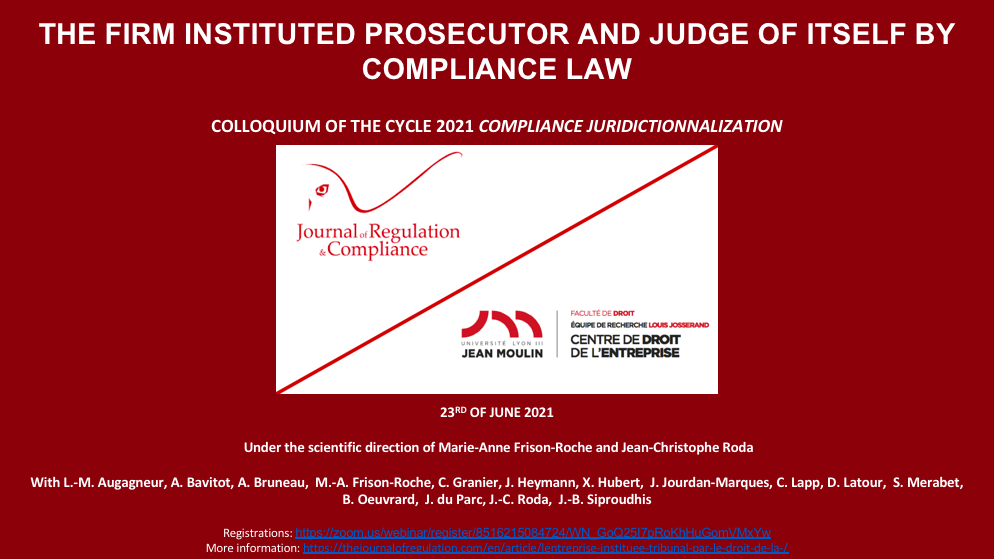
►This scientific manifestation is placed under the scientific responsibility of Marie-Anne Frison-Roche and Jean-Christophe Roda. It is organized by the Journal of Regulation & Compliance (JoRC) and the Centre de Droit de l'Entreprise of Lyon 3 University.
► Presentation of the topic: Initially, it was through Criminal Law, inseparable from the trial, which forced companies to take charge of monitoring within themselves behavior likely to be deviant, the requirement of Ex Ante to be designed by the 'Ex Post of the jurisdictional. From this reversal of things, there has always remained this presence of the judge and the prosecution bodies in a Compliance Law which is nevertheless defined by its concern for the future and the Ex Ante tools within the company.
In doing so, the company becoming on the one hand a judge of itself, on the other hand a prosecutor of itself, it splits up, taking in reverse the most established procedural principles. Moreover, because of the monumental goals which constitute Compliance Law, companies become attorneys and judges of the others, or for the others, the cutting machines and the "supreme courts" being by name instituted to regulate in Ex Ante all different before that it does not become litigation. The Ex Ante of Compliance would then make the Ex Post disappear.
► Method:
The colloquium which had to take place initially on 8th of April has been postponed to 23rd of June to enable speakers to meet and talk in face to face, with a limited audience.
These exchanges will be captured so that third parties can benefit from them, even before the publication of the works, La Juridictionnalisation de la Compliance and Compliance Juridictionalization, within which this work constitutes the basis for the development of a specific chapter.
Five practical cases will first be examined in five specific sectors, where this institution of the firm as prosecutor and judge of itself is particularly observable before both specific and more cross-sectoral themes are examined and discussed.



 to be published in the Regulation & Compliance series, jointly published by the Journal of Regulation & Compliance (JoR)C and Dalloz