The theme of the relationship between regulation and innovation finds every day new illustrations. The example of the drone is particularly noteworthy.
Indeed, the drone is a technical object that moves in the air without being driven in an immediate way by the hand of man.
The legal mechanism of qualification brought the drone in the category of "aircraft" and submit it to the regulatory power of the civil aviation regulator.
The regulation of civil aviation is primarily a safety regulation, not a regulation of the sector's economic deployment.
This is why regulators have taken restrictive positions on drones used for commercial purposes, to the extent that the presence of human beings, most the pilots, are the condition for the safety of people. The fact that the drones fly with "no one" led to consider as a danger a prior, which led regulators to take restrictive measures on flying drones for commercial purposes, restricton consistent withthe regulator's intervention criteria, without taking into account external rules, such as the protection of privacy.
But whatever the sector, regulators see themselves increasingly as economic regulators. If we adopt this perspective, a restrictive approach appears to be nonsense.
In the interests of balance in both approaches, the safety of people and the economic development through innovation, the US civil aviation regulator, the Federal Aviation Administration is developing new rules.
February 11, 2015, Federal Aviation Administration raised the need for a legal framework for commercial drones. The reason for this is economic. As it writes: "It is anticipated that this activity will result in significant economic benefits". Indeed, Article 333 of the 2012 ACT of modernization and reform imposes registration procedure for every commercial unmanned flying object in the sky!footnote-28. But this hinders business development, and therefore the incentive to technical innovation drone.
It was necessary to find a balance between security of persons and lifting of barriers to economic development. This is why the FAA will distinguish between "small" and other drones. The former are particularly useful in agriculture. To the extent that the former do not constitute danger to persons, an exemption from this procedure (Article 333 exemption) may be given concerning them.
One can analyze this evolution of air Regulation in two ways. First, it is for air regulator to take into account fundamental innovation of flying machines with "no one": innovation will be the base of a huge market for which strict regulatory rules could have been the troublemaker. The consideration of the safety of people remains since only drones "small" are allowed. In addition, they will have to remain at low level and away from airports and housing.
Second, the Regulator reacts by pragmatism. The ban on commercial flight drones hasn't prevented investment in this area. So far, the regulator had instead chosen not to react to the open violations of the standards, from the moment that the safety of the people wasn't in danger. The idea of the new conception is to promote this new market by putting the rules protecting the physical safety of people.
We hardly listen to to sermons. This is probably why Alain Supiot puts us on the table the text of Bossuet only occupying few pages, but since 1659 occupies the minds on "l'éminente dignité des pauves" (the eminent dignity of the poor). When Bossuet speaks of wealth and poverty, economists have interest in reading it. When Bossuet speaks of just order and "rightful place", lawyers must read it.
Alain Supiot comments it by writing to the following "Le renversement de l'ordre du monde" (The reversal of the order of the world).
Bossuet reminds that wealthy people think everything is owed to them while grace is given to the poor. Bossuet contends that rich people have interest to share with the poor, for thus it can alleviate the wealth that overwhelm them and they can enter the community (composed by the Church) in which poor people occupy the first place by natural order.
In his study, Alain Supiot looks back on the very definition of 'poverty', which accounts for the money the individual has. He takes up the theme of Bossuet to assert that, contrary to what the result of statistical methods (how much per person per day), the wealthy are "poor" since the market isolates them, spreading them of solidarity. Yet the natural order should lead them to share, by paying taxes, and other mechanisms through the welfare state. But he notes that the State departs increasingly this function, drawn in by this model only wealthy (the "rich-poor"), the only available model becoming what Alain Supiot calls "le marché total" (total market)!footnote-15.
We can no share this view of the world, for example if it is believed that the rich share (Social Responsibility Company theory), or if one believes that the state - sort of church - was often selfish, but already listen to the first advice: read Bossuet.
Reading the press, for example Les Echos January 16, 2015, we learn that Standard & Poor's will sign an agreement of $ 1 billion with the US administration to avoid a trial.
One can only be amazed or even upset.
First, the agreement is not yet concluded. It would be in a month or two. How is it that we already know? Secondly, contracts, because the transaction is a contract listed by the Civil Code, are not intended to be public. How is it that we already know everything? The person who gave the information "was keen to remain anonymous." It would have suspected ......
Third, it is true that the regulation of rating agencies is a big issue. Special texts have been taken but academics think the right tools stay missing and that is probably the liability, general legal instrument, which is the most appropriate.
But the responsibility of commitment requires a trial, evidence, respect for the rights of defense, due processs, legality of offenses and penalties.. Here, $ 1 billion is paid by the company only to avoid that opens a lawsuit against it. The allegation is the rating agency would have underestimated the subprime risk.
But on one hand everyone says that the rating agency has actually done the facts allegued since payroll so that the file doesn't open. On the other hand, and from the perspective of regulating the information that would be out of the trial, a trial being a form of crisis, will not come out.
So this sort of industry fof "Deals of Justice", apart from the fact that some describe the phenomenon as a "racket", isn't a "decriminalization" of regulation for a "civilized regulation" through the transaction contract. On the contrary, this movement that is spreading constitutes an increased repression whic diminishes rights of defense for the operator and information for the sector.
"Phishing" is a kind of cyber criminality aiming to obtain, by sending fraudulent emails which look like to those sent by legitimate organisms, recipient's personal information in order to impersonate or steal him or her. As it is difficult to find the authors of "phishing" and to prove their intentionality in order to punish them directly, on mean to fight against "phishing" could be to entitle banks to secure their information network and, to accompany this obligation with a strong incentive, to convict them to reimburse the victims in case of robbery of their personal data.
In 2015, a client victime of this kind of fraud asked to his bank, the Crédit Mutuel, to reimburse him the amount stole, what the bank refused to do on the grounds that the client committed a fault, transferring its confidential information without checking the email, however grossly counterfeit. The Court of first instance gave reason to the client because although he committed this fault, he was in good faith. This judgment was broken by the Chambre commerciale de la Cour de cassation (French Judicial Supreme Court) by a decision of 1st of July 2020 which states that this serious negligence, exclusive of any consideration of good faith, justifies the absence of reimbursement by the bank.
___
From this particular case, we can draw three lessons:
The Cour de Cassation states that good faith is not a salient criterion and that, as the bank must react when a banking account is objectively abnormal, the client must react face to an obviously abnormal email.
The Cour de Cassation describes the repartition of proof burden. Proof obligations are alternatively distributed between the bank and its client. First, the bank must secure its information network but, secondly, the client must take every reasonable measure to preserve its safety. It results from this that, if the email seems normal, phishing damages must be supported by the bank, and more generally of by the firm, while if the email is obviously abnormal, they must be supported by the client, but the burden to prove the abnormality of the email must be supported by the firm and not by the client.
Such a proof system shows that Compliance Law includes a pedagogic mission by educating each client in order to he or she would be able to distinguish among his or her emails, those which are normal and those which are obviously suspect. This pedagogic dimension, with the legal consequences associated to it, will not stop to spread.
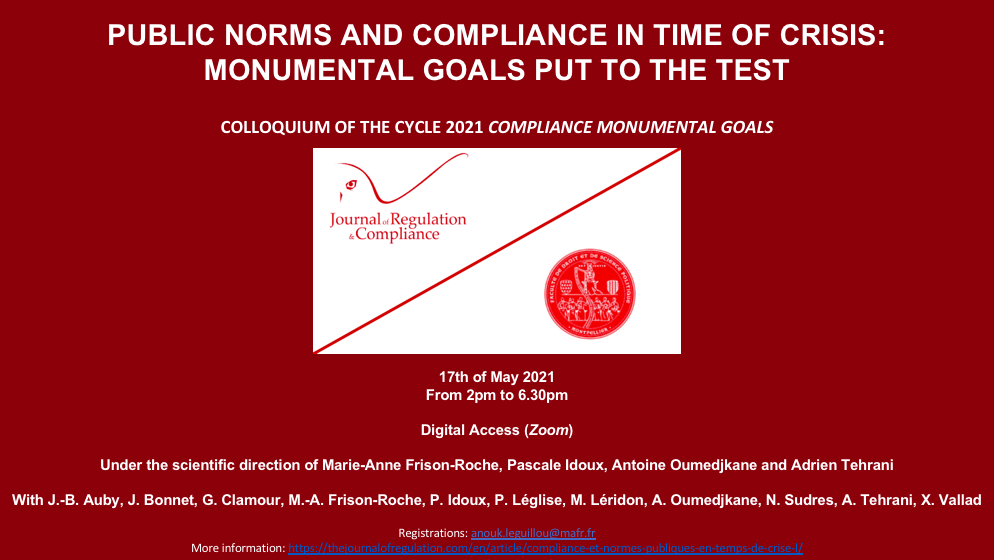
This manifestation took place on Zoom on 17th of May 2021.
Registrations: anouk.leguillou@mafr.fr
Assistance to this event may be validated as part of the continuing education of lawyers.
In addition, scientific videos will be extracted and disseminated later.
Presentation of the topic: In the overall problematic of "Monumental goals", this conference retains a particular case: that of the crisis and the emergency situation that it generates.
First of all, in general, does the importance of public norms in the emergency context engendered by a crisis situation imply a marginalization of Compliance? Don't private actors also have their place in these circumstances, at the service of the "monumental goals" that the public authorities want to maintain, or even which appear specifically?
Secondly, more concretely, we have been living for many months in a health crisis. By taking it as a framework and, within it from particular cases, how public and private actors react, act, adjust? and how do the courts assess these movements?
Going from the most general to the most specific, this conference aims to identify criteria, limits, of what could be specific rules when the emergency of a crisis meets Compliance, and will examine specific situations.
Working method: The conference is therefore built on a general issue, which was the subject of a "working paper", written by Antoine Oumedjkane, Adrien Tehrani and Pascale Idoux, on which the speakers will have thought in advance and from which they are intended to study the question from their particular perspective.
The conference, which is essentially interactive, therefore begins with an outline of the main lines of this general work. It is followed by the examination of concrete practical cases.
They are as follows:
1️⃣ hydro-alcoholic gel, its manufacture, price, availability,
2️⃣ information and regulation on all media in Covid period
3️⃣ the use of the bicycle during the state of health emergency
A first conclusion, thematically limited, will relate to Revealed by the crisis situation, the place of private initiative in Compliance Law.
A second, more general, undoubtedly open-ended conclusion is drawn from this confrontation between general reflection and concrete cases which must be resolved in a particular crisis.
🎤 Marie-Anne Frison-Roche, agrégée des Facultés de droit, Professor of Regulation and Compliance Law at Sciences Po (Paris) and Director of the Journal of Regulation & Compliance (JoRC)
🎤 Pascale Idoux, Professor at Montpellier University
🎤 Pascale Léglise, adjointe au directeur des libertés publiques et des affaires juridiques (Deputy Director of Civil Liberties and Legal Affairs) of the Ministère de l'intérieur (Home Ministry)
🎤 Michèle Léridon, Member of the Conseil supérieur de l'audiovisuel (French Media Regulator), President of the working group Pluralisme, déontologie, supervision des plateformes en ligne (Pluralism, Deontology, Supervision of Online Platforms)
🎤 Antoine Oumedjkane, Researcher of the Centre de recherche et d'études administratives (Research and Administrative Studies Center) of Montpellier University
🎤 Nelly Sudres, Maître de conférences at Montpellier University and member of the Centre de Recherches et d'Etudes Administratives (Research and Administrative Studies Center) of Montpellier University
🎤 Adrien Tehrani, Professor at Montpellier University and member of the Centre du Droit de l'Entreprise (Company Law Center)
The Journal of Regulation’s annual symposium on March 17, 2011 examined the theme of Neutrality in systems of economic regulation. After preliminaries on the definition of neutrality and neutral action, which were the common theme linking all speakers’ contributions, the first part of the colloquium explored the general aspects of neutrality in regulated industries, such as the neutrality of standards or the relationship between neutrality and legal categories, impact studies, or procedural techniques. The second part of this event raised more specific points, such as the interference between neutrality and the globalization of regulated industries, the question of regulators’ neutrality, and of net neutrality that some regulators wish to raise to the level of a general principle.
SPANISH
Informe bibliográfico (Simposio): La neutralidad en los sistemas de regulación económica
El simposio anual de la Revista de Regulación que se llevó a cabo el 17 de marzo del 2011 examinó el tema de Neutralidad en sistemas económicos de regulación. Después de algunos preliminares sobre la definición de la neutralidad y la acción neutral, los cuales fueron temas comunes en las contribuciones de los diferentes actores presentes, la primera parte del coloquio exploró los aspectos generales de la neutralidad en las industrias reguladas, como la neutralidad de los estándares o la relación entre la neutralidad y las categorías legales, estudios de impacto, o técnicas de procedimiento. La segunda parte del evento alzó cuestiones específicas, como la interferencia entra la neutralidad y la globalización de industrias reguladas, la cuestión de la neutralidad de diferentes reguladores y la neutralidad de la red, lo cual algunos quieren alzar a nivel de principio general.
There was a time when the key was in the rule. Today is essentially in the effectiveness of the rule. What the English and Americans call: Enforcement.
When operators are very powerful and regulators have little information, when the rule is complex, when situations are always changing and diverse, most of the regulatory art focuses on enforcement.
It shows a little more the continuum between Ex ante and ex post, moreover the circularity between them.Not only sanction is necessary ex post to the regulatory body for the rules that it asked ex ante have an effectiveness, but conversely, if we want that breaches the rule that powerful operators are committed could be sanctioned, it is through the Ex ante they must be punished.
Thus, when a financial operator wants to raise funds in the US financial market, he must request authorization from the Regulator to do so or at least to declare beforehand. It is therefore an Ex Ante mechanism. But if the operator is trustworthy, then it can be a kind of privilege that allows him to raise funds without submitting to the heavy and lengthy procedure. It takes but just whether trusted opérator.
However, Reuters reported the next development by the SEC guidelines for applying its power to withdraw the exemption to operators which had broken the law, civil or criminal.
While this may be explained by the fact that these operators have shown they don't deserve the confidence that justified access to the status of "well-known seasoned issuer" (WKSI) offering this "privilege" exempting regulation.
This is especially a new crackdown. The withdrawal of that relief proceedings valuable to the operator who regularly raises funds on the market, making him reach the common lot of borrowers, making carrying a disadvantage compared to operators who respect the law and shall remain holders of "bureaucratic privilege".
In a regulation in which repression becomes the central arrow in the quiver, here is an acute .
It begs the question: claiming that it is within the Ex Ante, can the regulator be dispensed to apply the rights of the defense?



 to be published in the Series Regulations & Compliance , co-published par the Journal of Regulation & Compliance (JoRC) and Dalloz.