The European Court of Justice upheld German regulations on Bovine Spongiform Encephalitis (BSE, or ‘mad cow disease’) testing, which were more stringent than those required by the European Union, on the grounds that Member States are alone legitimate to determine the level of public health protection they guarantee their citizens.
Airports are critical infrastructure. They often receive support from the State and the European Commission has adopted specific guidelines to soften the principle of prohibition of State aid in this area. Yet it is not necessary that the regulation be the mask of a violation of competitive equality. This is why the Commission has extended and prolonged on June 27, 2012, the investigation initiated in 2007 proposed to the airport of Alghero, Italy. Indeed, the investigation revealed including infrastructure subsidies, which the Commission doubt that they are comply with EU law.
In regulating more than anywhere else, the most important is the time.
Operators can't endure uncertainty. The uncertainty of the litigation is probably the worst weapons that the controller can turn against them. So much so that The Economist, in its issue of August 30, 2014 estimated that US regulators have transformed the repression organized racket, operators to pay for stop procedures, the fact that they are right or wrong is no longer the issue.
Seen in banking and finance, seen here in telecommunications.
In July 2014, the Federal Trade Communication opens proceedings against T-Mobile, a subsidiary of Deutsche Telekom, for charging customers for services provided by external providers, unsolicited services. The company had immediately claimed not to have breached the rules.
Then, a first calculation of the prejudice of consumers has been calculated. Each subscriber aspiring to claim a possibly unwarranted addition of about $ 10 a month for many years, the amount of damages was very high , for example in connection with a class action.
The company chose to stop there and have a settelment for $ 90 million, attributable in part to consumers, but also to different states, also paying a transactional fine to the US federal treasury.
The case is therefore financially resolved. The Federal Communications Commission commented on the agreement stating that overcharging is "a major problem" for consumers.
The case has been conducted for this operator as it has been for AT & T in October 2014, concluding a similar agreement for $ 105 millions.
____
Should we rejoice or not?
One will rejoice if one believes that the key is to close the file and enable the company to return to its business.
The reference may be regrettable if we think:
Punishment must remain a matter for the courts;
The accused persons, even if they are companies, need time for the defense ;
Regulatory Law must issue rules and interpretations of the texts, the law is depleting by agreements that close the litigation, the main objective being ... never reach the judge.
The European Parliament vetoed the agreement between the European Union and the United States on the transfer of financial data from the SWIFT network, on the grounds that such transfers violate privacy rights and are disproportionate to their aim of fighting terrorism.
Michel Prada is a graduate of the Institut d’Etudes Politiques de Bordeaux (Sciences Po Bordeaux) and the Ecole Nationale d’Administration (ENA). From 1966 to 1970, he was an Inspecteur des Finances. (...°
Thematic Report (Energy): The Swiss Federal Administrative Tribunal ruled on July 8th, 2010, that ElCom, the Swiss energy regulator, had overridden its powers in its decision of March 6th 2009. In a decision of July 8th 2010, the Bundesverwaltungsgericht (the Swiss Federal Administrative Tribunal) partially amended a decision of the Eidgenössiche Elektrizitätskommission (ElCom, the Swiss Federal Electricity Commission), stating that it is unconstitutional and illegal for power-plant operators to bear the price of “system-services”.
FRENCH
Fiche thématique (énergie) : Le tribunal fédéral administratif suisse a rendu un arrêt le 8 juillet 2010 contre une décision du 6 mars 2009 de l'ElCom, le régulateur suisse de l'énergie, pour excès de pouvoir
Dans un arrêt du 8 juillet 2010, le Bundesverwaltungsgericht (le Tribunal Fédéral Administratif suisse) a partiellement annulé une décision de l'Eidgenössiche Elektrizitätskommission (ElCom, la Commission fédérale suisse de l'électricité), déclarant qu'il est anticonstitutionnel et illégal que les opérateurs des centrales électriques supportent le coût des "services systémiques"
GERMAN
Thematischer Bericht (Energie): das schweizerische Bundesverwaltungsgericht hat am 8. Juli 2010 die Verfügung der ElCom, die Eidgenössische Elektrizitätskommission, die Schweizer Regulierungsbehörde für Elektrizität, vom 6. März 2009 für ungültig erklärt.
In einer Entscheidung vom 8. Juli 2010 hat das Schweizer Bundesverwaltungsgericht eine ElCom-Verfügung vom 6. März 2010 zum Teil für ungültig erklärt, da die in der Verordnung vorgesehene Anlastung der Systemdienstleistungskosten an die Kraftwerke gesetzeswidrig ist.
SPANISH
Informe Temático (Energía): El Swiss Federal Administrative Tribunal (El Tribunal administrativo federal de Suiza) dictó el 8 de julio 2010 que ElCom, el Regulador suizo de energía, había sobrepasado sus poderes en su decisión del 6 de marzo 2009.
En una decisión del 8 de julio 2010, el Bundesverwaltungsgericht (El Tribunal administrativo federal de Suiza) anuló parcialmente la decisión de Eidgenössiche Elektrizitätskommission (ElCom, la Comisión suiza de electricidad federal) constatando que es inconstitucional e ilegal que las operadoras de centrales eléctricas soporten el precio de “servicios sistemáticos.”
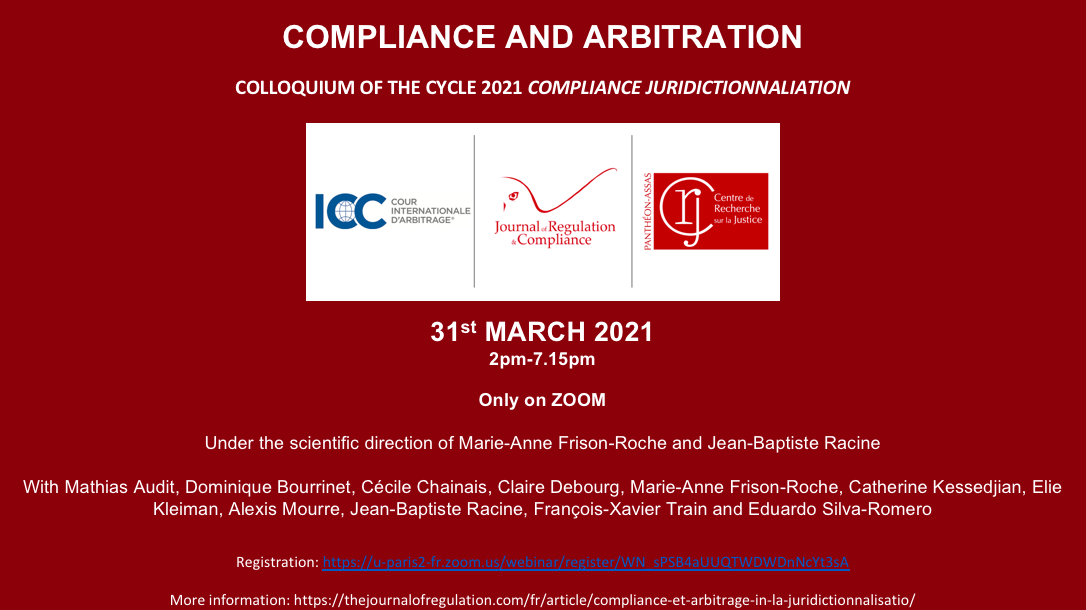
This colloquium took place the 31st of March 2021.
The manifestation was live broadcasted on Zoom.
Presentation of the theme:
The arbitrator is the ordinary judge of international trade. It was natural that he or she encountered Compliance: by definition Compliance Law takes hold of the whole world and follows the paths of international trade while it can only be deployed with the help of institutions which, by nature are spreading around the world and need authorities like the Courts.
The conference is based on the already perceptible connection points between Compliance and Arbitration to better identify what is emerging for tomorrow: contradiction or convergence between the two; weakening or consolidation. We are already seeing the impact that Compliance can have on the arbitrator's treatment of corruption or the consideration of money laundering. More generally, where do we stand with the arbitrator's knowledge of the many technical issues related to compliance? Beyond these, will the courts and arbitrators be able to achieve the goals, themselves new, sometimes monumental, pursued by Compliance Law?
Through this joint exploration of these avenues, the fate of compliance clauses inserted in contracts, the relevance in the matter of private codes of conduct, etc. will be examined.
Tomorrow, as of today, is the arbitrator a full and complete judge of Compliance Law?
How, with what specificities and what controls?
Notably will speak:
Mathias Audit, professeur à l'Université Panthéon-Sorbonne - Paris I (full professor at Sorbonne - University - Paris)
Cécile Chainais, director of the Centre de Recherche sur la Justice et le Règlement des Conflits (CRJ) and professeur à l'Université Panthéon-Assas (Paris II) (Full professor at Panthéon-Assas (Paris II) University)
Claire Debourg, professeure à l'Université Paris X- Nanterre (Full professor at Paris X - Nanterre)
Marie-Anne Frison-Roche, professeur à Sciences Po - Paris (Full Professor at Sciences Po - Paris)) and Director of the Journal of Regulation & Compliance (JoRC)
Catherine Kessedjian, professeur émérite de l'Université Panthéon-Assas (professor emeritus of Panthéon-Assas - Paris II University)
Constitutional Law will have an increasingly important role to play in regulatory Law. This is especially true since the State Council uses its power to filter itself become a sort of Constitutional Court or maybe a Supreme Court.
Indeed, to refuse to transmit to the Conseil constitutionnel (French Constitutional Council) the priority question of constitutionality formulated by UBS, the French Council of State gives what it believes to be the correct interpretation of the constitutional principle of legality of offenses and penalties in banking regulatory Law.
So to say there is no "question", the Conseil d'État says there is no "problem" because, through the interpretation it gives, the provisions of the Code Monétaire et Financier offers to the Supervisory Authority, the Autorité de Contrôle Prudentiel et de Résolution (ACPR), the power to sanction the bank for having not properly implemented its internal control, comply with the constitutional principle of legality of offenses and penalties, which is applicable in administrative repression.
But because to estimate that there is no "question", it must be said that there is no "problem", it is assumed that the High Administrative Court has acted as Constitutional Court.
We must take note. Is this really what the Constituent wanted by instituting a filter system by the constitutional law of the 23rd July 2008 establishing the priority question on constitutionality? Indeed, in this very sensitive and decisive question of repression in banking and finance, is it not at least to the French Constitutional Council itself to say the authoritative interpretation to remember that the constitutional text it is the guardian?
Through the publication of a new regulatory framework by Postcomm, the British Postal Services Commission, on May 27, 2010, Postcomm outlines its plans for regulating the postal sector in the years following 2012. This framework plans to adapt postal regulation to allow {Royal Mail} to profitably fulfill its Universal Service Obligations faced with drastically declining mail volumes and increased competition.
The translated summaries are done by the Editors and not by the Authors.
ENGLISH
The 12th General Assembly of the Association of Mediterranean Regulators
for Electricity and Gas (MEDREG) was held at the headquarters of the
Greek Regulatory Authority of Energy (RAE), on 14 December 2011. On this
occasion, members of MEDREG have approved the initial proposals made by
the Task Force devoted to investments in energy infrastructure, aiming
to stimulate investment in the Mediterranean region. The MEDRED also
exercises regulatory powers similar to those of ACER.
FRENCH
La 12ème Assemblée Générale de l’Association des Régulateurs Méditerranéens de l’Electricité et du Gaz (MEDREG) s’est tenue au siège de l’Autorité grecque de Régulation de l’Energie (RAE), le 14 décembre 2011. A cette occasion, les membres de MEDREG ont approuvé les premières propositions émises par la Task Force consacrée aux investissements dans les infrastructures énergétiques, ayant pour objectif de stimuler les investissements dans la région de la Méditerranée. La MEDRED exerce en outre des pouvoirs de régulation analogues à ceux de l’ACER.



 to be published in the Compliance & Regulation Series , co published by the Journal of Regulation & Compliance (JoRC) and Bruylant.