Search results (720 cards)

Updated: Dec. 8, 2011 (Initial publication: Sept. 23, 2011)
Sectorial Analysis
Translated Summaries
ENGLISH
Corporate officers that had provided financial markets with false information, as well as their auditors, were under investigation by the Autorité des Marchés Financiers (AMF—French financial markets authority) for failure to provide information. On March 31, 2011, the AMF’s Enforcement Commission punished the corporate officers, but decided to innocent the auditors, on the grounds that they had obeyed professional standards.
FRENCH
Lorsque les dirigeants d’une société cotée ont manqué à leur obligation d’informer le marché, l’auditeur, quant à lui, est selon le régulateur exempt de responsabilité, dès l’instant qu’il a respecté les normes professionnelles
SPANISH
Informe Temático (Finanza): Según el AMF, auditores no son responsables cuando una compañía falla en su obligación a proveer el mercado con información, siempre y cuando hayan obedecido los estándares profesionales.
Tanto los oficiales corporativos que habían proveído a los mercados financieros con información falsa, como sus auditores, estuvieron bajo investigación del Autorité des Marchés Financiers (AMF – la Autoridad francesa de mercados financieros) por no haber proveído información. El 31 de marzo del 2011, el AMF castigó a los oficiales corporativos, pero declaró inocentes a los auditores, atestando que ellos habían obedecido los estándares profesionales.
.....................
Other translations forthcoming.

Oct. 14, 2021
JoRC
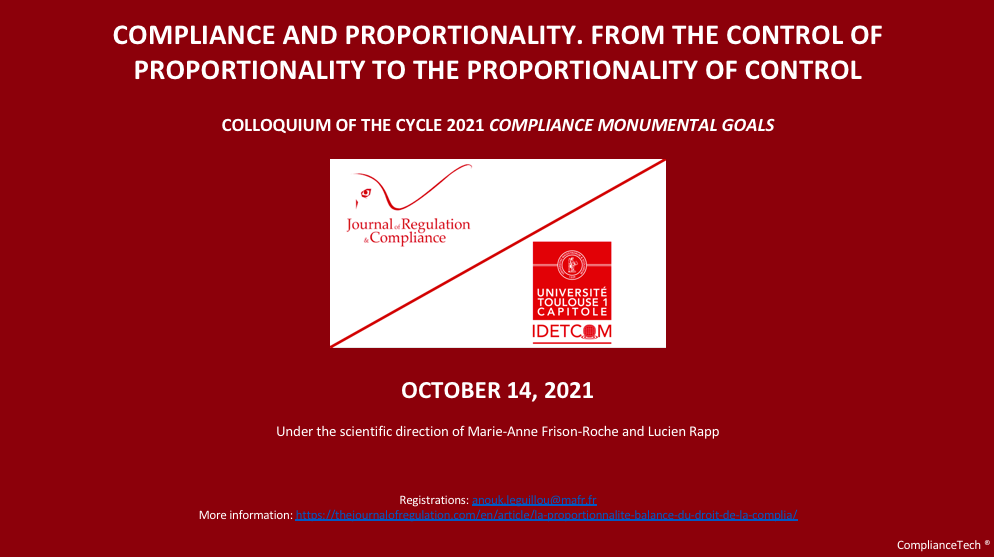
►This scientific manifestation is placed under the scientific responsibility of Marie-Anne Frison-Roche and Lucien Rapp.
This manifestation is organized by the Journal of Regulation & Compliance (JoRC) and by the IDETCOM of Toulouse-I-Capitole University.
📅 This colloquium is part of the cycle of colloquia organized in 2021 around the general topic about Compliance Monumental Goals
____
► Interventions during this colloquium will be the base for a specific chapter in :
📕 Les buts monumentaux de la Compliance,  forthcoming in the series Regulations & Compliance, co-published by the Journal of Regulation & Compliance (JoRC) with Dalloz.
📘Compliance Monumental Goals, forthcoming in the series Compliance & Regulation, co-published by the Journal of Regulation & Compliance (JoRC) and Bruylant.
____
The colloquium will take place, a priori, on site in Toulouse, on October 14, 2021.
It will be broadcasted in live online.
🎥 Videos will be extracted.
► Presentation of the topic :
Compliance Law tends towards "Monumental Goals". This puts the concern, the calculation and the control of proportionality at the center. Proportionality is one of the most common references for compliance practices and strategies, but paradoxically, one of the least well defined. Perhaps even one of the most elusive.
For the German Federal Constitutional Court in Karlsruhe, the principle of proportionality allows the quantitative easing policies of the European Central Bank (ECB) to be monitored. This principle is linked to nothing less than the principle of democracy and is the basis of the control of ultra vires. In French law, proportionality refers to the provisions of Article 8 of the Déclaration des droits (Bill of Rights) of 1789, according to which the law should only establish penalties that are strictly and obviously necessary. In many areas of civil or business life, the compliance of behavior and the consequences of non-compliance are assessed on the basis of a graded assessment by the censor (competitor, regulator or judge).
Proportionality calls for action, which opens up a margin of appreciation to take into account the facts or circumstances. It also allows for the exercise of control over abuse of rights or excess of power. It goes beyond the office of the judge or the censor to forge one of its tools: the control of proportionality, which is obviously not the proportionality of the control.
How to integrate proportionality into compliance practices and strategies?
Does it introduce a certain tolerance in the assessment of situations and is it thus a factor of rediscovered freedom in the development of risk matrices?
Conversely, is it not synonymous with increased vigilance on the part of compliance officers, by leaving open the possibility of a reinforced control of their acts or decisions, by the evaluation of their advisability and not of their conformity alone?
► Working method:
🚧 The colloquium is built around 4 topics, which would be prepared in 4 working papers.
🚧 The writing of each working paper will have been entrusted by experts.
Secondly, these working papers will be available to be criticized by two practionners of Compliance technics.
For each topic, there will be these three sequences:
- Presentation of the topic by the author of the working paper ;
- Discussion by the two discussants, who will have read the working paper previously ;
- Discussion with the public onsite and online.
The four topics chosen are:
1️⃣ Proportionality and Conformity
2️⃣ Proportionality and Evaluation
3️⃣ Proportionality and Normativity
4️⃣ Proportionality and Sanction
► registrations and information :
- attendance to the manifestation is free, onsite or online
- every registration for an attendance onsite will be supported by Toulouse-I-Capitole University
- information will be available on a website opened by Toulouse-I-Capitole University
____
►Will speak, notably :
🎤 Marie-Anne Frison-Roche, professor of Regulation and Compliance Law, director of the Journal of Regulation & Compliance
🎤 Alexandra Mendoza-Carminade, professor at Toulouse-I-Capitole University
🎤Lucien Rapp, professor at Toulouse-I-Capitole University
🎤 Marc Segonds, professor at Toulouse-I-Capitole University
____
See the program below:

Aug. 17, 2020
Newsletter MAFR - Law, Compliance, Regulation
Full reference: Frison-Roche, M.-A., Risk Mapping: is it legally different when it is made by Regulatory Bodies or by Regulated Enterprises?, in Newsletter MAFR - Law, Compliance, Regulation, 17th of August 2020
Read, by freely subscribing, other news of the Newsletter, MAFR - Law, Compliance, Regulation
Summary of the news
Each year, the Autorité des marchés financiers (French financial markets regulator), the European Central Bank and the Agence française anti-corruption (French anti-corruption agency) publish risk maps. At first glance, risk maps established by the regulator aim to both help regulator and the regulated company to face risks by anticipating them. These documents would only be an assistance brought to firms in their Compliance mission and not an injunction from the regulator to take into account the risks that it emphasizes.
However, Law forces firms to do their own risk maps under penalty of sanctions. Since the regulator has previously published its own risk map, can companies, obliged to write theirs, deviate from it? If the firm follows the map published by the regulator, can it protect itself against this if it is accused of not having fulfilled its compliance obligations? On the contrary, if the operator does not follow regulator's risk map, can this be blamed on it? Formally, regulator's risk maps do not come with an injunction to take it into account but, as everyone knows, any recommendation from a regulator or supervisor must be taken into account.
The legal solution could here be the implementation of a system of "comply or explain" which would mean that if the firm decides to no follow the risk map established by the regulator, it must be able to justify its choice.
To go further, read:
- Frison-Roche, M.-A., Legal Theory of Risk Mapping, center of Compliance Law, working paper, 2020
Updated: Sept. 25, 2012 (Initial publication: Sept. 15, 2010)
Sectorial Analysis
Click here to access the full-text article
Click here to access the full-text article
Thematic Report (Energy): The Swiss Federal Administrative Tribunal ruled on July 8th, 2010, that ElCom, the Swiss energy regulator, had overridden its powers in its decision of March 6th 2009.
In a decision of July 8th 2010, the Bundesverwaltungsgericht (the Swiss Federal Administrative Tribunal) partially amended a decision of the Eidgenössiche Elektrizitätskommission (ElCom, the Swiss Federal Electricity Commission), stating that it is unconstitutional and illegal for power-plant operators to bear the price of “system-services”.
FRENCH
Fiche thématique (énergie) : Le tribunal fédéral administratif suisse a rendu un arrêt le 8 juillet 2010 contre une décision du 6 mars 2009 de l'ElCom, le régulateur suisse de l'énergie, pour excès de pouvoir
Dans un arrêt du 8 juillet 2010, le Bundesverwaltungsgericht (le Tribunal Fédéral Administratif suisse) a partiellement annulé une décision de l'Eidgenössiche Elektrizitätskommission (ElCom, la Commission fédérale suisse de l'électricité), déclarant qu'il est anticonstitutionnel et illégal que les opérateurs des centrales électriques supportent le coût des "services systémiques"
GERMAN
Thematischer Bericht (Energie): das schweizerische Bundesverwaltungsgericht hat am 8. Juli 2010 die Verfügung der ElCom, die Eidgenössische Elektrizitätskommission, die Schweizer Regulierungsbehörde für Elektrizität, vom 6. März 2009 für ungültig erklärt.
In einer Entscheidung vom 8. Juli 2010 hat das Schweizer Bundesverwaltungsgericht eine ElCom-Verfügung vom 6. März 2010 zum Teil für ungültig erklärt, da die in der Verordnung vorgesehene Anlastung der Systemdienstleistungskosten an die Kraftwerke gesetzeswidrig ist.
SPANISH
Informe Temático (Energía): El Swiss Federal Administrative Tribunal (El Tribunal administrativo federal de Suiza) dictó el 8 de julio 2010 que ElCom, el Regulador suizo de energía, había sobrepasado sus poderes en su decisión del 6 de marzo 2009.
En una decisión del 8 de julio 2010, el Bundesverwaltungsgericht (El Tribunal administrativo federal de Suiza) anuló parcialmente la decisión de Eidgenössiche Elektrizitätskommission (ElCom, la Comisión suiza de electricidad federal) constatando que es inconstitucional e ilegal que las operadoras de centrales eléctricas soporten el precio de “servicios sistemáticos.”
Updated: June 24, 2011 (Initial publication: June 24, 2011)
I. Isolated Articles
ENGLISH
The Financial Reporting Council is the UK’s independent regulator responsible for promoting high quality corporate governance and reporting to foster investment. We set audit standards, conduct audit inspections and run the disciplinary scheme for misconduct. We are responsible for the UK Corporate Governance and Stewardship Codes.
ITALIAN
Articolo: La prospettiva dei regolatori sulle politiche di regolazione dell’audit
Il Financial Reporting Council è l’autorità di regolazione indipendente responsabile della promozione di un corretto governo d’impresa e dell’incoraggiamento degli investimenti nel Regno Unito. Stabiliamo gli standard dell’audit, svolgiamo tutte le operazioni di audit e applichiamo la procedura disciplinare in caso di infrazione. Siamo responsabili del governo d’impresa e dei codici di condotta.
SPANISH
Artículo: La perspectiva de reguladores en la política de auditas regulatorias.
El “Financial Reporting Council” (FRC - Consejo de Reportaje Financiero) es el regulador independiente británico responsable por asegurar una alta calidad de gobernanza y reportaje corporativo para promover la inversión. Promovemos estándares de auditoría, conducimos inspecciones de auditoría y manejamos el esquema disciplinario para la mala conducta. Somos los responsables para el UK Corporate Governance and Setwardship Codes (la gerencia corporativa británica y los códigos administrativos).
Other translations fortcoming.

Feb. 23, 2015
Breaking news
The theme of the relationship between regulation and innovation finds every day new illustrations. The example of the drone is particularly noteworthy.
Indeed, the drone is a technical object that moves in the air without being driven in an immediate way by the hand of man.
The legal mechanism of qualification brought the drone in the category of "aircraft" and submit it to the regulatory power of the civil aviation regulator.
The regulation of civil aviation is primarily a safety regulation, not a regulation of the sector's economic deployment.
This is why regulators have taken restrictive positions on drones used for commercial purposes, to the extent that the presence of human beings, most the pilots, are the condition for the safety of people. The fact that the drones fly with "no one" led to consider as a danger a prior, which led regulators to take restrictive measures on flying drones for commercial purposes, restricton consistent with the regulator's intervention criteria, without taking into account external rules, such as the protection of privacy.
But whatever the sector, regulators see themselves increasingly as economic regulators. If we adopt this perspective, a restrictive approach appears to be nonsense.
In the interests of balance in both approaches, the safety of people and the economic development through innovation, the US civil aviation regulator, the Federal Aviation Administration is developing new rules.
February 11, 2015, Federal Aviation Administration raised the need for a legal framework for commercial drones. The reason for this is economic. As it writes: "It is anticipated that this activity will result in significant economic benefits". Indeed, Article 333 of the 2012 ACT of modernization and reform imposes registration procedure for every commercial unmanned flying object in the sky!footnote-28. But this hinders business development, and therefore the incentive to technical innovation drone.
It was necessary to find a balance between security of persons and lifting of barriers to economic development. This is why the FAA will distinguish between "small" and other drones. The former are particularly useful in agriculture. To the extent that the former do not constitute danger to persons, an exemption from this procedure (Article 333 exemption) may be given concerning them.
One can analyze this evolution of air Regulation in two ways. First, it is for air regulator to take into account fundamental innovation of flying machines with "no one": innovation will be the base of a huge market for which strict regulatory rules could have been the troublemaker. The consideration of the safety of people remains since only drones "small" are allowed. In addition, they will have to remain at low level and away from airports and housing.
Second, the Regulator reacts by pragmatism. The ban on commercial flight drones hasn't prevented investment in this area. So far, the regulator had instead chosen not to react to the open violations of the standards, from the moment that the safety of the people wasn't in danger. The idea of the new conception is to promote this new market by putting the rules protecting the physical safety of people.
Updated: Sept. 3, 2012 (Initial publication: Aug. 29, 2012)
Breaking news
Sept. 12, 2017
I. Isolated Articles
Qualification is the key operation in Law.
For example, if one says what a bitcoin is, then one assigns to it the regime which corresponds to this "nature" that one has thus said;
One could say that the "token" that it constitutes corresponds to nothing of what it existed before. In this case, their creation, storage, management, sale, loan, purchase does not correspond to any particular category that pre-existed. They therefore come under what is called "the category unnamed".
It is then in a liberal system the vacuum of liberty that applies to it. In a system of liberty, it is contractual freedom, freedom which attaches to the property right, the articulation between the contract and the property being sufficient. Technology can establish such a qualification, because the risk inherent in a system of freedom is also borne by the blockchain mechanism. Indeed, by the spread of risk on the one hand, and the safety of machines on the other, there would be no need to worry, and the principle of freedom could give credence to the idea that the "token" would be a sui generis category.
But central banks and financial regulators are probably not convinced and prefer to qualify by bringing the "token" to a pre-existing category, which automatically triggers the legal regime. It is well known that the art of qualification consists in choosing from among the attainable qualifications the one which will allow the application of the regime which is the most adequate to satisfy the aim which one wishes to attain. In terms of regulation, governed entirely by goals, qualification is therefore primarily a matter of strategy.
Now, to affirm that the bitcoin is a sui generis object amounts to not regulating its emission, usages and intermediations, not to control those who make use of it. It amounts to taking away the merits of self-regulation.
This was excluded.
First of all by the Central Banks. Bitcoins and other tokens, based on the mechanical security of the blockchain, can be described as "money" when it is a matter of their acquisition to allow people to access other goods. The central bankers retained the qualification of "currency", which does not prohibit their issuance but which justifies the application of banking Regulation.
Then by the Financial Regulators. Indeed, the same tokens of securities and financial instruments can be described when they are issued by persons who issue them to raise funds, buyers bringing money not to acquire other things but in consideration of the future value of the undertaking which issued them. On July 25, 2017, the SEC therefore classified them as securities and applied all of the financial law in order to protect these investments and the capital markets.
Once again, we measure that the norm of the Regulation resides in these aims and that on the other hand its main tool is in the qualification of the various activities which are "new" only if the Regulator wants it
June 30, 2018
I. Isolated Articles
The Law of Compliance is a branch of law so recent that some still doubt its very existence.
This paper does not take up this question again, nor that so often evoked of the "definition" of the Compliance and the Law that goes, nor the issue of the translation which is appropriate for it.
The purpose of the reflection is rather to observe the movement that started from the requirements of specific sectoral Law, such as Financial Law and Banking Law, which undeniably correspond to "sectors", the Law of Compliance being the extension of the Law of Regulation, an extension that metamorphoses it, extending beyond the regulated sectors.
THE CONSEQUENCES ON COMPANIES
OF THE COMPLIANCE LAW BEYOND THE REGULATION LAW
Read below
Updated: June 18, 2012 (Initial publication: June 10, 2012)
Breaking news