The translated summaries are done by the Editors
and not by the Authors.
ENGLISH
The main theme of the eighth issue of The Journal of Regulation is that
of Neutrality in systems of economic regulation in accordance with the
conference that the Journal organized around this issue. This question
is essential for a number of reasons: on one hand, companies sometimes
demand that regulation be ‘neutral’ in the impact it has on their
economic activities. On the other hand, States have other reasons for
believing that regulation palliates market failure by using price-fixing
to restore neutrality in certain sectors of the economy that are
incapable of producing a fair market price. Still others believe that
Regulation is not neutral because it intervenes against the neutrality
of the market by imposing access to common goods, social policy
concerns, etc.
FRENCH
Le principal thème du 8° numéro du Journal of Regulation est la question de la neutralité dans les systèmes de régulation économique, telle qu’elle avait été examinée dans le colloque annuel du Journal. Cette question est essentielle pour un certains nombres de raisons. D’une part, les entreprises exigent parfois que les régulation soient "neutres" dans les activités économiques des entreprises. D’autre part, les Etats peuvent avoir d’autres raisons d’adopter des régulations que de palier des défaillances de marchés, lesquelles sont incapables de produire des prix. Les Etats restaurent alors par leurs interventions une neutralité que les marchés ne peuvent pas techniquement engendrer. D’autres croient encore que la Régulation n’est pas neutre parce qu’elle intervient précisément contre la neutralité du marché, en imposant l’accès pour tous à des biens communs, décisions politiques adoptées pour des considérations de politique sociale.
ITALIAN
Il tema principale di questo ottavo numero de The Journal of Regulation è la Neutralità nei sistemi di regolazione economica in linea con la conferenza organizzata dalla rivista relativamente a tale tema. Tale tema riveste un’importanza fondamentale per diverse ragioni: da un lato, le società talvolta richiesto che tale regolazione sia neutrale rispetto all’impatto provocato sulle loro attività economiche. Inoltre, gli Stati hanno diverse ragioni per considerare che la regolazione riduca il rischio di disfunzioni del mercato usando il potere di fissazione del prezzo garantendo così la neutralità che certi settori sono incapaci di raggiungere in quanto incapaci di stabilire un prezzo equo di mercato. Infine, altri ritengono che la Regolazione non sia neutrale in quanto interviene sulla neutralità del mercato ed impone l’accesso ai beni comuni, obiettivi di politica sociale, ecc.
ESPAGNOL
El tema principal del 8º volumen del Journal of Regulation es a cuestión de la neutralidad en los sistemas de regulación económica, tal como ha sido examinada en coloquio anual del Journal. Esta cuestión es esencial por varias razones. De una parte, las empresas a veces exigen que las regulaciones sean “neutras” en las actividades económicas de las empresas. Por otra parte, los Estados pueden tener otras razones para adoptar regulaciones , a parte de lidiar con los fallos de los mercados, los cuales son incapaces de producir precios. Los Estados restauran, a través de sus intervenciones, una neutralidad que los mercados no pueden engendrar. Algunos siguen pensando que la Regulación no es neutra porque interviene precisamente en contra de la neutralidad del mercado, al imponer el acceso universal a bienes comunes, decisiones políticas adoptadas por consideraciones de política social.
ARABIC
الموضوع الرّئيسي للطبعة الثامنة لمجلة التنظيم هو الحياد في النّواضم الاقتصادية وفقا للمؤتمر أللذي انتظم حول هذه القضية. هذا السّؤال ضروري لأسباب متعدّدة : أوّلا، الشّركات تطلب في بعض الأحيان "محايدة" اللّوائح في تأثير على أنشطتها الاقتصادية. من ناحية أخرى، فإن الدول الأخرى يعتقدون أن التّنظيم يخفّف من فشل السوق بمساعدة استخدام التسعير من أجل استعادة الحياد في القطاعات الاقتصاد غير القادرة على إنتاج سعر السوق العادل. لا يزال البعض يعتقد أن التنظيم ليس محايدا لأنّه يأتي ضدّ الحياد السوق عن طريق اشتراط الحصول على الملكية المشتركة، والمخاوف من السياسة الاجتماعية، الخ
A Chinese company issued shares on American exchanges, and was subsequently the subject of a Securities and Exchange Commission (SEC) investigation. The company’s auditor concomitantly revealed frauds it had discovered during its review of the company’s accounts. The SEC sued the auditor on May 27, 2011 in order to force it to communicate the documents it held. The auditor refused, arguing that Chinese criminal law prohibited the revelation of such documents. The SEC filed a motion in Federal Court to compel the auditor to comply with its request on September 6, 2011.
FRENCH
Une société chinoise lève des fonds aux Etats-Unis, puis fait l’objet d’une enquête de la part du régulateur financier nord-américain. Parallèlement, l’auditeur de la société dénonce des fraudes qu’il a découvertes par l’examen des comptes. La SEC assigne l’auditeur le 27 mai 2011 pour obtenir communication des documents qu’il détient. L’auditeur refuse, arguant de l’interdiction par le droit pénal chinois qui prohibe. La SEC saisit le 6 septembre 2011 le juge fédéral pour que celui-ci contraigne l’auditeur.
SPANISH
Informe Temático (Finanza): el regulador financiero americano presentó una moción para obligar ante una Corte Federal a un auditor para que revele documentes concerniendo una compañía china que había auditado, aunque la revelación de dicho documente es prohibido por la ley china.
Una compañía china emitió acciones sobre intercambios americanos, y fue subsecuentemente el sujeto de una investigación del Security and Exchange Commission (SEC). El auditor reveló fraude que había descubierto durante su revisión de las cuentas de la compañía. El SEC demandó al auditor el 27 de mayo del 2011 para forzarlo a comunicar documentos en su posesión. El auditor se rehusó, argumentando que el derecho criminal chino prohibía la revelación de dichos documentos. El SEC presentó el 6 de septiembre del 2011 una moción en la Corte Federal para obligar al auditor a obedecer estas órdenes.
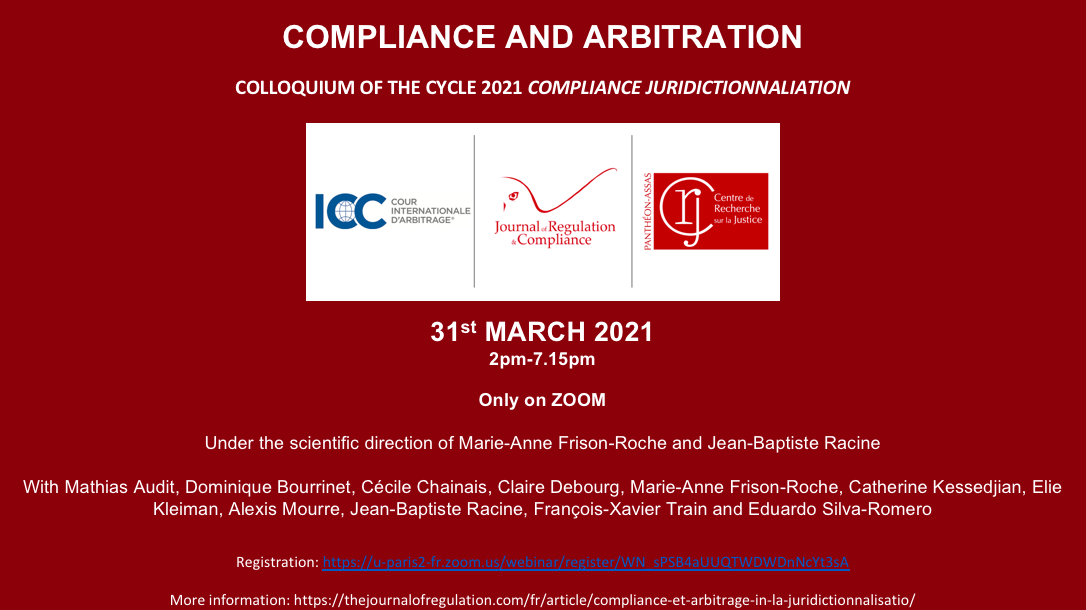
This colloquium took place the 31st of March 2021.
The manifestation was live broadcasted on Zoom.
Presentation of the theme:
The arbitrator is the ordinary judge of international trade. It was natural that he or she encountered Compliance: by definition Compliance Law takes hold of the whole world and follows the paths of international trade while it can only be deployed with the help of institutions which, by nature are spreading around the world and need authorities like the Courts.
The conference is based on the already perceptible connection points between Compliance and Arbitration to better identify what is emerging for tomorrow: contradiction or convergence between the two; weakening or consolidation. We are already seeing the impact that Compliance can have on the arbitrator's treatment of corruption or the consideration of money laundering. More generally, where do we stand with the arbitrator's knowledge of the many technical issues related to compliance? Beyond these, will the courts and arbitrators be able to achieve the goals, themselves new, sometimes monumental, pursued by Compliance Law?
Through this joint exploration of these avenues, the fate of compliance clauses inserted in contracts, the relevance in the matter of private codes of conduct, etc. will be examined.
Tomorrow, as of today, is the arbitrator a full and complete judge of Compliance Law?
How, with what specificities and what controls?
Notably will speak:
Mathias Audit, professeur à l'Université Panthéon-Sorbonne - Paris I (full professor at Sorbonne - University - Paris)
Cécile Chainais, director of the Centre de Recherche sur la Justice et le Règlement des Conflits (CRJ) and professeur à l'Université Panthéon-Assas (Paris II) (Full professor at Panthéon-Assas (Paris II) University)
Claire Debourg, professeure à l'Université Paris X- Nanterre (Full professor at Paris X - Nanterre)
Marie-Anne Frison-Roche, professeur à Sciences Po - Paris (Full Professor at Sciences Po - Paris)) and Director of the Journal of Regulation & Compliance (JoRC)
Catherine Kessedjian, professeur émérite de l'Université Panthéon-Assas (professor emeritus of Panthéon-Assas - Paris II University)
To registrer for following on site and online: anouk.leguillou@mafr.fr (please specify in your e-mail whether you wish to attend the event on site or online)
As places are limited, you will be asked to confirm 48 hours in advance
🧮The event will take place at the Conseil Économique Social et Environnemental, 9, place d’Iéna, 75116 Paris, on February 9, 2024, between 9 am and 12.45 pm.
_____
►Presentation of the topic: "Compliance Obligation" appears to be far from International Arbitration if Compliance Law is only understood in terms of binding regulations or even Criminal Law. Arbitration would only have contact with Compliance Obligation in a repulsive way, when a person claims to have enforced a contract before an arbitration court that disregards a compliance prohibition, e.g. corruption or money laundering. It is therefore from a negative angle that the cross-over has taken place.
The fact that Arbitration Law respects the requisite of Criminal Law is nothing new. Moreover, the power of Compliance in its detection and prevention tools, particularly in terms of evidence, no doubt increases the global efficiency.
But Compliance Obligation is based on Monumental Goals, notably linked to global human rights and active ambitions about environment and climate which, particularly in the value chain economy, take the legal form of compliance clauses, or even compliance contracts, or various commitments and plans, which the parties can ask the international arbitrator to enforce. They will do so even more as arbitrators are often the only international, or even global, judges available.
The use they will do of Contract Law, Quasi-Contract Law, Enforcement Law, Tort Law, reinforces Compliance Law in a global dimension.
____
The symposium, and the articles following, will expose the crucial global movement that starts. l
_____
Speakers:
🎤 Laurent Aynès, emeritus professor of Law at Paris 1 Panthéon-Sorbonne University, attorney, Darrois Villey Maillot Brochier law firm (Paris)
🎤 Marie-Anne Frison-Roche, professor of Law, director of the Journal of Regulation & Compliance (JoRC)
🎤 Jean-François Guillemin, former General Secretary of the Bouygues Group
🎤 Jean-Baptiste Racine, professor of Law at Paris Panthéon-Assas University (Paris 2)
🎤 Eduardo Silva-Romero, president of the Institute of World Business Law of the ICC (Institute), attorney, Wordstone (Paris)
____
The symposium work will be the basis of complete chapters in the books:
📕 L'obligation de compliance, to be published in the collection 📚Regulations & Compliance, copublished by the Journal of Regulation & Compliance (JoRC) andDalloz.
📘Compliance Obligation, to be published in the collection 📚Compltiance & Regulation, copublished by the Journal of Regulation & Compliance (JoRC) and Bruylant.
🔻 read une first presentation of the manifestation below ⤵️
Chairman of the Board of Directors of KPMG S.A. (KPMG France). Jean-Luc Decornoy graduated from the ESSEC and is also an accountant and auditor.
Jean-Luc Decornoy became part of KPMG in 1977. He became a partner in 1988. He was nominated Director-General in 1993, and has been the Chairman of the Board since 2001. (...)


 to be published in the Compliance & Regulation Series , co published by the Journal of Regulation & Compliance (JoRC) and Bruylant.