In Cameroon, the electricity sector is organized around a public operator, the Aes-Sonel, which the State conceded the transmission and distribution of electricity. The “Agence de Régulation du Secteur de l’Energie – ARSEL ( Cameroons Regulatory Agency Electricity Sector ) is responsible for ensuring the proper functioning of the system, quality of service and consumer protection. As in other African countries for the moment the country suffers from a lack of electrification planning and a lack of access to electricity, a significant portion of the population.
However, the regulator has commissioned a survey from June 4 to August 16, 2012. He was released on September 5 which he says the study shows that the operator doesn’t provide public service obligations correctly towards consumers. The operator responds by saying that on the one hand the study is not conclusive and that other conditions, external to him, do not bring electricity to everyone but it’s not its fault.
It was expected that the CEO of the Citigroup Bank receive for 2011 a salary of 15 million, a part immediately, and the other part deferred, and approximately 155 times the average earnings of employees, and while the Citigroup stock price fell from 45% in 2011. Consulting firms advised shareholders to express an unfavourable opinion to this draft resolution, presented in the General Assembly by the Board of Directors of the Bank under the Dodd-Frank Act. Two Consulting firms advised to deliver a negative vote, believing that compensation was disproportionate. Shareholders followed this advice.This is the second time that a such disapproval is expressed.
On 17 June 2016 the prosecutor (Avocat général près la Cour d'appel) presented its closing arguments (réquisitoire) before the judges of the Court of Appeal of Versailles, in the Kerviel case.
On the merits, the prosecution asked the condemnation of the trader for criminal offenses he has committed but asked that the bank, which is presented as a victim of its trader should be dismissed from all its claims against the author.
Rating agencies are in the eye of the cyclone, due to the ambiguity of the situation: by their status, they are simple operators but by their role are almost regulators. Governing the markets, the banks can not for the moment dispense with them. However, the rating market is oligopolistic. On August 1, 2012, the association of German public banks complained that the prices practiced by rating agencies are monopoly pricing. What is remarkable is that this a complaint is made not to the European Competition Authority, the Commission, but to the European Banking Authority (EBA). Thus, regulation is a tool and a wider tool more than is the competition.
Vogel, David, The Politics of precaution: Regulating Health, Safety and Environmental Risks in Europe and the United States, Princetown University Press, 2012, 332 pp.
Online gambling is becoming a worldwide phenomenon. Whether it be card games, lotteries, or betting on sports games and races, more and more customers flock towards websites that operate games of chance online, often without any sort of government control or supervision. Customers are attracted to the facility and privacy of these services, and especially the higher rate of return on their outlay than provided in physical casinos or betting services. However, physical gambling and betting are amongst the most universally regulated sectors: cultural and public policy differences play a very significant role in explaining the differences in regulation found in this sector.
FRENCH
Article: Une analyse comparative de la régulation des jeux en ligne
Jouer en ligne est désormais un phénomène mondial. Qu'il s'agisse des jeux de cartes, des loteries, ou des paris sportifs et hippiques, de plus en plus de clients affluent vers des sites Internet qui organisent des jeux de chance et de hasard sur Internet, souvent sans aucune forme de supervision ou de contrôle étatique. Les clients sont attirés par la facilité et la confidentialité de tels services, et surtout le taux de retour plus élevé sur leurs mises que dans un casino ou service de pari physique. Cependant, les jeux d'argent physiques sont parmi les secteurs les plus régulés: les différences culturelles et d'ordre public jouent un rôle important dans l'explication des différences dans la régulation de ce secteur.
GERMAN
Artikel: Vergleichende Analyse der Regulierung von Online-Wetten
Online-Wetten sind dabei eine weltweites Phänomen zu werden. Ob Kartenspiele, Lotterien oder Sportwetten: mehr und mehr Kunden strömen auf die Seiten von Online-Wettmachern, die ihr Geschäft oft ohne jegliche staatliche Kontrolle oder Aufsicht betreiben. Gelockt werden die Kunden durch die Vertraulichkeit und Mühelosigkeit der Online-Spiele, aber auch durch die höheren Returns auf ihren Einsatz im Vergleich zu traditionellen Casinos. Allerdings gehören Glücksspiele und Casinos zu den weltweit am stärksten regulierten Sektoren: kulturelle und politische Unterschiede spielen jedoch eine große Rolle bei der Erklärung der Unterschiede in der Regulierung in diesem Bereich.
POLISH
Artykuł: Analiza porównawcza regulacji gier na Internecie.
Grać na Internecie stało się światowym fenomenem. Czy chodzi o gry w karty, loterie lub o stawienie pieniędzy na zakłady sportowe lub wyścigi hippiczne, coraz więcej konsumentów przybywa na strony internetowe firm, które oferują gry hazardowe, często bez jakiejkolwiek formy nadzoru czy kontroli państwowej. Klientów przyciąga łatwość i poufność usług, a szczególnie wyższa stawka procentowa niż ta proponowana w klasycznym kasynie lub firmach przyjmujących zakłady na gry hazardowe. Pomimo, że gry na pieniądze należą do sektorów ekonomicznych najbardziej uregulowanych, odmiennosci kulturowe, jak również różnice w polityce porządku publicznego, odgrywają ważną rolę w wyjaśnianiu różnic związanych z regulacją tego sektoru gospodarki.
SPANISH
Un análisis comparativo sobre la regulación del juego en el Internet
El juego en el Internet se ha vuelto un fenómeno mundial. Ya sean juegos de cartas, loterías, o apuestas sobre partidos deportivos y carreras, es más y más la cantidad de consumidores que se dirigen hacia sitios web que operan, frecuentemente sin control o supervisión del gobierno, los juegos sobre el Internet. La facilidad y privacidad que ofrecen estos servicios atraen a muchos consumidores, especialmente considerando la gran tasa de rendimiento que reciben aquí en comparación con los casinos físicos o los servicios de apuestas. No obstante, los juegos físicos y las apuestas se encuentran entre los sectores con la mayor cantidad de regulación a nivel mundial: diferencias de culturas y políticas públicas juegan un papel muy importante para explicar las diferencias entre la regulación existente en este sector.
Virtual currency is a perfect example of the difficulties of interregulation: indeed, the bitcoins are currencies created on the Internet, usually to play games, such as poker. Thus intersect banking regulation, banking supervision, regulation and control of the game, Internet regulation itself.
In the US, the situation is complicated in that banking regulation is exercised at the state level, while the Internet is subject to intervention by federal regulators, including the Federal Communication Commission.
The European Directive of September 16th 2009 introduces a clear definition of electronic money and establishes a new prudential supervisory regime of the business of electronic money institutions.
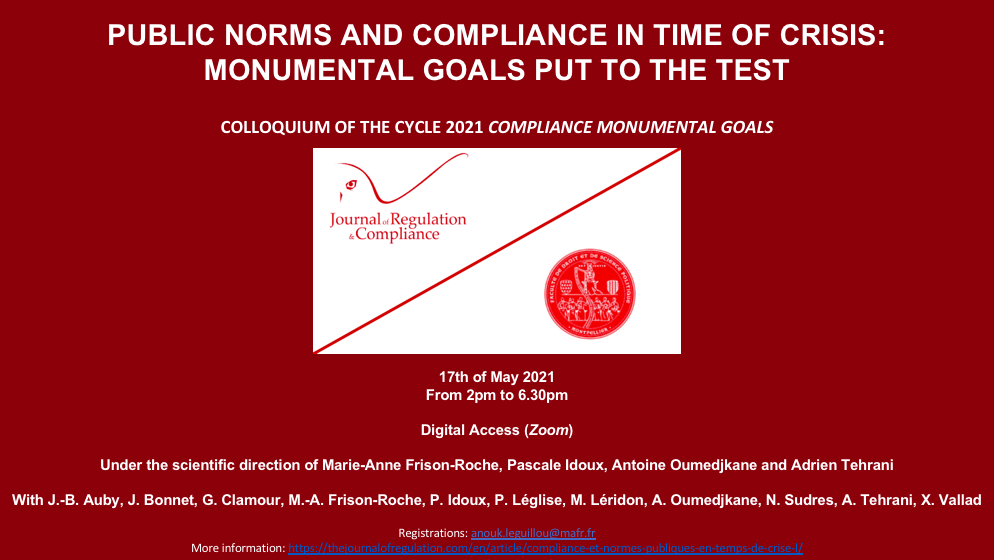
This manifestation took place on Zoom on 17th of May 2021.
Registrations: anouk.leguillou@mafr.fr
Assistance to this event may be validated as part of the continuing education of lawyers.
In addition, scientific videos will be extracted and disseminated later.
Presentation of the topic: In the overall problematic of "Monumental goals", this conference retains a particular case: that of the crisis and the emergency situation that it generates.
First of all, in general, does the importance of public norms in the emergency context engendered by a crisis situation imply a marginalization of Compliance? Don't private actors also have their place in these circumstances, at the service of the "monumental goals" that the public authorities want to maintain, or even which appear specifically?
Secondly, more concretely, we have been living for many months in a health crisis. By taking it as a framework and, within it from particular cases, how public and private actors react, act, adjust? and how do the courts assess these movements?
Going from the most general to the most specific, this conference aims to identify criteria, limits, of what could be specific rules when the emergency of a crisis meets Compliance, and will examine specific situations.
Working method: The conference is therefore built on a general issue, which was the subject of a "working paper", written by Antoine Oumedjkane, Adrien Tehrani and Pascale Idoux, on which the speakers will have thought in advance and from which they are intended to study the question from their particular perspective.
The conference, which is essentially interactive, therefore begins with an outline of the main lines of this general work. It is followed by the examination of concrete practical cases.
They are as follows:
1️⃣ hydro-alcoholic gel, its manufacture, price, availability,
2️⃣ information and regulation on all media in Covid period
3️⃣ the use of the bicycle during the state of health emergency
A first conclusion, thematically limited, will relate to Revealed by the crisis situation, the place of private initiative in Compliance Law.
A second, more general, undoubtedly open-ended conclusion is drawn from this confrontation between general reflection and concrete cases which must be resolved in a particular crisis.
🎤 Marie-Anne Frison-Roche, agrégée des Facultés de droit, Professor of Regulation and Compliance Law at Sciences Po (Paris) and Director of the Journal of Regulation & Compliance (JoRC)
🎤 Pascale Idoux, Professor at Montpellier University
🎤 Pascale Léglise, adjointe au directeur des libertés publiques et des affaires juridiques (Deputy Director of Civil Liberties and Legal Affairs) of the Ministère de l'intérieur (Home Ministry)
🎤 Michèle Léridon, Member of the Conseil supérieur de l'audiovisuel (French Media Regulator), President of the working group Pluralisme, déontologie, supervision des plateformes en ligne (Pluralism, Deontology, Supervision of Online Platforms)
🎤 Antoine Oumedjkane, Researcher of the Centre de recherche et d'études administratives (Research and Administrative Studies Center) of Montpellier University
🎤 Nelly Sudres, Maître de conférences at Montpellier University and member of the Centre de Recherches et d'Etudes Administratives (Research and Administrative Studies Center) of Montpellier University
🎤 Adrien Tehrani, Professor at Montpellier University and member of the Centre du Droit de l'Entreprise (Company Law Center)


 to be published in the Series Regulations & Compliance , co-published par the Journal of Regulation & Compliance (JoRC) and Dalloz.