► Full Reference: Journal of Regulation & Compliance (JoRC) and Law Faculty of Perpignan, Le juge face aux clauses et aux contrats de compliance (The Judge facing clauses and contracts of Compliance), Faculty of Perpignan, 7 April 2023.
🧮The event takes place in the premises of the University of Perpignan, on Friday 7 April 2023, from 9:00 to 18:30. It takes place in a hybrid way.
_____
Presentation of the theme:
The Compliance obligation will increasingly take the form of contracts. This is because the texts unilaterally adopted by Public Authorities oblige economic operators to adopt clauses to give concrete form to the legal obligations of Compliance, for instance active prevention of corruption or effective vigilance in the value chain to avoid environmental or human rights violations. It also comes from the fact that companies, for many reasons, commit themselves to contribute to the efficacy achievement of the Monumental Goals of Compliance, with the contract being the most natural, balanced and flexible way to achieve this.
In this multiple contractual activity, which can manifest itself either in complete contracts, "compliance contracts", or in stipulations that more or less deviate from the regulations, the judge is never far away, because the judge is always, regardless of the legal system and the type of contract, active in this matter.
The general relationship between the Judge and Compliance Law has just been the subject of a series of symposiums and the publication of a book, La juridictionnalisation de la Compliance (Compliance Jurisdictionalisation, to be published in English). The aim here is to refocus the perspective on what happens when the judge is facing a contract that has Compliance issues at stake or, at the very least, contains Compliance stipulations.
The purpose of this symposium and the articles that will follow is to study this hypothesis, which is becoming more and more frequent and could become the standard.
Jean-Patrice de La Laurencie is a graduate of the Institut d’Etudes Politiques de Paris (Sciences Po Paris) and the Ecole Nationale d’Administration (ENA). He is currently a Lawyer at the Paris Bar (...)
The translated summaries are done by the Editors
and not by the Authors.
ENGLISH
The main theme of the eighth issue of The Journal of Regulation is that
of Neutrality in systems of economic regulation in accordance with the
conference that the Journal organized around this issue. This question
is essential for a number of reasons: on one hand, companies sometimes
demand that regulation be ‘neutral’ in the impact it has on their
economic activities. On the other hand, States have other reasons for
believing that regulation palliates market failure by using price-fixing
to restore neutrality in certain sectors of the economy that are
incapable of producing a fair market price. Still others believe that
Regulation is not neutral because it intervenes against the neutrality
of the market by imposing access to common goods, social policy
concerns, etc.
FRENCH
Le principal thème du 8° numéro du Journal of Regulation est la question de la neutralité dans les systèmes de régulation économique, telle qu’elle avait été examinée dans le colloque annuel du Journal. Cette question est essentielle pour un certains nombres de raisons. D’une part, les entreprises exigent parfois que les régulation soient "neutres" dans les activités économiques des entreprises. D’autre part, les Etats peuvent avoir d’autres raisons d’adopter des régulations que de palier des défaillances de marchés, lesquelles sont incapables de produire des prix. Les Etats restaurent alors par leurs interventions une neutralité que les marchés ne peuvent pas techniquement engendrer. D’autres croient encore que la Régulation n’est pas neutre parce qu’elle intervient précisément contre la neutralité du marché, en imposant l’accès pour tous à des biens communs, décisions politiques adoptées pour des considérations de politique sociale.
ITALIAN
Il tema principale di questo ottavo numero de The Journal of Regulation è la Neutralità nei sistemi di regolazione economica in linea con la conferenza organizzata dalla rivista relativamente a tale tema. Tale tema riveste un’importanza fondamentale per diverse ragioni: da un lato, le società talvolta richiesto che tale regolazione sia neutrale rispetto all’impatto provocato sulle loro attività economiche. Inoltre, gli Stati hanno diverse ragioni per considerare che la regolazione riduca il rischio di disfunzioni del mercato usando il potere di fissazione del prezzo garantendo così la neutralità che certi settori sono incapaci di raggiungere in quanto incapaci di stabilire un prezzo equo di mercato. Infine, altri ritengono che la Regolazione non sia neutrale in quanto interviene sulla neutralità del mercato ed impone l’accesso ai beni comuni, obiettivi di politica sociale, ecc.
ESPAGNOL
El tema principal del 8º volumen del Journal of Regulation es a cuestión de la neutralidad en los sistemas de regulación económica, tal como ha sido examinada en coloquio anual del Journal. Esta cuestión es esencial por varias razones. De una parte, las empresas a veces exigen que las regulaciones sean “neutras” en las actividades económicas de las empresas. Por otra parte, los Estados pueden tener otras razones para adoptar regulaciones , a parte de lidiar con los fallos de los mercados, los cuales son incapaces de producir precios. Los Estados restauran, a través de sus intervenciones, una neutralidad que los mercados no pueden engendrar. Algunos siguen pensando que la Regulación no es neutra porque interviene precisamente en contra de la neutralidad del mercado, al imponer el acceso universal a bienes comunes, decisiones políticas adoptadas por consideraciones de política social.
ARABIC
الموضوع الرّئيسي للطبعة الثامنة لمجلة التنظيم هو الحياد في النّواضم الاقتصادية وفقا للمؤتمر أللذي انتظم حول هذه القضية. هذا السّؤال ضروري لأسباب متعدّدة : أوّلا، الشّركات تطلب في بعض الأحيان "محايدة" اللّوائح في تأثير على أنشطتها الاقتصادية. من ناحية أخرى، فإن الدول الأخرى يعتقدون أن التّنظيم يخفّف من فشل السوق بمساعدة استخدام التسعير من أجل استعادة الحياد في القطاعات الاقتصاد غير القادرة على إنتاج سعر السوق العادل. لا يزال البعض يعتقد أن التنظيم ليس محايدا لأنّه يأتي ضدّ الحياد السوق عن طريق اشتراط الحصول على الملكية المشتركة، والمخاوف من السياسة الاجتماعية، الخ
The conferences cycle Les outils de la Compliance (The Compliance tools) taking place between November 2019 and June 2020 organized by The Journal of Regulation & Complianceand all the Partner Universities will start this year on the theme of "La cartographie des risques" (Risk Mapping) .
Risk Mapping is defined as a process of identifying, evaluating and prioritizing risks: it is an integral and fundamental part of an effective global strategy for managing these risks.
As a central tool for Compliance, this approach may not be radically new, but the Risk Mapping Technique is now renewed and sometimes compromised by the emergence of new Risks, often due to their new mutiform nature. Moreover, the primacy of the new pair of "Political Risks/Compliance Risks" tends to increase the vulnerability of organizations obliged by new legal provisions to draw up these maps, whereas these tools must also protect these organizations.
Before discussing it with the audience, the speakers will explain through their experience the place of this tool in Compliance, by looking at how Risk Mapping is articulated with the logic of value creation through risk-taking, inherent in entrepreneurial and political action. This good understanding is not only essential for the company, but also for the administrative and judicial authorities which control or sanction firms.
Especially with the interventions of:
- Marie-Anne Frison-Roche, full professor of Regulatory Law and Compliance Law, Sciences Po
- Jean-François Guillemin, former general secretary of the Bouygues Group
- Lamia Liabes, Chief Operating Office, HSBC France
The translated summaries are done by the
Editors and not by the Authors.
ENGLISH
On November 28th, 2011, the Conseil d’Etat (French Council of State) ruled that the ban on GMOs established by several ministerial decrees in December 2007 and February 2008 is not valid. The main reason for this decision is the lack of sufficient proof given by the French government that GMOs represent a high threat for public health or the environment. Yet, the French Ministers of Agriculture and Environment declared on January 13th, 2012, that the same probition will be adopted.
FRENCH
Le
28 novembre 2011, le Conseil d’Etat, a décidé que l’interdiction des
OGM, établie par plusieurs décrets ministériels et adoptée en décembre
2007 et février 2008, était nulle. La principale raison de cette
décision est le manque de preuves suffisantes apportées par le
Gouvernement français en ce que les OGM représenteraient un grand danger
pour la santé publique ou pour l’environnement. Pourtant, le ministère
français de l’agriculture et de l’environnement a déclaré le 13 janvier
2011 que l’interdiction sera adoptée de nouveau.
ITALIAN
Il 28 novembre 2011, il Conseil d’Etat
(il Consiglio di Stato francese) ha deciso che il divieto di OGM
contenuto in diversi decreti ministeriali del Dicembre 2007 e Febbraio
2008 non è valido. La ragione principale di tale decisione è l’assenza
di prove fornite dal Governo francese che gli OGM costituiscano un
rischio importante per la salute pubblica o l’ambiente. Ciononostante,
il 13 gennaio 2012, il Ministro francese dell’Ambiente e
dell’Agricoltura, chelo stesso divietosarà adottato
ARABIC
28 نوفمبر 2011، قرر مجلس الدولة، أن الحظر المفروض على الكائنات المعدلة وراثيا*، التي وضعتها الوزارة في عدة مراسيم والتي اعتمدت في ديسمبر 2007 وفبراير 2008، كانت صفرا. السَّبب الرئيسي وراء هذا القرار هو عدم وجود ما يكفي من الأدلة التي أدخلتها الحكومة الفرنسية أن الكائنات المعدلة وراثيا* تشكل خطرا كبيرا على الصحة العامة أو البيئة. ومع ذلك، قالت وزارة الزراعة الفرنسية والبيئة 13 جافني 2011 أنه سيتم حظر يعاد تمثيلها..
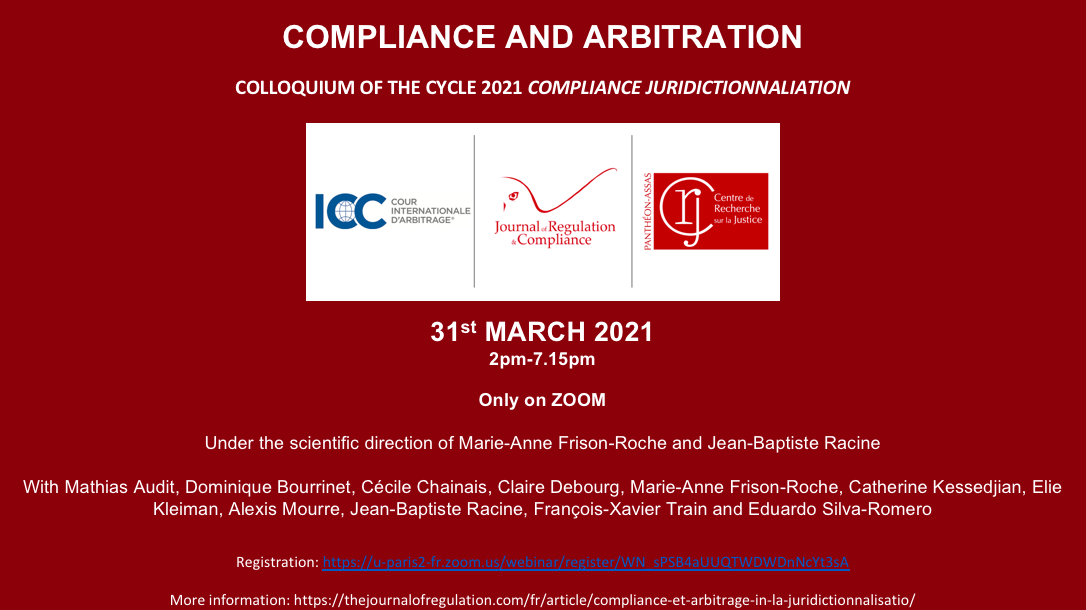
This colloquium took place the 31st of March 2021.
The manifestation was live broadcasted on Zoom.
Presentation of the theme:
The arbitrator is the ordinary judge of international trade. It was natural that he or she encountered Compliance: by definition Compliance Law takes hold of the whole world and follows the paths of international trade while it can only be deployed with the help of institutions which, by nature are spreading around the world and need authorities like the Courts.
The conference is based on the already perceptible connection points between Compliance and Arbitration to better identify what is emerging for tomorrow: contradiction or convergence between the two; weakening or consolidation. We are already seeing the impact that Compliance can have on the arbitrator's treatment of corruption or the consideration of money laundering. More generally, where do we stand with the arbitrator's knowledge of the many technical issues related to compliance? Beyond these, will the courts and arbitrators be able to achieve the goals, themselves new, sometimes monumental, pursued by Compliance Law?
Through this joint exploration of these avenues, the fate of compliance clauses inserted in contracts, the relevance in the matter of private codes of conduct, etc. will be examined.
Tomorrow, as of today, is the arbitrator a full and complete judge of Compliance Law?
How, with what specificities and what controls?
Notably will speak:
Mathias Audit, professeur à l'Université Panthéon-Sorbonne - Paris I (full professor at Sorbonne - University - Paris)
Cécile Chainais, director of the Centre de Recherche sur la Justice et le Règlement des Conflits (CRJ) and professeur à l'Université Panthéon-Assas (Paris II) (Full professor at Panthéon-Assas (Paris II) University)
Claire Debourg, professeure à l'Université Paris X- Nanterre (Full professor at Paris X - Nanterre)
Marie-Anne Frison-Roche, professeur à Sciences Po - Paris (Full Professor at Sciences Po - Paris)) and Director of the Journal of Regulation & Compliance (JoRC)
Catherine Kessedjian, professeur émérite de l'Université Panthéon-Assas (professor emeritus of Panthéon-Assas - Paris II University)



 to be published in the Compliance & Regulation Series , co published by the Journal of Regulation & Compliance (JoRC) and Bruylant.