
Search results (720 cards)

Dec. 22, 2014
Breaking news
In regulating more than anywhere else, the most important is the time.
Operators can't endure uncertainty. The uncertainty of the litigation is probably the worst weapons that the controller can turn against them. So much so that The Economist, in its issue of August 30, 2014 estimated that US regulators have transformed the repression organized racket, operators to pay for stop procedures, the fact that they are right or wrong is no longer the issue.
Seen in banking and finance, seen here in telecommunications.
Then, a first calculation of the prejudice of consumers has been calculated. Each subscriber aspiring to claim a possibly unwarranted addition of about $ 10 a month for many years, the amount of damages was very high , for example in connection with a class action.
The company chose to stop there and have a settelment for $ 90 million, attributable in part to consumers, but also to different states, also paying a transactional fine to the US federal treasury.
The case is therefore financially resolved. The Federal Communications Commission commented on the agreement stating that overcharging is "a major problem" for consumers.
The case has been conducted for this operator as it has been for AT & T in October 2014, concluding a similar agreement for $ 105 millions.
____
One will rejoice if one believes that the key is to close the file and enable the company to return to its business.
The reference may be regrettable if we think:
- Punishment must remain a matter for the courts;
- The accused persons, even if they are companies, need time for the defense ;
- Regulatory Law must issue rules and interpretations of the texts, the law is depleting by agreements that close the litigation, the main objective being ... never reach the judge.

Updated: Sept. 25, 2012 (Initial publication: June 12, 2011)
Sectorial Analysis
ENGLISH
On May 12, 2011, both Neelie Kroes, the European Commissioner for the digital agenda within the European Commission, and Larry Strickling, Assistant Commissioner for Communications and Information within the United States Department of Commerce, sent a notification to the ICANN, a private association that manages Internet domain names. First of all, they agreed with the principle of self-regulation of Internet domain names by the ICANN. But, they requested a reform of its “governance” to improve its transparency and better take into account public authorities’ recommendations.
Association - Conflict resolution - Domain name - European commission - Internet - Internet Corporation for Assigned Names & Numbers (ICANN) - Memorandum - Power - Private regulator - Regulatory Authority - Self regulation - Soft law - Transparency - United Nations (UN) *
* In The Journal of Regulation, these keywords are done by the Editor and not by the Author.
PORTUGUESE
Informe bibliográfico (Internet): Autoridades europeias e norte-americanas notificaram a ICANN, uma associação privada encarregada da auto-regulação de nomes de domínio na Internet, que ela deve adotar uma governança mais transparente e também adotar as recomendações de estruturas públicas.
Em 12 de maio de 2011, tanto Neelie Kroes, o Comissário Europeu para a agenda digital dentro da Comissão Europeia, quanto Larry Strickling, Comissário Assistente para Comunicações e Informação dentro do Departamento de Comércio dos Estados Unidos da América, enviaram uma notificação para a ICANN, uma associação privada que gerencia nomes de domínio na internet. Em primeiro lugar, eles concordaram com o princípio da auto-regulação dos nomes de domínio na Internet pela ICANN. No entanto, eles solicitaram uma reforma em sua governança para melhorar sua transparência e melhor levar em consideração as recomendações de autoridades públicas.
Associação – Resolução de conflitos – Nome de domínio – Comissão Europeia – Internet - Internet Corporation for Assigned Names & Numbers (ICANN) – Memorandum – Poder – Regulação privada – Autoridade de regulação – Auto-regulação – Soft law – Transparência – Nações Unidas (ONU)*
* No Journal of Regulation, as palavras-chave são fornecidas pelo Diretor, e não pelo Autor.
ITALIAN
Relazione bibliografica (Internet): Le autorità europee e nord americane hanno indicato che l’ICANN, una società privata che ha lo scopo di auto-regolare i nomi a dominio di internet, dovrà aumentare la trasparenza della gestione ed adottare le raccomandazioni delle strutture pubbliche
Il 12 maggio 2011, Neelie Kroes, Commissario europeo per l’agenda digitale della Commissione europea, e Larry Strickling, Commissario assistente per le comunicazioni e l’informazione del Dipartimento del Commercio degli Stati Uniti, hanno entrambi dichiarato che l’ICANN, una società privata che gestisce i nomi a dominio di Internet, deve riformare il proprio sistema di gestione migliorando la sua trasparenza e deve prendere in debita considerazione le raccomandazioni provenienti dalle autorità pubbliche.
Associazione - Autorità di regolazione - Autorità privata di regolazione - Auto-regolazione - Commissione Europea - Internet - Internet Corporation for Assigned Names & Numbers (ICANN) - Memorandum - Nazioni Unite (ONU) - Nomi di dominio - Potere - Risoluzione di controversie - Soft law - Transparenza *
* In The Journal of Regulation, le parole chiave sono responsabilità dell’Editore e non dall’Autore.
Other translations fortcoming.

Sept. 23, 2021
JoRC
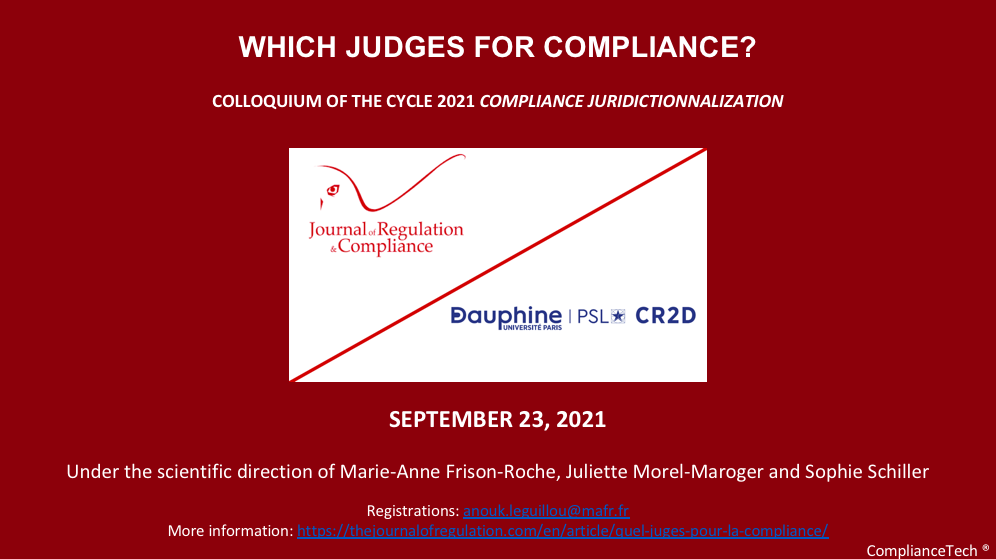
►This scientific event is placed under the scientific responsibility of Marie-Anne Frison-Roche, Juliette Morel Maroger and Sophie Schiller. It is organized by the Journal of Regulation & Compliance (JoRC) and by the Centre de recherche en Droit (CR2D) of Paris Dauphine-PSL University.
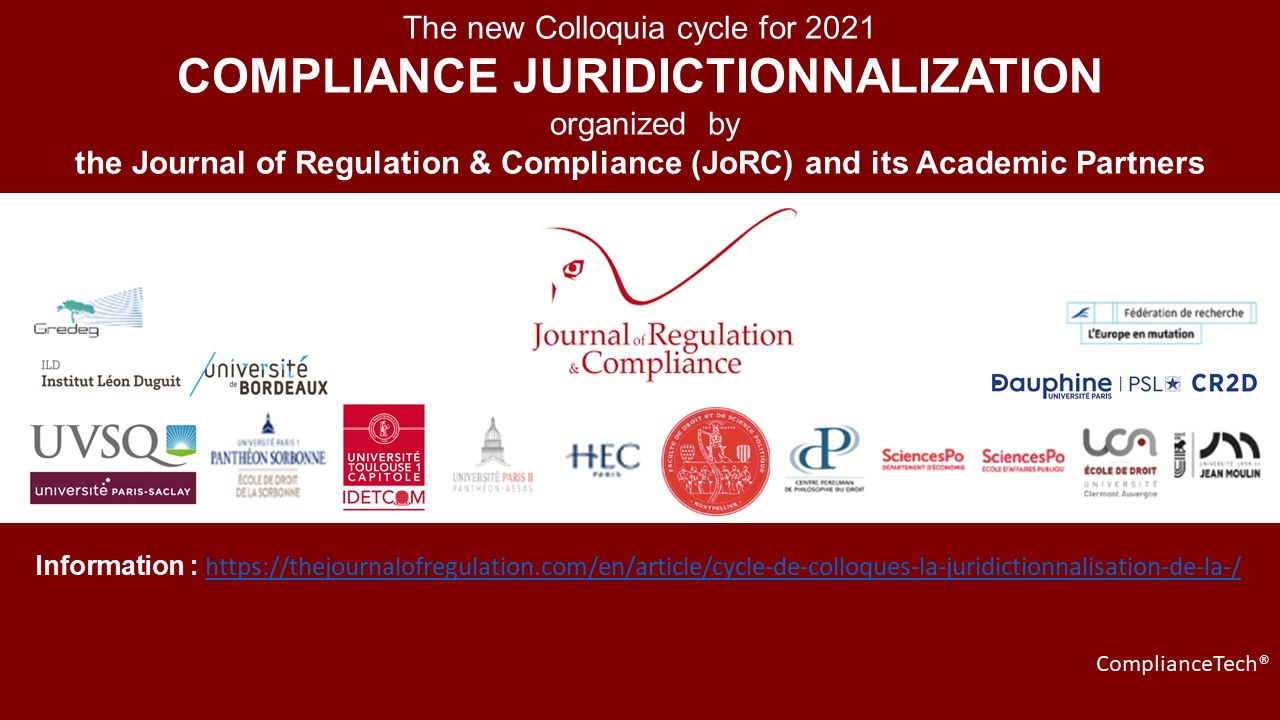
This event is part of the 2021 colloquia cycle around the general theme of Compliance Jurisdictionalisation.
►The interventions will be then transformed into a chapter in the books: contributions in the 📕 La Juridictionnalisation de la Compliance , to be published the Regulation & Compliance series ries, jointly published by the Journal of Regulation & Compliance (JoR)C and Dalloz
📘Compliance Jurisdictionalisation,  to be published in the Compliance & Regulation Series , co published by the Journal of Regulation & Compliance (JoRC) and Bruylant.
____
This colloquium will take place in Paris Dauphine-PSL University in September 2021.
Presentation of the topic :
Judges, regulatory and supervisory authorities, or even authorities specially instituted by Compliance Law, such as the Agence Française Anticorruption (French Anticorruption Agency), must implement it.
The colloquium aims initially to identify and discuss the procedural rules that they then specifically implement, in particular when the strong requirements of Compliance Law, efficiency and immediacy, new negotiation techniques and commitment, must be articulated with the traditional procedural requirements that remain.
The question arises in particular as to whether the rules of a fair trial should apply (or can they be similar in transactional procedures and in the context of judicial procedures, and how the control by judges operates during homologation) in transactional procedures, with more or less specific treatment of the evidence used.
Secondly, the colloquium considers the way in which the different judges assess the different constitutive standards of Compliance Law. These are often soft Law and depending on whether the judge is repressive, administrative, or European, his or her assessment will not be legally of the same scope or of the same nature, which together leads to an issue of articulation of method. Due to the breadth of the subject, certain sectors will be particularly examined, in particular the banking sector.
Thirdly, the way in which the judge himself or herself applies Compliance Law will be examined, in what appears to be a balance between pedagogy and sanction. It then appears to play a triple role, in that it ensures compliance with standards but also in that it must find effective solutions in a Law which is more in Ex Ante than in Ex Post and that it must support operators so that they act effectively, by mastering their obligations. The motivation for decisions then appears to be a primary issue.
Because this last phase concerns the even more direct relationship between the judge and the operators and stakeholders, this theme is intended to give rise to a presentation and a round table.
______________
Will speak notably:
- Claudie Boiteau, Professor at Paris Dauphine-PSL University, Member of the Centre de Recherche en Droit de l'Université Paris Dauphine-PSL (CR2D).
- Jean-François Bohnert, Financial National Prosecutor
- Olivier Catherine, Secretary General at Sonepar
- Nicolas Cayrol, Professor at Tours Law School and Director of the Institut d'Etudes Judiciaires François Grua
- Jean-Michel Darrois, Attorney, Darrois, Villey, Maillot, Brochier Law Firm
- Marie-Laure Denis, President of the CNIL
- Eric Dezeuze, Attorney, Bredin Prat Law Firm
- Marie-Anne Frison-Roche, Professor at Sciences Po (Paris), Director of the JoRC
- Juliette Morel-Maroger, Professor at Paris Dauphine-PSL University
- Sophie Scemla, Associate attorney, Gide Law Firm
- Sophie Schiller, Professor at Paris Dauphine-PSL University
Read a more detailed presentation below:
Updated: Sept. 26, 2011 (Initial publication: July 4, 2011)
Symposiums
ENGLISH
On May 20, 2011, a colloquium was held in Paris on the question of How should the Audit be regulated?, organized by The Journal of Regulation, l’Ecole de droit de la Sorbonne, and KPMG France, one of the Journal’s privileged partners. The participants were Jean-Luc Decornoy, Nathalie de Basaldua, Alain Couret, Marie-Anne Frison-Roche, Christine Thin, Stephen Haddrill, Claude Cazes, Etienne Wasmer, and Mara Cameran. The reflections and discussions bore upon the European Commission’s Green Paper on Audit Policy. The colloquium’s ambition was to discuss the methodological links that must guide the future of the Audit, both in relation to financial regulation and competition, and also to analyze what the inspirations for audit reform should be, especially by using the available economic studies. Each participant agreed that the most important goal was to ensure that the audit is of very high quality, and everything ought to converge towards this goal.
ITALIAN
Relazione bibliografica (Convegno): Vers quelle régulation de l’audit faut-il aller? (Come dovrebbe essere regolato l’audit ?)
Il 20 maggio 2011, si è tenuto a Parigi un convegno sulla questione di come dovrebbe essere regolato l’audit, organizzato da The Journal of Regulation, da l’Ecole de droit de la Sorbonne e KPMG France, partner privilegiato della rivista. I partecipanti erano Jean-Luc Decornoy, Nathalie de Basaldua, Alain Couret, Marie-Anne Frison-Roche, Christine Thin, Stephen Haddrill, Claude Cazes, Etienne Wasmer e Mara Cameran. Le riflessioni e le discussioni si sono concentrate sul Libro Verde della Commissione europea sulla politica in materia di audit. L’ambizione del convegno era di studiare i nessi metodologici che devono costituire le linee guida dell’audit, tenendo conto della regolazione finanziare e della libera concorrenza. Il convegno mirava inoltre ad analizzare le possibili piste di una riforma dell’audit, sulla base anche di studi di tipo economico. Ogni partecipante ha sottolineato che lo scopo più importante era quello di assicurare un’attività di audit di grande qualità, e che tutti gli sforzi dovrebbero convergere verso tale scopo.
SPANISH
Informe bibliográfico (Simposio): ¿En qué dirección debe dirigirse la regulación?
El 20 de mayo del 2011 se llevó a cabo un coloquio en París sobre la cuestión de “Cómo debe regularse la auditoría?” organizado por The Journal of Regulation, l’école de droit de la Sorbonne y el KPMG France, uno de los asociados principales de esta publicación. Los participantes incluyen Jean-Luc Decornoy, Nathalie de Basaldua, Alain Couret, Marie-Anne Frison-Roche, Christine Thin, Stephen Haddrill, Claude Cazes, Etienne Wasmer, and Mara Cameran. Las reflecciones y discusiones se centraron sobre el Papel Verde de la Comisión Europea sobre la política auditiva. La ambición de este coloquio era de discutir las conexiones metodológicas que deben guiar el futuro de la Auditoría, tanto en relación con la regulación de finanzas y la competencia, y también de analizar cuáles deben de ser las inspiraciones para la reforma de la auditoría, especialmente al usar los estudios económicos disponibles. Cada participante concertó que el objetivo más importante era de asegurar que la auditoría sea de alta calidad, y que todo ha de converger hacia este objetivo.
PORTUGUESE
Informe bibliográfico (Symposium): vers quelle régulation de l’audit faut-il aller ? Como deveria a auditoria ser regulada?
Em 20 de maio de 2011, um colóquio foi realizado em Paris sobre a questão Como deveria a auditoria ser regulada?, organizado por The Journal of Regulation, l’Ecole de droit de la Sorbonne, e KPMG France, um dos principais parceiros deste periódico. Os participantes foram Jean-Luc Decornoy, Nathalie de Basaldua, Alain Couret, Marie-Anne Frison-Roche, Christine Thin, Stephen Haddrill, Claude Cazes, Etienne Wasmer, e Mara Cameran. As reflexões e discussões surgiram a partir do Informe Verde sobre Política de Auditoria da Comissão Europeia. O propósito do colóquio foi discutir as ligações metodológicas que devem guiar o futuro da auditoria, ambos em relação com regulação financeira e concorrência, e também analizar quais deveriam ser as inspirações para a reforma da auditoria, especialmente usando os estudos econômicos disponíveis. Todos os participantes concordaram que o objetivo mais importante seria assegurar que a auditoria é de alta qualidade, e que tudo deve convergir para este objetivo.
Padrão contábil – Alternativa financeira – Auditoria – Mercado de auditoria – Falência – Big Four – Certificação – Colóquio – Concentração – Confiança – Conflito de interesses – Cooperação – Custo – Agência de notação – Operador crucial – Definição – Deontologia – Mercado desregulado – Eficiência – Europa – Mercado europeu de auditoria – Comissão Europeia – Especulação – Crise financeira – Mercado financeiro – Futuro – Mercado global – Objetivo – Informe Verde sobre auditoria – Incentivo – Independência – Informação – Informação assimétrica – Fórum de auditoria internacional – Itália – Auditoria conjunta – Responsabilidade – Gerente – Votação obrigatória – Mercado – Expectativas de mercado – Micro economia – Acaso moral – Opacidade – Opinião – Perímetro – Preço – Lucro – Bem público – Interesse público – Serviço público – Qualidade – Economia real – Informação do risco – Ceticismo – Responsabilidade social – Risco sistêmico – Raciocínio teleológico – Trust – Reino Unido – Estados Unidos da América.*
* Em The Journal of Regulation, estas palavras-chave são fornecidas pelo Editor e não pelo Autor.
Other translations forthcoming.
Updated: Oct. 27, 2011 (Initial publication: Oct. 27, 2011)
Authors
Updated: Sept. 25, 2012 (Initial publication: March 2, 2010)
Sectorial Analysis
Main information
The Law of 9 February 2010 transforms the status of La Poste (the French Postal Service) into a Public Limited Company ({Société Anonyme}) from 1st March 2010 and organises postal activities, especially as relates to national and regional development programmes.
Updated: April 4, 2012 (Initial publication: Feb. 8, 2012)
Sectorial Analysis
Translated summaries
The translated summaries are done by the
Editors and not by the Authors.
ENGLISH
On November 28th, 2011, the Conseil d’Etat (French Council of State) ruled that the ban on GMOs established by several ministerial decrees in December 2007 and February 2008 is not valid. The main reason for this decision is the lack of sufficient proof given by the French government that GMOs represent a high threat for public health or the environment. Yet, the French Ministers of Agriculture and Environment declared on January 13th, 2012, that the same probition will be adopted.
FRENCH
Le
28 novembre 2011, le Conseil d’Etat, a décidé que l’interdiction des
OGM, établie par plusieurs décrets ministériels et adoptée en décembre
2007 et février 2008, était nulle. La principale raison de cette
décision est le manque de preuves suffisantes apportées par le
Gouvernement français en ce que les OGM représenteraient un grand danger
pour la santé publique ou pour l’environnement. Pourtant, le ministère
français de l’agriculture et de l’environnement a déclaré le 13 janvier
2011 que l’interdiction sera adoptée de nouveau.
ITALIAN
Il 28 novembre 2011, il Conseil d’Etat
(il Consiglio di Stato francese) ha deciso che il divieto di OGM
contenuto in diversi decreti ministeriali del Dicembre 2007 e Febbraio
2008 non è valido. La ragione principale di tale decisione è l’assenza
di prove fornite dal Governo francese che gli OGM costituiscano un
rischio importante per la salute pubblica o l’ambiente. Ciononostante,
il 13 gennaio 2012, il Ministro francese dell’Ambiente e
dell’Agricoltura, che lo stesso divieto sarà adottato
ARABIC
28 نوفمبر 2011، قرر مجلس الدولة، أن الحظر المفروض على الكائنات المعدلة وراثيا*، التي وضعتها الوزارة في عدة مراسيم والتي اعتمدت في ديسمبر 2007 وفبراير 2008، كانت صفرا. السَّبب الرئيسي وراء هذا القرار هو عدم وجود ما يكفي من الأدلة التي أدخلتها الحكومة الفرنسية أن الكائنات المعدلة وراثيا* تشكل خطرا كبيرا على الصحة العامة أو البيئة. ومع ذلك، قالت وزارة الزراعة الفرنسية والبيئة 13 جافني 2011 أنه سيتم حظر يعاد تمثيلها..
*OGM : كائنات المعدلة وراثيا
...........
Other translations forthcoming.

Dec. 10, 2014
Sectorial Analysis
Constitutional Law will have an increasingly important role to play in regulatory Law. This is especially true since the State Council uses its power to filter itself become a sort of Constitutional Court or maybe a Supreme Court.
One can think so reading the UBS decision on the 5th of November 2014.
Indeed, to refuse to transmit to the Conseil constitutionnel (French Constitutional Council) the priority question of constitutionality formulated by UBS, the French Council of State gives what it believes to be the correct interpretation of the constitutional principle of legality of offenses and penalties in banking regulatory Law.
So to say there is no "question", the Conseil d'État says there is no "problem" because, through the interpretation it gives, the provisions of the Code Monétaire et Financier offers to the Supervisory Authority, the Autorité de Contrôle Prudentiel et de Résolution (ACPR), the power to sanction the bank for having not properly implemented its internal control, comply with the constitutional principle of legality of offenses and penalties, which is applicable in administrative repression.
But because to estimate that there is no "question", it must be said that there is no "problem", it is assumed that the High Administrative Court has acted as Constitutional Court.
We must take note. Is this really what the Constituent wanted by instituting a filter system by the constitutional law of the 23rd July 2008 establishing the priority question on constitutionality? Indeed, in this very sensitive and decisive question of repression in banking and finance, is it not at least to the French Constitutional Council itself to say the authoritative interpretation to remember that the constitutional text it is the guardian?
Updated: Sept. 17, 2012 (Initial publication: Sept. 13, 2012)
Breaking news
Updated: Sept. 25, 2012 (Initial publication: June 2, 2010)
Sectorial Analysis
FRENCH
Le 27 mai 2010, la Broadcasting Sanctions Committee (Commission des Sanctions de l’Autorité britannique de régulation des communications électroniques et de l’audiovisuel (Ofcom) a sanctionné pour un montant de £225.000 Teletext Limited, validant en outre la révocation administrative opérée le 29 janvier 2010 par Ofcom de la délégation de service public concernant la fourniture de services de télétexte, suite à la cessation unilatérale de la diffusion de ceux-ci par Teletext le 15 décembre 2009.
L’Ofcom (The Office of Communications — le régulateur britannique des télécommunications et de l’audiovisuel), a annulé le 29 janvier 2010 la délégation de service public accordé à Teletext Limited pour la fourniture de services de télétexte, et a rendu le 27 mai 2010 un arrêt de sanction de £225.000 à l’encontre de ce dernier, pour avoir unilatéralement cessé de diffuser les services de télétexte le 15 décembre 2009, alors que sa licence n’expirait qu’en 2014.
GERMAN
Teletext Ltd. hat am 27. Mai 2010 eine Strafe von £225.000 von der Ofcom's Broadcasting Sanction Committee (die Sanktionskommission der britischen Medienaufsichtsbehörde) bekommen. Grund dafür ist, dass Teletext Ltd. am 15. Dezember 2009 einseitig aufgehört hat, die Teletextsdienste, für die sie von einer Übertragung öffentlicher Diensten bezug, zu leisten. Diese Strafe bestätigt auch die Amtsenthebung, die am 29. Januar 2010 infolge der einseitigen Entscheidung von Teletext Ltd., verkündet wurde.
Die Ofcom (The Office of Communication - die britische Mediensaufsichtsbehörde) hat am 29. Januar 2010 Teletext Ltd. aus seiner Amt enthebt, da die Firma am 15. Dezember 2009 einseitig aufgehört hat, die Teletextdiensten zu liefern, für welche sie tätig war, obwohl seine Lizenz noch bis 2014 gültig war. Infolgedessen hat am 27. Mai 2010 die Ofcom auch eine Geldstrafe von £225.000 gegen Teletext Ltd. verhängt.
SPANISH
El 27 de mayo del 2010, el Comité de sanciones de emisoras del Ofcom (la oficina británica de comunicaciones) multó a Teletext Ltd. la cantidad de £225,000 después de que Ofcom haya revocado la licencia pública para los servicios teletext el 29 de enero del 2010, acto necesario en vista del cese unilateral de emisiones que Teletext Ltd. dio a los servicios telextext el 15 de diciembre del 2009.
Ofcom (la Oficina de comunicaciones), la autoridad regulatoria de audiovisuales y telecomunicaciones de Gran Bretaña, revocó la licencia pública teletext de Teletext Ltd. el 29 de enero del 2010 y sancionó a éste con la cantidad de £225,000 el 27 de mayo del 2010 por haber unilateralmente cesado las emisiones de servicios teletext el 15 de enero del 2009, antes de la caducidad de la licencia en el 2014.