The translated summaries are done by the Editors
and not by the Authors.
ENGLISH
The main theme of the eighth issue of The Journal of Regulation is that
of Neutrality in systems of economic regulation in accordance with the
conference that the Journal organized around this issue. This question
is essential for a number of reasons: on one hand, companies sometimes
demand that regulation be ‘neutral’ in the impact it has on their
economic activities. On the other hand, States have other reasons for
believing that regulation palliates market failure by using price-fixing
to restore neutrality in certain sectors of the economy that are
incapable of producing a fair market price. Still others believe that
Regulation is not neutral because it intervenes against the neutrality
of the market by imposing access to common goods, social policy
concerns, etc.
FRENCH
Le principal thème du 8° numéro du Journal of Regulation est la question de la neutralité dans les systèmes de régulation économique, telle qu’elle avait été examinée dans le colloque annuel du Journal. Cette question est essentielle pour un certains nombres de raisons. D’une part, les entreprises exigent parfois que les régulation soient "neutres" dans les activités économiques des entreprises. D’autre part, les Etats peuvent avoir d’autres raisons d’adopter des régulations que de palier des défaillances de marchés, lesquelles sont incapables de produire des prix. Les Etats restaurent alors par leurs interventions une neutralité que les marchés ne peuvent pas techniquement engendrer. D’autres croient encore que la Régulation n’est pas neutre parce qu’elle intervient précisément contre la neutralité du marché, en imposant l’accès pour tous à des biens communs, décisions politiques adoptées pour des considérations de politique sociale.
ITALIAN
Il tema principale di questo ottavo numero de The Journal of Regulation è la Neutralità nei sistemi di regolazione economica in linea con la conferenza organizzata dalla rivista relativamente a tale tema. Tale tema riveste un’importanza fondamentale per diverse ragioni: da un lato, le società talvolta richiesto che tale regolazione sia neutrale rispetto all’impatto provocato sulle loro attività economiche. Inoltre, gli Stati hanno diverse ragioni per considerare che la regolazione riduca il rischio di disfunzioni del mercato usando il potere di fissazione del prezzo garantendo così la neutralità che certi settori sono incapaci di raggiungere in quanto incapaci di stabilire un prezzo equo di mercato. Infine, altri ritengono che la Regolazione non sia neutrale in quanto interviene sulla neutralità del mercato ed impone l’accesso ai beni comuni, obiettivi di politica sociale, ecc.
ESPAGNOL
El tema principal del 8º volumen del Journal of Regulation es a cuestión de la neutralidad en los sistemas de regulación económica, tal como ha sido examinada en coloquio anual del Journal. Esta cuestión es esencial por varias razones. De una parte, las empresas a veces exigen que las regulaciones sean “neutras” en las actividades económicas de las empresas. Por otra parte, los Estados pueden tener otras razones para adoptar regulaciones , a parte de lidiar con los fallos de los mercados, los cuales son incapaces de producir precios. Los Estados restauran, a través de sus intervenciones, una neutralidad que los mercados no pueden engendrar. Algunos siguen pensando que la Regulación no es neutra porque interviene precisamente en contra de la neutralidad del mercado, al imponer el acceso universal a bienes comunes, decisiones políticas adoptadas por consideraciones de política social.
ARABIC
الموضوع الرّئيسي للطبعة الثامنة لمجلة التنظيم هو الحياد في النّواضم الاقتصادية وفقا للمؤتمر أللذي انتظم حول هذه القضية. هذا السّؤال ضروري لأسباب متعدّدة : أوّلا، الشّركات تطلب في بعض الأحيان "محايدة" اللّوائح في تأثير على أنشطتها الاقتصادية. من ناحية أخرى، فإن الدول الأخرى يعتقدون أن التّنظيم يخفّف من فشل السوق بمساعدة استخدام التسعير من أجل استعادة الحياد في القطاعات الاقتصاد غير القادرة على إنتاج سعر السوق العادل. لا يزال البعض يعتقد أن التنظيم ليس محايدا لأنّه يأتي ضدّ الحياد السوق عن طريق اشتراط الحصول على الملكية المشتركة، والمخاوف من السياسة الاجتماعية، الخ
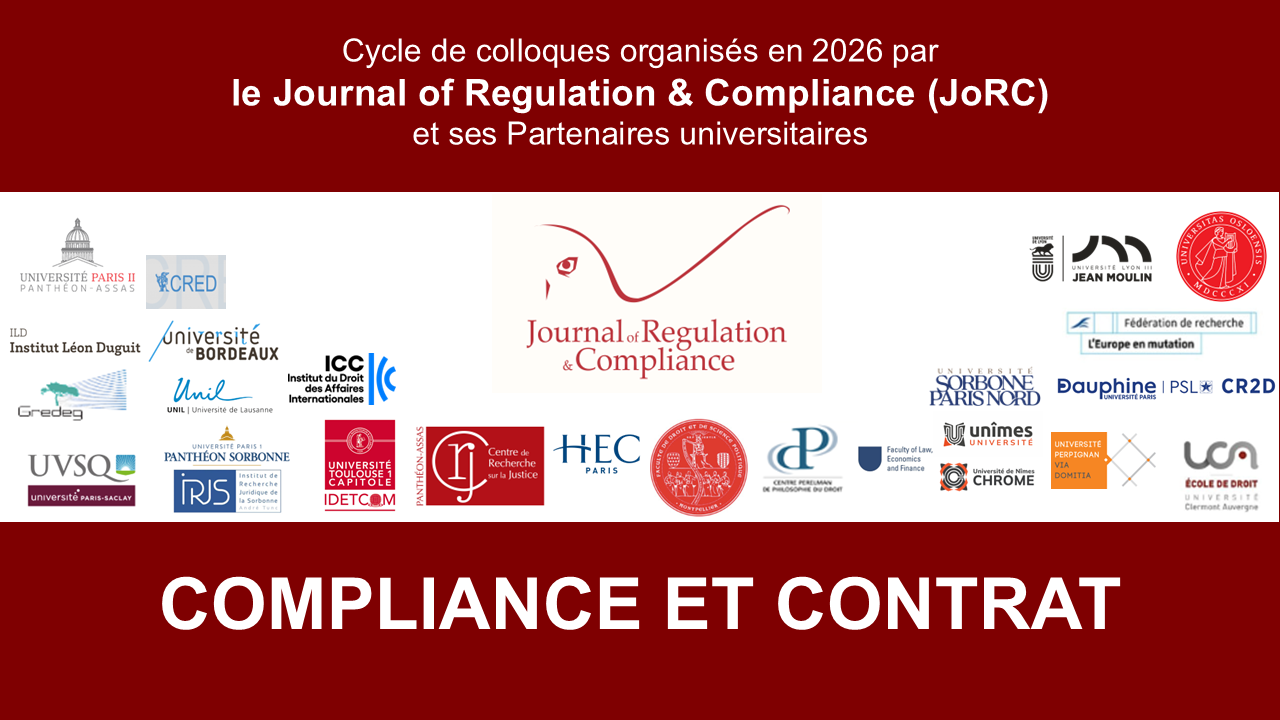
►Full reference : Journal of Regulation & Compliance (JoRC) and Panthéon-Assas University (Paris II), Le "contrat de compliance (The "compliance contract"') Paris, 12 June 2026.
To register for in-person or remote attendance: ...
As the number of places is limited, you will be asked to confirm your attendance 48 hours in advance.
🧮The event will take place in the auditorium, Rue Notre-Dame-des-Champs, 75006 Paris, on 12 June 2026, between 9.30 a.m. and 1.30 p.m.
_____
► Presentation of the topic : Companies have a legal obligation to put "compliance structures" in place, such as whistleblowing mechanisms, plans, information gathering systems and data security systems. Many adopt a management strategy that leads them to choose to outsource the implementation of this obligation, or even to outsource the compliance structure itself, which then most often takes the form of a platform, even though responsibility cannot be transferred. But the line between structure and behaviour, between responsibility for the decision and its implementation, becomes blurred.
The hypothesis examined here through the "Compliance Contract", which should not be confused with compliance clauses but which is linked to them, is the widespread use by companies of this type of contract, the existence and typology of which was identified in 2022. Corresponding to a very significant share of the "compliance market", perhaps a specific market, it could constitute a special contract, requiring at the very least a specific regime, either under Competition Law, Data Law, particularly Personal Data Law, etc.
____
Speakers will include :
🎤Bruno Deffains, Professor of Economics at the University of Paris Panthéon-Assas (Paris II)
🎤 Marie-Anne Frison-Roche, Professor of Regulatory Law and Compliance, Director of the Journal of Regulation & Compliance (JoRC)
The Journal of Regulation’s annual symposium on March 17, 2011 examined the theme of Neutrality in systems of economic regulation. After preliminaries on the definition of neutrality and neutral action, which were the common theme linking all speakers’ contributions, the first part of the colloquium explored the general aspects of neutrality in regulated industries, such as the neutrality of standards or the relationship between neutrality and legal categories, impact studies, or procedural techniques. The second part of this event raised more specific points, such as the interference between neutrality and the globalization of regulated industries, the question of regulators’ neutrality, and of net neutrality that some regulators wish to raise to the level of a general principle.
SPANISH
Informe bibliográfico (Simposio): La neutralidad en los sistemas de regulación económica
El simposio anual de la Revista de Regulación que se llevó a cabo el 17 de marzo del 2011 examinó el tema de Neutralidad en sistemas económicos de regulación. Después de algunos preliminares sobre la definición de la neutralidad y la acción neutral, los cuales fueron temas comunes en las contribuciones de los diferentes actores presentes, la primera parte del coloquio exploró los aspectos generales de la neutralidad en las industrias reguladas, como la neutralidad de los estándares o la relación entre la neutralidad y las categorías legales, estudios de impacto, o técnicas de procedimiento. La segunda parte del evento alzó cuestiones específicas, como la interferencia entra la neutralidad y la globalización de industrias reguladas, la cuestión de la neutralidad de diferentes reguladores y la neutralidad de la red, lo cual algunos quieren alzar a nivel de principio general.
A "cookie", so named because its shape recalls the shape of the cake, allows a site to remember the tastes of the user through visits and purchases which he made and decide to reuse this information. A European directive decided to limit these practices, the English legislature has provided the obligation for sites to warn the user that connects that a cookie identifies him and agrees of this acquisition of personal information, the justification for the Act is the protection of personal information that a third party data protection may thus have without the consent of the person concerned.
The Act came into application in the United Kingdom on May 25, 2012. Some companies they say it technically inapplicable, both as relevant information to justify the application of the consent form and what form the consent of the user should take. They are more concerned because the entire device is subjected to penal sanctions.
The FCC’s 2010 “open Internet” (net neutrality) order went into effect on November 20, 2011. Verizon Communications and Metro PCS have challenged the FCC Order in court, alleging that the FCC lacked statutory power to impose net neutrality rules in connection with Internet access services.
FRENCH
L’ordonnace 2010 de la FFC (le régulateur nord-américain des communications) "open Internet" est entrée en vigueur le 20 novembre 2011. Les sociétés Verizon Communications et Metro PCS ont contesté devant le juge cette ordonnance, alléguant quela FCCn’avait pasle pouvoir légald’imposer des règles sur la neutralité du net concernant l'accès aux services d'Internet.