Germany is characterized in that in Europe generally has refused liberalization of the gambling industry. For this, it will incur remonstrance’s from the European Commission. But this issue is the responsibility of the Länder. That is why, when the Land of Schleswig-Holsteing decided in April 2011 to open the sector to competition online games, Everyone saw a sign of liberalism and compliance with European lines.
But the government of this land has changed in May 2012 to make way for a coalition, it seems more favorable to a closure of that activity or, at lesse, should be left to public monopolies.
However, on September 2, 5 licenses are to be given by that Government to the major operators of online games, which shows that the line previously adopted market-opening games online is maintained, unlike the rest of the Germany.
This collective work describes the contours of French, European, and International healthcare regulation, and explores past, present, and future evolutions and tendencies in this sector. Original French title: Annales de la régulation, 2009, volume 2, sous la direction de Thierry Revet et Laurent Vidal, collection Bibliothèque de l'Institut de Recherche Juridique de la Sorbonne (IRJS) – André Tunc. (LGDJ)
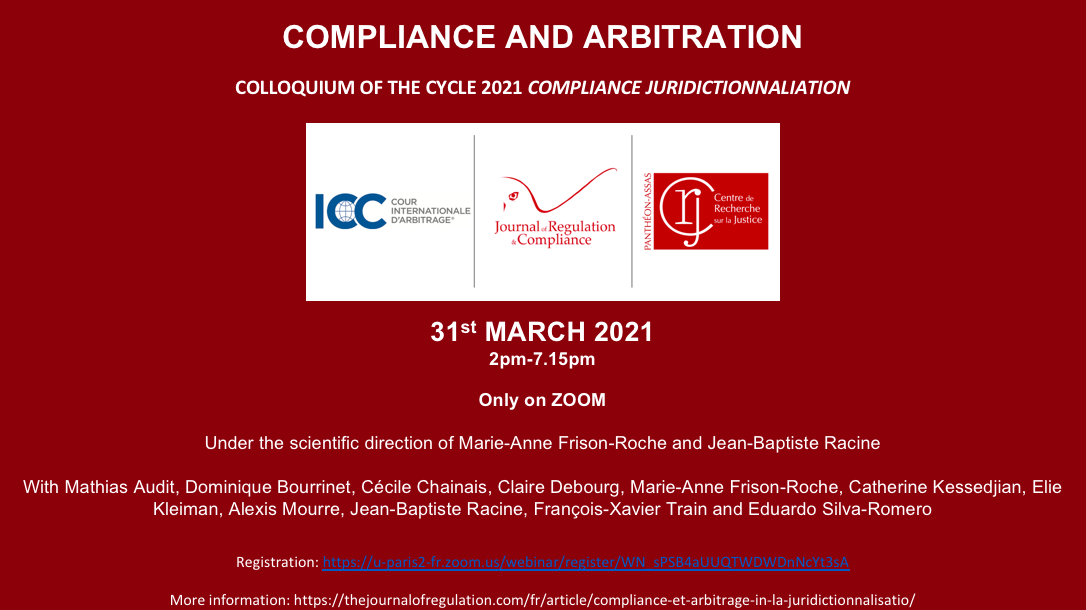
This colloquium took place the 31st of March 2021.
The manifestation was live broadcasted on Zoom.
Presentation of the theme:
The arbitrator is the ordinary judge of international trade. It was natural that he or she encountered Compliance: by definition Compliance Law takes hold of the whole world and follows the paths of international trade while it can only be deployed with the help of institutions which, by nature are spreading around the world and need authorities like the Courts.
The conference is based on the already perceptible connection points between Compliance and Arbitration to better identify what is emerging for tomorrow: contradiction or convergence between the two; weakening or consolidation. We are already seeing the impact that Compliance can have on the arbitrator's treatment of corruption or the consideration of money laundering. More generally, where do we stand with the arbitrator's knowledge of the many technical issues related to compliance? Beyond these, will the courts and arbitrators be able to achieve the goals, themselves new, sometimes monumental, pursued by Compliance Law?
Through this joint exploration of these avenues, the fate of compliance clauses inserted in contracts, the relevance in the matter of private codes of conduct, etc. will be examined.
Tomorrow, as of today, is the arbitrator a full and complete judge of Compliance Law?
How, with what specificities and what controls?
Notably will speak:
Mathias Audit, professeur à l'Université Panthéon-Sorbonne - Paris I (full professor at Sorbonne - University - Paris)
Cécile Chainais, director of the Centre de Recherche sur la Justice et le Règlement des Conflits (CRJ) and professeur à l'Université Panthéon-Assas (Paris II) (Full professor at Panthéon-Assas (Paris II) University)
Claire Debourg, professeure à l'Université Paris X- Nanterre (Full professor at Paris X - Nanterre)
Marie-Anne Frison-Roche, professeur à Sciences Po - Paris (Full Professor at Sciences Po - Paris)) and Director of the Journal of Regulation & Compliance (JoRC)
Catherine Kessedjian, professeur émérite de l'Université Panthéon-Assas (professor emeritus of Panthéon-Assas - Paris II University)
In Cameroon, the electricity sector is organized around a public operator, the Aes-Sonel, which the State conceded the transmission and distribution of electricity. The “Agence de Régulation du Secteur de l’Energie – ARSEL ( Cameroons Regulatory Agency Electricity Sector ) is responsible for ensuring the proper functioning of the system, quality of service and consumer protection. As in other African countries for the moment the country suffers from a lack of electrification planning and a lack of access to electricity, a significant portion of the population.
However, the regulator has commissioned a survey from June 4 to August 16, 2012. He was released on September 5 which he says the study shows that the operator doesn’t provide public service obligations correctly towards consumers. The operator responds by saying that on the one hand the study is not conclusive and that other conditions, external to him, do not bring electricity to everyone but it’s not its fault.
The translated summaries are done by the Editors and not by the Authors
ENGLISH
The purpose of this collective work is to understand the causes of the financial crisis. It has a strong international dimension and draws in both legal and economic science. Although composed of independent contributions from each other, it relies on a general demonstration, summary of which will largely be the focus of this first bibliographic report, the importance of justifying the work that results in three successive bibliographic reports. Furthermore, the book focuses on the specific issue of governance in international finance, which runs through regulatory issues, but one cannot be reduced to the other and vice versa.
Therefore in all three bibliographic records, abstracts will be more or less developed on the contributions, depending on whether they directly concerned by regulation, in which case they will be preferred or more remote areas, in which case they will shortly exposed.
The firstbibliographic recordaimsto present,on the one hand,the general problemof the book,and alsoto highlighttwocontributionsof historical(1920-1930/2001-2007).
FRENCH
Fiche Bibliographique (Livre) : La globalisation de l’intégration financière. Perspective de trente ans, de la réforme à la crise)
Cet ouvrage collectif a pour objet de comprendre les causes de la crise financière. Il présente une dimension fortement internationale et puise à la fois dans la science juridique et économique. Bien que constitué de contributions autonomes les unes des autres, il s’appuie sur une démonstration générale, dont le résumé sera en grande partie l’objet de cette première fiche bibliographique, l’importance de l’ouvrage justifiant qu’il donne lieu à a trois fiches bibliographiques successives. En outre, l’ouvrage porte sur la question précise de la gouvernance dans la finance internationale, ce qui traverse les questions de régulation mais l’un ne se réduit à l’autre et vice et versa.
C’est pourquoi dans chacune des trois fiches bibliographiques, des résumés seront plus au moins développés concernant des contributions, suivant que celles-ci abordent directement des thèmes de régulation, auquel cas elles seront privilégiées, ou des thèmes plus éloignés, auquel cas elles ne seront qu’évoquées.
Cette première fiche bibliographique a pour objet de présenter d’une part la problématique générale de l’ouvrage et d’autre part de mettre en valeur deux contributions, de nature historique (1920-1930/2001-2007).
SPANISH
Informe Bibliográfico (Libro): La Integración Global Financiera, perspectivas desde 30 años. De la reforma hasta la crisis.
El objetivo de este trabajo colectivo es de entender las causas de la crisis financiera. Contiene una gran dimensión internacional y se apoya tanto en las ciencias legales como en las económicas. Aunque es una colección de contribuciones independientes el uno del otro, todos tienen en común una dimensión general, lo cual será detallado en el primer informe bibliográfico, la importancia de justificar el trabajo que resulta en tres informes bibliográficos sucesivos. El libro se centra en el tema específico de la gobernabilidad en la finanza internacional, la cual se relaciona a la regulación, pero uno no se reduce al otro y viceversa.
Por lo tanto, en cada uno de los tres informes bibliográficos, abstractos serán desarrollados para cada contribución, dependiendo de su relatividad a la regulación, en dado caso se les dará preferencia sobre casos mas lejanos, los cuales serán brevemente mencionados.
El primer informe bibliográfico se propone a presentar, de un lado, el problema general del libro, y del otro, de subrayar dos contribuciones históricas (1920-1930/2001-2007).
ITALIAN
Lo scopo di questo lavoro collettivo è capire le cause della crisi finanziaria. Tale lavoro ha una forte dimensione internazionale e si posiziona in un contesto legale ed economico. Sebbene composto da contributori indipendenti l’un dall’altro, si fonda su una problematica generale, il cui riassunto sarà l’oggetto principale di questa prima relazione bibliografica. L’importanza di tale studio è tale da giustificare i tre articoli che seguiranno su tale lavoro. Inoltre, questo lavoro di ricerca si focalizza sul tema specifico della governance in materia di finanza internazionale, e tocca diversi temi relativi alla regolazione che non possono essere ridotti o confusi l’un con l’altro. Pertanto, per tutti e tre questi articoli bibliografici, gli abstract saranno più o meno approfonditi su tali contribuzioni, a seconda del fatto che tale contribuzione sia rilevante ai fini dell’analisi della regolazione, nel qual caso l’abstract sarà più consistente, o se la contribuzione tocchi solo incidentalmente la regolazione, nel qual caso gli abstract saranno più corti. La prima relazione bibliografica punta, da un lato, a presentare la problematica generale di tale lavoro e, dall’altro, ad attirare l’attenzione su due contribuzioni, di natura storica.



 to be published in the Compliance & Regulation Series , co published by the Journal of Regulation & Compliance (JoRC) and Bruylant.