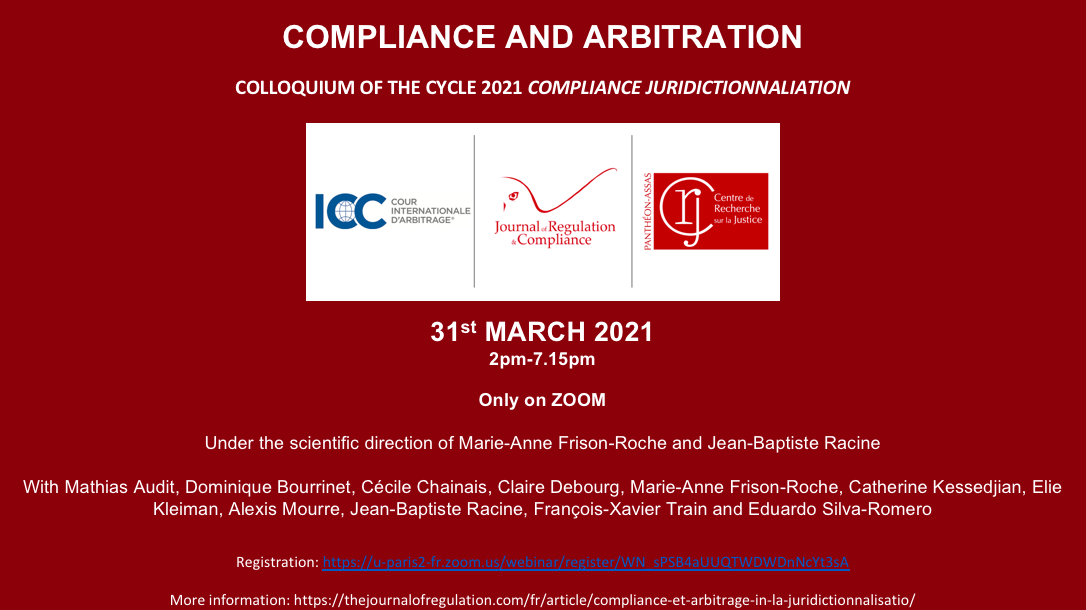
This colloquium took place the 31st of March 2021.
The manifestation was live broadcasted on Zoom.
Presentation of the theme:
The arbitrator is the ordinary judge of international trade. It was natural that he or she encountered Compliance: by definition Compliance Law takes hold of the whole world and follows the paths of international trade while it can only be deployed with the help of institutions which, by nature are spreading around the world and need authorities like the Courts.
The conference is based on the already perceptible connection points between Compliance and Arbitration to better identify what is emerging for tomorrow: contradiction or convergence between the two; weakening or consolidation. We are already seeing the impact that Compliance can have on the arbitrator's treatment of corruption or the consideration of money laundering. More generally, where do we stand with the arbitrator's knowledge of the many technical issues related to compliance? Beyond these, will the courts and arbitrators be able to achieve the goals, themselves new, sometimes monumental, pursued by Compliance Law?
Through this joint exploration of these avenues, the fate of compliance clauses inserted in contracts, the relevance in the matter of private codes of conduct, etc. will be examined.
Tomorrow, as of today, is the arbitrator a full and complete judge of Compliance Law?
How, with what specificities and what controls?
Notably will speak:
Mathias Audit, professeur à l'Université Panthéon-Sorbonne - Paris I (full professor at Sorbonne - University - Paris)
Cécile Chainais, director of the Centre de Recherche sur la Justice et le Règlement des Conflits (CRJ) and professeur à l'Université Panthéon-Assas (Paris II) (Full professor at Panthéon-Assas (Paris II) University)
Claire Debourg, professeure à l'Université Paris X- Nanterre (Full professor at Paris X - Nanterre)
Marie-Anne Frison-Roche, professeur à Sciences Po - Paris (Full Professor at Sciences Po - Paris)) and Director of the Journal of Regulation & Compliance (JoRC)
Catherine Kessedjian, professeur émérite de l'Université Panthéon-Assas (professor emeritus of Panthéon-Assas - Paris II University)
The European Commission published a Green Paper in September 2010 on Audit Policy, in order to give its opinion on the Lessons from the Crisis.From a systemic perspective of financial markets' stability, the Commission analyzes the role of the auditor, the internal structure of audit firms, the concentration of the audit market, and the possibility of a European market for auditing. But, what the Commission presents as a neutral description is actually a series of ideological stances, which are tenable, but also debatable. Thus, the Green Paper makes auditing out to be a structural element of financial markets, which shatters auditing's uniqueness, while attributing it a structural and systemic role, which is questionable. It then requires regulatory tools to open the auditing market to more competition, which will, in reality, expose it to the pressures of demand and lower the efficiency of auditing missions. It would be better to reinforce regulatory mechanisms towards security and conflicts of interest, rather than towards competition, which corresponds to the traditional French model of audit regulation.
FRENCH
La Commission européenne a lancé en septembre 2010 un Livre vert la Politique de l’audit, pour que soient tirée à son propos les Leçons de la Crise. C’est donc dans une perspective systémique de stabilité des marchés financiers que les questions sont posées par la Commission, concernant l’auditeur, l’organisation des sociétés d’audit, la concentration du marché de l’audit et l’hypothèse d’un marché européen de l’audit. Mais ce que la Commission présente comme une description neutre est une réalité une série de prises de positions idéologiques, soutenables mais aussi discutables. Ainsi, le Livre Vert présente l’audit comme un élément structurel des marchés financiers, ce qui brise l’unicité de l’audit, tandis qu’elle lui confère un rôle structurel et systémique, ce qui est discutable. Elle requiert ensuite des outils de régulations pour ouvrir à une plus forte concurrence le marché de l’audit, ce qui va en réalité l’exposer à la pression de la demande et abaisser l’effectivité des missions de l’audit, alors qu’il faut renforcer les outils de régulations, non pas par rapport à la concurrence mais par rapport à la sécurité et aux conflits d’intérêts, ce à quoi correspond le modèle traditionnel français.
GERMAN
Artikel: Kritische Analyse des Grünbuches der Europäischen Kommission im Bereich Abschlussprüfung: Eine problematische Definition vom systemrelevanten Agent und eine Illustration des Gegensatzes zwischen Regulierung und Wettbewerb.
Die Europäische Kommission hat im September 2010 ein Grünbuch zur Rolle der Abschlussprüfung veröffentlicht, um ihre Stellungnahme über die Lehre der Krise zu verbreiten. Die Kommission analysiert die Rolle des Abschlussprüfers, die innere Struktur von Abschlussprufüngsunternehmen, die Marktkonzentration des Prüfungsmarktes und die Möglichkeiten der Entstehung eines europäischen Abschlussprüfungsmarktes aus der systemischen Perspektive der Finanzmarktstabilität. Aber was die Europäische Kommission als eine neutrale Schilderung darstellt trägt eher mit sich eine Reihe von ideologischen Einstellungen, die zwar haltbar aber auch strittig sind. So stellt das Grünbuch die Abschlüssprufung als Strukturelement für die Finanzmärkte, was die Einheit der Abschlussprüfung zerbricht. Laut des Grünbuches spielt sie auch eine systemische und strukturelle Rolle, was auch fragwürdig ist. Der Prufüngsmarkt sollte auch zu mehr Wettbewerb durch Regulierungsmassnahmen eröffnet werden, was in der Tat dem Markt dem Drück der Anfrage aussetzen wird, und die Effizienz von Abschlussprüfungsaufträgen einschränken wird. Es wäre besser, Regulierungsmechanismen mit Hinsicht auf Sicherheit und Interessenkonflikten, eher als Wettbewerb, zu verfestigen, was eigentlich dem französichen Modell der Prüfungsregulierung entsprechen würde.
ITALIAN
Articolo: Analisi critica del Libro verde della Commissione europea sulla politica in materia di revisione dei conti: una definizione problematica dell'agente sistemico ed un'illustrazione dell'opposizione tra regolazione e concorrenza.
Nel mese di settembre 2010, la Commissione europea ha pubblicato un libro verde sulla politica in materia di audit (revisione dei conti) per emettere il suo parere sulle "Lezioni dalla crisi". Con una prospettiva sistemica della stabilità dei mercati finanziari, la Commissione analizza il ruolo del revisore dei conti, la struttura interna degli studi di revisione dei conti, la concentrazione del mercato dell'audit e la possibilità di strutturare un mercato europeo della revisione dei conti. Tuttavia, quello che la commissione presenta come un dato di fatto, in realtà è il frutto di una riflessione ideologica, sostenibile ma sicuramente discutibile. Il Libro verde rende la revisione dei conti, un'attività strutturale dei mercati finanziari, la cui unicità è quindi frazionata, e gli attribuisce un ruolo strutturale e sistemico, di per sé discutibile. Inoltre auspica con l'intervento di meccanismi di regolazione, un'apertura del mercato dell'audit al fine di garantire una concorrenza maggiore, che sarà esposta alle pressioni della domanda e diminuirà l'efficienza degli incarichi di revisione dei conti. Sarebbe meglio rafforzare i meccanismi di regolazione al fine di raggiungere una sicurezza maggiore ed evitare conflitti d’interessi, invece di auspicare una maggiore concorrenza, cosa che corrisponde al modello francese tradizionale della regolazione del mercato della revisione dei conti.
SPANISH
Artículo: Análisis crítico del Libro Verde de la Comisión Europea sobre su política de auditoría: una definición problemática sobre el agente del sistema y una ilustración sobre la oposición entre regulación y competencia.
En septiembre del 2010, la Comisión Europea publicó El Libro Verde sobre la política de auditoría para proveer su opinión sobre Las Lecciones de la Crisis. Desde una perspectiva sistemática de la estabilidad de los mercados financieros, la Comisión analiza el papel del auditor, la estructura interna de empresas de auditoría, la concentración del mercado de auditoría y la posibilidad de un mercado europea de auditoría. Pero, lo que la Comisión presenta como una descripción neutral es, de hecho, una serie de declaraciones ideológicas, que son defendibles, pero también discutibles. Por lo tanto, el Informe Verde describe a la auditoría como un elemento estructural de los mercados financieros, lo cual destruye la cualidad única de la auditoría, mientras que le atribuye un rol estructural y sistemático, lo cual es cuestionable. También requiere de instrumentos regulatorios para abrir el mercado de auditoría a una competencia más substancial, lo cual, en realidad, lo expone a las presiones de demanda y disminuye la eficacia de las misiones de auditoría. Sería mejor reforzar los mecanismo regulatorios hacia la seguridad y conflicto de intereses, y no hacia la competencia, lo cual corresponde al modelo tradicional francés de la regulación de auditoría.
In Cameroon, the electricity sector is organized around a public operator, the Aes-Sonel, which the State conceded the transmission and distribution of electricity. The “Agence de Régulation du Secteur de l’Energie – ARSEL ( Cameroons Regulatory Agency Electricity Sector ) is responsible for ensuring the proper functioning of the system, quality of service and consumer protection. As in other African countries for the moment the country suffers from a lack of electrification planning and a lack of access to electricity, a significant portion of the population.
However, the regulator has commissioned a survey from June 4 to August 16, 2012. He was released on September 5 which he says the study shows that the operator doesn’t provide public service obligations correctly towards consumers. The operator responds by saying that on the one hand the study is not conclusive and that other conditions, external to him, do not bring electricity to everyone but it’s not its fault.
The translated summaries are done by the Editors and not by the Authors
ENGLISH
The purpose of this collective work is to understand the causes of the financial crisis. It has a strong international dimension and draws in both legal and economic science. Although composed of independent contributions from each other, it relies on a general demonstration, summary of which will largely be the focus of this first bibliographic report, the importance of justifying the work that results in three successive bibliographic reports. Furthermore, the book focuses on the specific issue of governance in international finance, which runs through regulatory issues, but one cannot be reduced to the other and vice versa.
Therefore in all three bibliographic records, abstracts will be more or less developed on the contributions, depending on whether they directly concerned by regulation, in which case they will be preferred or more remote areas, in which case they will shortly exposed.
The firstbibliographic recordaimsto present,on the one hand,the general problemof the book,and alsoto highlighttwocontributionsof historical(1920-1930/2001-2007).
FRENCH
Fiche Bibliographique (Livre) : La globalisation de l’intégration financière. Perspective de trente ans, de la réforme à la crise)
Cet ouvrage collectif a pour objet de comprendre les causes de la crise financière. Il présente une dimension fortement internationale et puise à la fois dans la science juridique et économique. Bien que constitué de contributions autonomes les unes des autres, il s’appuie sur une démonstration générale, dont le résumé sera en grande partie l’objet de cette première fiche bibliographique, l’importance de l’ouvrage justifiant qu’il donne lieu à a trois fiches bibliographiques successives. En outre, l’ouvrage porte sur la question précise de la gouvernance dans la finance internationale, ce qui traverse les questions de régulation mais l’un ne se réduit à l’autre et vice et versa.
C’est pourquoi dans chacune des trois fiches bibliographiques, des résumés seront plus au moins développés concernant des contributions, suivant que celles-ci abordent directement des thèmes de régulation, auquel cas elles seront privilégiées, ou des thèmes plus éloignés, auquel cas elles ne seront qu’évoquées.
Cette première fiche bibliographique a pour objet de présenter d’une part la problématique générale de l’ouvrage et d’autre part de mettre en valeur deux contributions, de nature historique (1920-1930/2001-2007).
SPANISH
Informe Bibliográfico (Libro): La Integración Global Financiera, perspectivas desde 30 años. De la reforma hasta la crisis.
El objetivo de este trabajo colectivo es de entender las causas de la crisis financiera. Contiene una gran dimensión internacional y se apoya tanto en las ciencias legales como en las económicas. Aunque es una colección de contribuciones independientes el uno del otro, todos tienen en común una dimensión general, lo cual será detallado en el primer informe bibliográfico, la importancia de justificar el trabajo que resulta en tres informes bibliográficos sucesivos. El libro se centra en el tema específico de la gobernabilidad en la finanza internacional, la cual se relaciona a la regulación, pero uno no se reduce al otro y viceversa.
Por lo tanto, en cada uno de los tres informes bibliográficos, abstractos serán desarrollados para cada contribución, dependiendo de su relatividad a la regulación, en dado caso se les dará preferencia sobre casos mas lejanos, los cuales serán brevemente mencionados.
El primer informe bibliográfico se propone a presentar, de un lado, el problema general del libro, y del otro, de subrayar dos contribuciones históricas (1920-1930/2001-2007).
ITALIAN
Lo scopo di questo lavoro collettivo è capire le cause della crisi finanziaria. Tale lavoro ha una forte dimensione internazionale e si posiziona in un contesto legale ed economico. Sebbene composto da contributori indipendenti l’un dall’altro, si fonda su una problematica generale, il cui riassunto sarà l’oggetto principale di questa prima relazione bibliografica. L’importanza di tale studio è tale da giustificare i tre articoli che seguiranno su tale lavoro. Inoltre, questo lavoro di ricerca si focalizza sul tema specifico della governance in materia di finanza internazionale, e tocca diversi temi relativi alla regolazione che non possono essere ridotti o confusi l’un con l’altro. Pertanto, per tutti e tre questi articoli bibliografici, gli abstract saranno più o meno approfonditi su tali contribuzioni, a seconda del fatto che tale contribuzione sia rilevante ai fini dell’analisi della regolazione, nel qual caso l’abstract sarà più consistente, o se la contribuzione tocchi solo incidentalmente la regolazione, nel qual caso gli abstract saranno più corti. La prima relazione bibliografica punta, da un lato, a presentare la problematica generale di tale lavoro e, dall’altro, ad attirare l’attenzione su due contribuzioni, di natura storica.



 to be published in the Compliance & Regulation Series , co published by the Journal of Regulation & Compliance (JoRC) and Bruylant.