Passenger transport markets in Europe have been, and continue to be, liberalised across jurisdictions and sectors.
Since July 2015, passenger coach operators in France have been allowed to operate without regulation on longer routes (over 100km). For shorter routes, ARAFER, the French regulator for rail and roads, will test whether the coach service is likely to threaten the viability of the public rail service offered by SNCF on the same route. What changes could this reform bring, and how might the economic test be applied?
On December 10, 2010, the Commission de Régulation de l’Energie (CRE – French Commission for Energy Regulation) and the Autorité des marches financiers (French Securities Regulator – the AMF) entered into a memorandum of understanding (the MoU). Cooperation between these two sector based regulators is, for the most part, set against the background of, and aims at, a better (or, rather, burgeoning) regulation of the market for CO2 emission allowances.
FRENCH
Fiche thématique (Finance, Environnement, Energie): Exécution d’un accord de coopération passé entre les régulateurs français de l’énergie et des marchés financiers concernant la régulation du marché des émissions de carbone.
Le 10 décembre 2010, la Commission de Régulation de l’Energie (CRE) ET L’Autorité des MarchésFinanciers (AMF) ont signé un accord de coopération. La coopération entre ces deux régulateurs sectoriels a lieu dans un cadre plus général de réflexion sur une meilleure, voire future, régulation du marché des permis d'émission de CO2, et vise plus particulièrement ce but
GERMAN
Thematischer Bericht (Finanz, Umwelt, Energie): Erfüllung eines Kooperationsvertrages zwischen den französischen Energie- und Finanzdienstleistungsaufsichtsbehörden bezüglich auf der Regulierung vom Emissionsrechtehandel.
Am 10. Dezember 2010 haben die the Commission de Régulation de l’Energie (CRE – die französische Energieregulierungsbehörde) und die Autorité des marchés financiers (AMF – die französische Finanzdienstleistungsaufsichtbehörde) eine Vereinbarung geschlossen. Die Zusammenarbeit zwischen beiden Behorden ist Teil einer breiteren Überlegung über eine bessere, sogar zukünftige Regulierung des Emissionsrechtehandels – und zielt besonders darauf.
SPANISH
Informe temático (Finanza, Ambiente, Energía): Ejecución de un acuerdo de cooperación entre los reguladores franceses de finanza y de energía en relación a la regulación del mercado para las cuetos de emisión de gas de carbono.
El 10 de diciembre del 2010, la Commission de Régulation de l’Energie (CRE- La Comisión francesa de la regulación de energía) y la Autorité des marchés financiers (AMF – La Autoridad francesa de los mercados financieros) entraron en un memorándum de entendimiento (MoU). La cooperación entre estos dos reguladores basados en sectores distintos, es, primordialmente, centrado sobre el trasfondo, o bien, tiene como objetivo, una mejor regulación del mercado para las cuotas de emisiones de CO2 y se centre en dos principios (…).
ITALIAN
Relazione tematica (Finanza, Ambiente, Energia): Adempimento di un accordo in materia di cooperazione concluso tra i regolatori francesi in materia di finanza e di energia in relazione alla regolazione del mercato in materia di quote di emissione di CO2
Il 10 Dicembre 2010, la Commission de Régulation de l’Energie (CRE – la Commissione francese in materia di energia) e la Autorité des marches financiers (l’organo francese di regolazione finanziaria – la AMF) hanno concluso un memorandum of understanding (un MoU-una serie di accordi preliminari). La cooperazione tra questi due settori in materia di regolazione finanziaria é, in gran parte, punta a una regolazione migliore (o piuttosto una regolazione maggiore) del mercato delle quote di emissioni di CO2 ed è basata sui seguenti principi.
PORTUGUESE
Informe Temático (Finanças, Meio ambiente, Energia): Execução de um acordo de cooperação firmado pelos reguladores franceses de finanças e energia acerca da regulação do mercado de quotas para emissão de CO2.
A Commission de Régulation de l’Energie (CRE – Comissão francesa de regulação energética) e a Autorité des marches financiers (AMF – Autoridade francesa dos mercados financeiros) firmaram um memorando de acordo no dia 10 de dezembro de 2010. A cooperação entre estes dois reguladores de setor é, em sua maior parte, estabelecida em resposta ao contexto e orientada para uma melhor (ou, mais precisamente, para a emergente) regulação do mercado de quotas para emissão de CO2.
2010年12月10日,Commission de Régulation de l’Energie(CRE-法国能源监管委员会)与Autorité des marches financiers(AMF-法国金融市场管理局)达成了一份谅解备忘录。基于两部门间的监管合作,在极大程度上共同致力于改善或完善二氧化碳排放市场的配额管制。
The Law of 9 February 2010 transforms the status of La Poste (the French Postal Service) into a Public Limited Company ({Société Anonyme}) from 1st March 2010 and organises postal activities, especially as relates to national and regional development programmes.
Internet needs to be regulated, but by whom and from what criteria?
The high speed building of very different cases shows the urgency of reflections on the principles.
Consider the case in which just entered the British Regulatory Authority Advertising Standards Authority (ASA). Thiss Authority isn't specific to the Internet but the fact the behavior takes place on the Internet doesn't stop the Regulator, the ASA applying its control on "all media".
An Irish betting company organized bets about a future event: conviction or acquittal of Oscar Pistorus for the death of his fiancée. The latter doesn't deny being the author of the fatal blow but claims that he isn't responsible legally.
The website reproduces the accused of a very recognizable way in the form of an Oscar statuette. This is due to the homonymous first name and the statue of the reward. But this is also a triple ambiguity created by the company.
Secondly the statue can't walk as the athlete si one takes off his prosthetic that made him win races.
Thirdly and more than that, if convicted, he remains in prison, Oscar Pistorum would continue to be deprived of his freedom to come and go, and therefore still unable to "walk" freely, the betting firm indicating that it will reimburses money if the accused will "walk" (out of prison - as a sort of miracle ...).
_____
Watchingthat, more than 5,000 people protested. But before whom? In this excess of regulators, people turn to perhaps the most dynamic: in the UK it is probably the Advertising Standards Authority (ASA) .
But what to blame?
One could have said that it is illegal to bet on the outcome of a trial.
One could argue that you can't bet about a terrible history, whose center is the death of a young woman.
But it's rather toward the disability side and "minority rights" that the case is taking shape. Indeed, associations see it as primarily a mockery of people who can't walk.
Without further developed if the ASA takes a position on this advertising that the company has since removed, it will take a strong position in the regulation of the Internet and could for example clarify and prioritize the interests that must be respect in the virtual world.
Cass R. Sunstein is a prominent Law & Economics teacher (first at the University of Chicago, then at Harvard). Not only has he written reference handbooks on Regulation, he was also the one who inspired the Regulation policies of Obama. In his 2013 book Simpler, he expresses his stance: to be better, public policies need to be simpler.
In this essay, Sunstein explores how behavorial economics might lead to improve public decision-making processes. He bases its stances upon his experience as the Administrator, from 2009 to 2012, of the US Office of Information and Regulatory Affairs; that is why anyone who cares about Regulation should read it and ask themselves if simplicity, as the author states, may or may not be an actual leading principle for an effective government.
The OIRA, under the supervision of the Office of Management and Budget placed within the Executive Office, reviews the draft Regulations that are prepared by the cabinets of various rulemaking agencies. In this view, the OIRA can be regarded as a sort of custodian of the quality of Regulation throughout the US; conversely to the mainly consultative functions granted to the Conseil d'Etat in France, the OIRA's opinions are binding. Hence, a draft project shall not be issued nor be enforced without its prior consent. Part of OIRA's defining mission is also to centralize all the information held by diverse people within the executive branch, as to enable its access and circulation between all the rulemaking agencies responsible for elaborating and producing binding regulations.
Simpler is dedicated to the detailed study of the main decisions taken under Sunstein's decisive influence by the OIRA in the Regulation field during Obama's first mandate (2009-2012). Before taking up government functions, Sunstein focused part of his academic work on the interactions that are the most likely to occur between behavioral economics, law and public policy. To him, "a general lesson is that small, inexpensive policy initiatives, informed by behavioral economics, can have big benefits" (p. 41). He namely provides that "without a massive reduction in its current functions, government can be far more effective, far less confusing, far less counterproductive, and far more helpful if it opts, wherever it can, for greater simplicity" (p. 11).
This reference to 'simplicity', from which the name of Sunstein's essay stems, aims at translating all the efforts done by public authorities, under the supervision of the OIRA, to issue rules that were clearer and more accessible than before and that provided their subjects (whether they are citizens, companies, or federal administrations) a greater freedom in the choices they were able to make.
Throughout his book and with a little help from the various situations he had to face during his term at the OIRA, Sunstein shows that there is a virtuous relationship between a better information of the agents (whether they are the authors or the subjects of the norms at stake), a greater simplicity in public decision-making process and a better quality of the regulations meilleure qualité de la réglementation in force in a State. This paper hence aims to sum up the main points of the essay (I.), before making a few comments about it (II.).
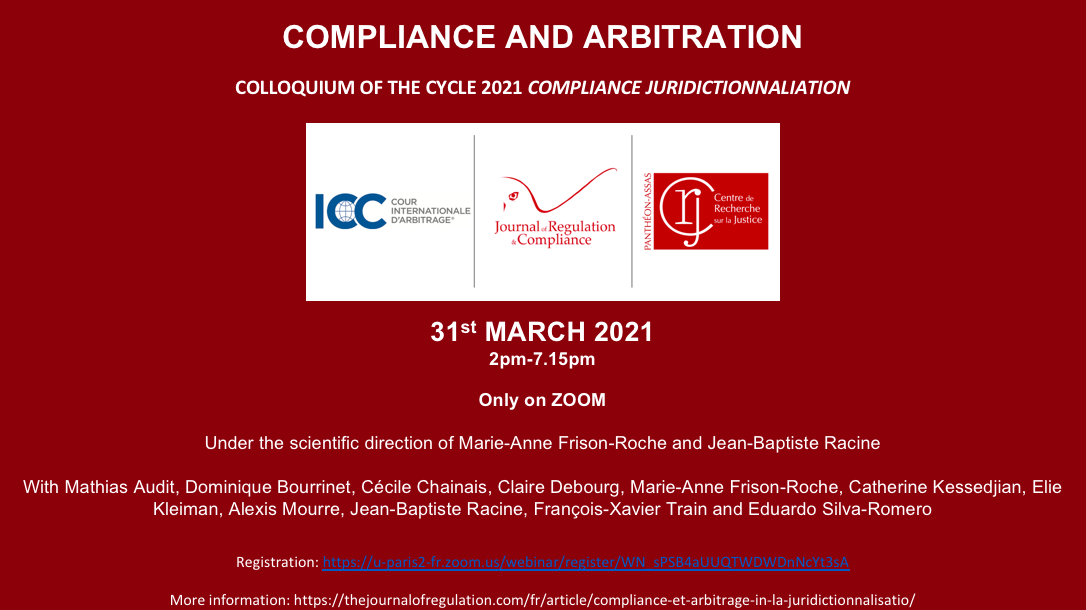
This colloquium took place the 31st of March 2021.
The manifestation was live broadcasted on Zoom.
Presentation of the theme:
The arbitrator is the ordinary judge of international trade. It was natural that he or she encountered Compliance: by definition Compliance Law takes hold of the whole world and follows the paths of international trade while it can only be deployed with the help of institutions which, by nature are spreading around the world and need authorities like the Courts.
The conference is based on the already perceptible connection points between Compliance and Arbitration to better identify what is emerging for tomorrow: contradiction or convergence between the two; weakening or consolidation. We are already seeing the impact that Compliance can have on the arbitrator's treatment of corruption or the consideration of money laundering. More generally, where do we stand with the arbitrator's knowledge of the many technical issues related to compliance? Beyond these, will the courts and arbitrators be able to achieve the goals, themselves new, sometimes monumental, pursued by Compliance Law?
Through this joint exploration of these avenues, the fate of compliance clauses inserted in contracts, the relevance in the matter of private codes of conduct, etc. will be examined.
Tomorrow, as of today, is the arbitrator a full and complete judge of Compliance Law?
How, with what specificities and what controls?
Notably will speak:
Mathias Audit, professeur à l'Université Panthéon-Sorbonne - Paris I (full professor at Sorbonne - University - Paris)
Cécile Chainais, director of the Centre de Recherche sur la Justice et le Règlement des Conflits (CRJ) and professeur à l'Université Panthéon-Assas (Paris II) (Full professor at Panthéon-Assas (Paris II) University)
Claire Debourg, professeure à l'Université Paris X- Nanterre (Full professor at Paris X - Nanterre)
Marie-Anne Frison-Roche, professeur à Sciences Po - Paris (Full Professor at Sciences Po - Paris)) and Director of the Journal of Regulation & Compliance (JoRC)
Catherine Kessedjian, professeur émérite de l'Université Panthéon-Assas (professor emeritus of Panthéon-Assas - Paris II University)
Les étudiants de Sciences po peuvent accéder à l'article lui-même par le Drive de Sciences po.
L'auteur rappelle ce cas dans lesquelles les banques membres du GIE ont été condamnées par la Commission européenne, en ce que les nouvelles règles adoptées au sein de ce GIE de gestion du mécanisme des cartes bancaires, qualifiées de "régulation" avaient un "objet anticoncurrentiel", ce qui suffisait à justifier la condamnation des opérateurs (décision de la Commission du 17 octobre 2007). Le Tribunal de Première Instance a confirmé cette analyse par un arrêt du 29 novembre 2012, estimant que la condamnation était fondée, puisque par sa nature un tel accord était "susceptible de produire des effets négatifs sur la concurrence".
Cela est invalidé par la Cour de justice, qui casse l'arrêt et renvoie le cas devant le Tribunal de première instance car le fait que l'accord soit "susceptible d'affecter la concurrence" ne le rend pas "anticoncurrentiel par objet".


 to be published in the Compliance & Regulation Series , co published by the Journal of Regulation & Compliance (JoRC) and Bruylant.