It regulates not only financial markets and also insurance companies.
It presents its mission in its website :
"FINMA's mandate is to protect creditors, investors and policy holders and ensure the smooth functioning of the financial markets. Through consistent supervision and predictable regulation, we make an important contribution to safeguarding the stability and good reputation of the Swiss financial centre, and consequently to enhancing its competitiveness."
On May 28, 2010, the Autorité de régulation des communications électroniques et des postes (ARCEP — French postal and telecommunications regulatory authority) published a report it ordered from WIK Consult, which details the tangible and intangible benefits accruing to La Poste (The French postal service) as a result of its universal service obligation, which are to be included in calculating compensation provided to the universal service provider for its universal service obligations, in application of the European Union’s Third Postal Directive liberalizing the postal market in the European Union. This report is critical in tone, but La Poste takes issue with its methodology and conclusions.
FRENCH
Rapport bibliographique (littérature grise) : Le 28 mai 2010, l’ARCEP a publié un rapport commandé auprès de WIK Consult, qui détaille une méthodologie pour l’évaluation des avantages immatériels dont bénéficie La Poste dans le cadre de ses obligations de service universel.
Le 28 Mai 2010, l’ARCEP a publié un rapport commandé auprès de WIK Consult, qui détaille les avantages matériels et immatériels dont bénéficie La Poste en tant que prestataire de service universel, et qui doivent être compris dans le calcul de la compensation accordée au prestataire de service universel en contrepartie de ses obligations de service universel, en application de la Troisième Directive Postale de l’Union Européenne.
GERMAN
Buchrezension: Die Autorité de Régulation des Communications Electroniques et des Postes (ARCEP - die französische Post- und Telekommunikationsaufsichtsbehörde) hat am 28. Mai 2010 einen Bericht veröffentlicht, den WIK Consult bestellt wurde. In diesem Bericht wird eine Methode für die Auswertung den unwesentlichen Vorzügen, die La Poste (die französische Post) aus ihrer Verpflichtung des öffentlichen Dienstes zieht, vorgestellt.
Die Autorité de Régulation des Communications Electroniques et des Postes (ARCEP - die französische Post- und Telekommunikationsaufsichtsbehörde) hat am 28. Mai 2010 einen Bericht, der von WIK Consult erstattet wurde, in dem detailliert wurden, welche sind die Vorzüge der Poste (die französische Post) im Lauf ihrer von den Dritten Richtlinien für Postdienste verlangerten Verpflichtung des öffentlichen Dienstes. Sehr kritisch, die Ergebnisse dieses Berichtes bleiben für La Poste umstritten.
GREEK
Βιβλιογραφική Έκθεση (Γκρίζα Βιβλιογραφία): Στις 28 Μαΐου 2010, η Αρχή Ηλεκτρονικών Επικοινωνιών& Ταχυδρομείων Γαλλίας (ARCEP) δημοσιεύει μια έκθεση που ανέθεσε να ετοιμάσει το WIK Consult, στην οποία παρουσιάζονται λεπτομερώς μέθοδοι για την αξιολόγηση των άϋλων οφελών που προκύπτουν ωφελούν για το Γαλλικό Ταχυδρομείο από τις υποχρεώσεις καθολικής υπηρεσίας.
Στις 28 Μαΐου 2010, η Αρχή Ηλεκτρονικών Επικοινωνιών& Ταχυδρομείων Γαλλίας (ARCEP) δημοσίευσε μια έκθεση που ανέθεσε στο WIK Consult, στην οποία παρουσιάζονται λεπτομερώς τα υλικά και μη υλικά οφέλη που εισρέουν στο Γαλλικό Ταχυδρομείο ως αποτέλεσμα των υποχρεώσεων καθολικής υπηρεσίας, τα οποία πρέπει να συμπεριληφθούν στον υπολογισμό αποζημίωσης που παρέχεται στον φορέα παροχής καθολικής υπηρεσίας κατ’ εφαρμογή της Τρίτης Κοινοτικής Οδηγίας για τα Ταχυδρομεία, με την οποία απελευθερώνεται στην Ευρώπη η σχετική αγορά. Η Έκθεση αυτή έχει επικριτικό ύφος, αλλά το Ταχυδρομείο διαφωνεί με τη μεθοδολογία και τα συμπεράσματά της.
POLISH
Raport bibliograficzny (szara literatura) : W dniu 28 maja 2010 r. Autorité de régulation des communications électroniques et des postes (ARCEP - francuski organ regulacji Telekomunikacji i Poczty) opublikował zlecony raport wykonany przez firmę WIK Consult, który szczegółowo prezentuje metodę oszacowywania niematerialnych korzyści wykorzystywanych przez La Poste (francuski serwis pocztowy) w ramach swoich zobowiązań świadczenia usług uniwersalnych.
W dniu 28 maja 2010 r. Autorité de régulation des communications électroniques et des postes (ARCEP - francuski organ regulacji Telekomunikacji i Poczty) opublikował raport WIK Consult, który szczegółowo prezentuje metodę oszacowywania materialnych i niematerialnych korzyści wykorzystywanych przez La Poste (francuski serwis pocztowy) w wyniku realizowania zobowiązań świadczenia usług uniwersalnych. Przedstawiona w raporcie metoda mówi o konieczności ujęcia korzyści w wyliczaniu kompensacji przyznanej dłużnikowi świadczenia usług uniwersalnych w zamian za jego zobowiązania świadczenia usług uniwersalnych, co jest zgodne z Trzecia Dyrektywą Pocztową Unii Europejskiej.
POLISH
Raport bibliograficzny (szara literatura) : W dniu 28 maja 2010 r. Autorité de régulation des communications électroniques et des postes (ARCEP - francuski organ regulacji Telekomunikacji i Poczty) opublikował zlecony raport wykonany przez firmę WIK Consult, który szczegółowo prezentuje metodę oszacowywania niematerialnych korzyści wykorzystywanych przez La Poste (francuski serwis pocztowy) w ramach swoich zobowiązań świadczenia usług uniwersalnych.
W dniu 28 maja 2010 r. Autorité de régulation des communications électroniques et des postes (ARCEP - francuski organ regulacji Telekomunikacji i Poczty) opublikował raport WIK Consult, który szczegółowo prezentuje metodę oszacowywania materialnych i niematerialnych korzyści wykorzystywanych przez La Poste (francuski serwis pocztowy) w wyniku realizowania zobowiązań świadczenia usług uniwersalnych. Przedstawiona w raporcie metoda mówi o konieczności ujęcia korzyści w wyliczaniu kompensacji przyznanej dłużnikowi świadczenia usług uniwersalnych w zamian za jego zobowiązania świadczenia usług uniwersalnych, co jest zgodne z Trzecia Dyrektywą Pocztową Unii Europejskiej.
POLISH
Raport bibliograficzny (szara literatura) : W dniu 28 maja 2010 r. Autorité de régulation des communications électroniques et des postes (ARCEP - francuski organ regulacji Telekomunikacji i Poczty) opublikował zlecony raport wykonany przez firmę WIK Consult, który szczegółowo prezentuje metodę oszacowywania niematerialnych korzyści wykorzystywanych przez La Poste (francuski serwis pocztowy) w ramach swoich zobowiązań świadczenia usług uniwersalnych.
W dniu 28 maja 2010 r. Autorité de régulation des communications électroniques et des postes (ARCEP - francuski organ regulacji Telekomunikacji i Poczty) opublikował raport WIK Consult, który szczegółowo prezentuje metodę oszacowywania materialnych i niematerialnych korzyści wykorzystywanych przez La Poste (francuski serwis pocztowy) w wyniku realizowania zobowiązań świadczenia usług uniwersalnych. Przedstawiona w raporcie metoda mówi o konieczności ujęcia korzyści w wyliczaniu kompensacji przyznanej dłużnikowi świadczenia usług uniwersalnych w zamian za jego zobowiązania świadczenia usług uniwersalnych, co jest zgodne z Trzecia Dyrektywą Pocztową Unii Europejskiej.
SPANISH
El 28 de mayo del 2010, la ARCEP (el regulador francés de telecomunicaciones y servicios postales) publicó un informe que comisionó de WIK Consult, detallando los métodos de la evaluación intangible de los beneficios que acumula La Poste (el servicio postal francés) de sus obligaciones universales de servicios.
El 28 de mayo del 2010, la Autorité de régulation des communications électroniques et des postes (ARCEP — el regulador francés de telecomunicaciones y servicios postales) publicó un informe que había encomendado a WIK Consult, en donde se detalla los beneficios tangibles e intangibles pertenecientes a La Poste (el servicio postal francés) como resultado de sus obligaciones universales de servicios, los cuales serán incluidos ahora in la calculación de la compensación otorgada al proveedor universal de servicio por sus obligaciones universales de servicios en aplicación de la tercera Directiva Postal de la Unión Europea que liberaliza el mercado postal en le Union Europea. Este informe es de carácter crítico pero La Poste reconoce su legitimidad en cuanto a su metodología y sus conclusiones.
The Report on The Patent Markets in Knowledge Economy focuses on the development of new forms of “commoditisation” patents (as sold at auction, by brokers’ interventions, electronic platforms...) that lead to a more structured and open market. The difficulties linked to the emergence of those new tools, first and foremost, the valuation of the patents, are real and must not be ignored. However, for the authors of the Report, the great state of uncertainty where we currently find ourselves implies the need for the authorities to be very cautious, despite that fact the opportunities these different Patent Markets present must at the same time lead to a positive and proactive approach. France and Europe (the European level is imperative) must be present in this arena. For these actors, new experiments must undoubtedly be encouraged and the creation of new forms of valorisation must be developed. Simultaneously, the Patent System would have to be reconsidered to ensure the delivery of high quality patents. In sum, the authors of the Report plead for “sustained attention” to be accorded to these questions on behalf of the public authorities.
FRENCH
Rapport bibliographique (Littérature Grise): Les marchés des brevets dans l'économie de la connaissance (The Patent Markets in Knowledge Economy)
Le rapport sur Les marchés des brevets dans l'économie de la connaissance se concentre sur le développement de nouvelles formes de "marchandisation" des brevets (lorsque vendus aux enchères, par l'intervention de courtiers, sur des plateformes électroniques...) qui aboutissent à un marché plus structuré et plus ouvert. Les difficultés liées à l'émergence de ces nouveaux outils, avant tout l'évaluation des brevets, sont réelles et ne doivent pas être ignorées. Cependant, pour les auteurs du rapport, l'état de grande incertitude dans lequel nous sommes aujourd'hui implique des autorités qu'elles soient très précautionneuses, malgré le fait que les possibilités que ces marchés des brevets offrent doivent faire l'objet d'une approche à la fois positive et incitative. La France et l'Europe (le niveau Européen est inévitable) doivent être présentes dans domaine. Pour ces acteurs, de nouvelles formes de valorisation doivent être développées. Simultanément, le système de brevets devrait être reconçu pour assurer la délivrance de brevets de haute qualité. En somme, les auteurs du rapport plaident pour qu'une "attention maintenue" soit accordée à ces questions au nom des autorités publiques.
GERMAN
Bibliographischer Bericht: die Patentmärkte in der Ökonomie des Wissens (The Patent Markets in Knowledge Economy)
Der Bericht über „Die Patentmärkte in der Ökonomie des Wissens“ beschreibt die Entwicklung von neuen Formen der „Kommodifizierung“ und Kommerzialisierung von Patenten (Verkauf auf Auktionen, durch Börsenmakler, auf elektronischen Plattformen…), die zu einem strukturierteren und offeneren Markt führen. Die Schwierigkeiten dieser Kommerzialisierung sind beträchtlich, vor allem im Hinblick auf die Wertbestimmung der Patente. Die Autoren betonen einerseits, dass die allgemeine Ungewissheit, in der wir uns befinden, zur Vorsicht anhält, aber dass andererseits ein proaktives Eingreifen und Regulierung notwendig erscheinen um dieses Potential zu nutzen. Frankreich und vor allem Europa muss in diesem Bereich aktiv werden. Sie müssen sich hier auf unbekanntes Terrain wagen und neue Formen der Bewertung von Patenten erproben. Gleichzeitig sollte jedoch das Patentsystem reformiert werden um eine hohe Qualität der Patente zu sichern. Insgesamt, fordern die Autoren „nachhaltige Aufmerksamkeit“ der öffentlichen Autoritäten zu diesen Fragen.
ITALIAN
Relazione bibliografica (Letteratura Grigia): Les Marchés des brevets dans l’economie de la connaissance (I mercati dei brevetti nell’economia della conoscenza)
La relazione su “I mercati dei brevetti nell’economica della conoscenza” si concentra sullo sviluppo di nuove forme di mercificazione di brevetti (vendita all’asta, per mezzo di intermediari finanziari, piattaforme elettroniche…) che portano verso un mercato più strutturato e più aperto. Le difficoltà legate alla diffusione di questi nuovi meccanismi, soprattutto per quanto riguarda la valutazione dei brevetti, sono reali e non devono essere sottovalutate. Tuttavia, secondo gli autori della relazione, il grande stato di incertezza, in cui versiamo , implica la necessità per le autorità di essere molto caute, nonostante le opportunità offerte da questi mercati dei brevetti e devono indurre ad un approccio positivo e proattivo. La Francia e l’Europa (lo standard europeo è obbligatorio) vanno tenuti in debita considerazione. Per questi operatori, vanno certamente incoraggiate nuove esperienze e sviluppata la creazione di nuove forme di valorizzazione. Nel contempo, il sistema dei brevetti dovrebbe essere riconsiderato in modo da assicurare il rilascio di brevetti di alto livello. In sintesi, gli autori sostengono che le autorità pubbliche debbano accordare una “attenzione sostenuta” a tali questioni.
CHINESE
书目报告(灰色文献):知识经济中的专利交易(The Patent Markets in Knowledge Economy)
Informe bibliográfico (Literatura Gris): Los mercados de patentes en la economía del conocimiento (The Patent Markets in Knowledge Economy)
El informe Los mercados de patentes en la economía del conocimiento se enfoca en el desarrollo de nuevas formas de patentes de "commoditización" (vendidos en subastas, por intervención de agentes, plataformas electrónicas...) que llevan a un mercado más estructurado y abierto. Las dificultades liadas al surgimiento de esos nuevos instrumentos, primordialmente, la tasación de los patentes, son reales y no deberían de ser ignoradas. Sin embargo, para los autores del informe, el estado de gran incertitud en la cual nos encontramos ahora implica la necesidad de que las autoridad actúen con cautela, pero a pesar de esto, las oportunidades que presentan estos diferentes Mercados de Patentes deberán a la misma vez llevar a una postura positiva y proactiva. Francia y Europa (el nivel europeo es imperativo) deberán de estar presentes en esta arena. Para estos actores, nuevos experimentos deberán ser alentados y la creación de nuevas formas de valoración deberán ser desarrolladas. Simultáneamente, el Sistema de Patentes debería de ser reconsiderado para asegurar la entrega de patentes de alta calidad. En síntesis, los autores del informe le ruegan a las autoridades públicas una mayor "atención sostenida" a estas cuestiones.
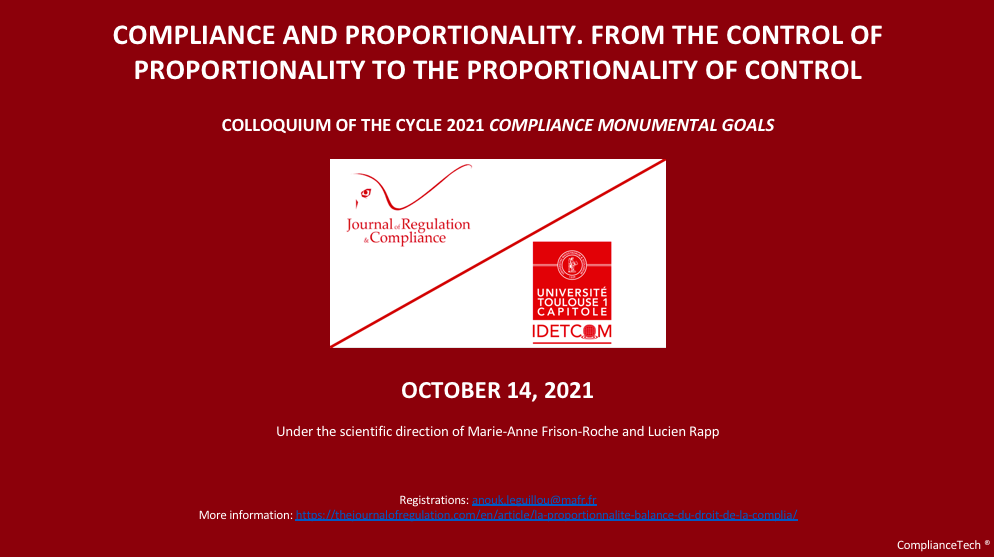
The colloquium will take place, a priori, on site in Toulouse, on October 14, 2021.
It will be broadcasted in live online.
🎥 Videos will be extracted.
► Presentation of the topic :
Compliance Law tends towards "Monumental Goals". This puts the concern, the calculation and the control of proportionality at the center. Proportionality is one of the most common references for compliance practices and strategies, but paradoxically, one of the least well defined. Perhaps even one of the most elusive.
For the German Federal Constitutional Court in Karlsruhe, the principle of proportionality allows the quantitative easing policies of the European Central Bank (ECB) to be monitored. This principle is linked to nothing less than the principle of democracy and is the basis of the control of ultra vires. In French law, proportionality refers to the provisions of Article 8 of the Déclaration des droits (Bill of Rights) of 1789, according to which the law should only establish penalties that are strictly and obviously necessary. In many areas of civil or business life, the compliance of behavior and the consequences of non-compliance are assessed on the basis of a graded assessment by the censor (competitor, regulator or judge).
Proportionality calls for action, which opens up a margin of appreciation to take into account the facts or circumstances. It also allows for the exercise of control over abuse of rights or excess of power. It goes beyond the office of the judge or the censor to forge one of its tools: the control of proportionality, which is obviously not the proportionality of the control.
How to integrate proportionality into compliance practices and strategies?
Does it introduce a certain tolerance in the assessment of situations and is it thus a factor of rediscovered freedom in the development of risk matrices?
Conversely, is it not synonymous with increased vigilance on the part of compliance officers, by leaving open the possibility of a reinforced control of their acts or decisions, by the evaluation of their advisability and not of their conformity alone?
► Working method:
🚧 The colloquium is built around 4 topics, which would be prepared in 4 working papers.
🚧 The writing of each working paper will have been entrusted by experts.
Secondly, these working papers will be available to be criticized by two practionners of Compliance technics.
For each topic, there will be these three sequences:
Presentation of the topic by the author of the working paper ;
Discussion by the two discussants, who will have read the working paper previously ;
Discussion with the public onsite and online.
The four topics chosen are:
1️⃣ Proportionality and Conformity
2️⃣ Proportionality and Evaluation
3️⃣ Proportionality and Normativity
4️⃣ Proportionality and Sanction
► registrations and information :
attendance to the manifestation is free, onsite or online
every registration for an attendance onsite will be supported by Toulouse-I-Capitole University
information will be available on a website opened by Toulouse-I-Capitole University
____
►Will speak, notably :
🎤 Marie-Anne Frison-Roche, professor of Regulation and Compliance Law, director of the Journal of Regulation & Compliance
🎤 Alexandra Mendoza-Carminade, professor at Toulouse-I-Capitole University
🎤Lucien Rapp, professor at Toulouse-I-Capitole University
🎤 Marc Segonds, professor at Toulouse-I-Capitole University
This article is a continuation of the Regulatory Law Review’s first public symposium, entitled "The Role of Supreme Courts in Economic Cases", which was held on January 25, 2010.
FRENCH
Article : Régulation et les Cours Suprêmes, les perspectives transatlantiques
Cet article fait suite au premier symposium public organisé par la Regulatory Law Review intitulé "Le rôle des cours suprêmes en matière économique" qui a eu lieu le 25 janvier 2010.
GERMAN
Dieser Artikel folgt die erste Fachkonferenz der Regulatory Law Review zum Thema "Die Rolle der Oberster Gerichtshofen im wirtschaftlichen Fällen", die am 25. Januar 2010 stattfand.
SPANISH
Artículo: Regulación y cortes supremas: perspectivas transatlánticas.
Este artículo es la continuación del primer simposio público organizado por la Regulatory Law Review, titulado “El rol de las cortes supremas en casos de materia económica," que tuvo lugar el 25 de enero del 2010.
The French Rail Regulator entrusts a public undertaking, RFF ("Réseau Ferré de France"), the management of the railway infrastructure. It must therefore enter into contracts with the railway undertakings to have rail transportation. European laws provide that these contracts must follow on the one hand, the specific legal provisions, and on the other hand the "network statement ". In addition, framework agreements determine the distribution of the allocation of capacity of the infrastructure between transport undertakings, schedules and prices. The regulator must give a reasoned opinion on these agreements. The notice is only optional, binding neither the State nor the parties. RFF ("Réseau Ferré de France") has developed a project of framework agreement and transmitted it to the autorité française de régulation des activités ferroviaires (ARAF) – (French Rail Regulator). It has chosen to open on 17 April a public consultation, with on its website the project of framework agreement, allowing any stakeholders to express themselves on the duration, pricing, transparency and confidentiality, and also the contractual balance of such an agreement. The consultation will be closed on 4 June and the autorité française de régulation des activités ferroviaires (ARAF) – (French Rail Regulator) will then deliver its opinion.
The Bundesanstalt für Finanzdienstleistungsaufsicht - BaFin (the German Federal Financial Supervisory Authority) issued on Tuesday May 18th 2010 three decrees prohibiting temporarily naked short selling. These decisions are effective from May 19th 2010 until March 31th 2011. They will be regularly assessed and can be lifted during this period.
FRENCH
La Bundesanstalt für Finanzdienstleistungsaufsicht - BaFin (l’autorité allemande de surveillance des marchés financiers) a interdit par trois décrets publié le 18 mai 2010 la vente à découvert à nu et les CDS du 19 mai 2010 au 31 mars 2011.
La Bundesanstalt für Finanzdienstleistungsaufsicht - BaFin (l’autorité allemande de surveillance des marchés financiers) a publié mardi 18 mai 2010 trois décrets interdisant temporairement la vente à découvert à nu. Ces décrets prennent effet le 19 mai 2010 et durent jusqu’au 31 mars 2011. Ils seront régulièrement évalués et pourront être levés à n’importe quel moment durant cette période.
GERMAN
Die Bundesanstalt für Finanzdienstleistungsaufsicht - BaFin hat am 18. Mai 2010 die ungedeckte Leerverkäufe und ungedeckte CDS auf Staatsanleihen der Eurozone untersagt.
Die BaFin hat drei Anordnungen am 18. Mai 2010 herausgegeben. Sie untersagen die ungedeckte Leerverkäufe von Schuldtiteln von Staaten der Eurozone, die an einer inländischen Börse zum Handel im regulierten Markt zugelassen sind, so wie ungedeckte CDS. Diese Verbote gelten vom 19. Mai 2010 bis zum 31. März 2011 und werden laufend überprüft.
SPANISH
La Bundesanstalt für Finanzdienstleistungsaufsicht – BaFin (la Autoridad Supervisora de Finanza Federal Alemana) prohíbe las ventas de cortos al descubierto y los CDS a través de tres decretos que se aplicarán entre el 19 de mayo 2010 hasta el 31 de marzo 2011.
La Bundesanstalt für Finanzdienstleistungsaufsicht – BaFin (la Autoridad Supervisora de Finanza Federal Alemana) publicó tres decretos el 18 de mayo del 2010 prohibiendo temporalmente la vena de cortos al descubierto. Estas decisiones serán efectivas desde el 19 de mayo 2010 hasta el 31 de marzo 2011. Serán asesoradas regularmente y podrán ser desmanteladas en cualquier instante durante este periodo.
CHINESE
Bundesanstalt für Finanzdienstleistungsaufsicht - (BaFin:德国金融市场监管机构)于2010年5月18日出台三项法令,规定在2010年5月9日至2011年3月31日期间内禁止“裸卖空”和信贷违约掉期行为。
Bundesanstalt für Finanzdienstleistungsaufsicht - (BaFin:德国金融市场监管机构)于2010年5月18日出台三项法令暂时禁止“裸卖空”行为。这些法令将于2010年5月9日至2011年3月31日内生效。它们将被定期评估并且可能在上述期限的任何时间被撤销。



 forthcoming in the series Regulations & Compliance, co-published by the Journal of Regulation & Compliance (JoRC) with Dalloz.