Before the rules called Basel III shall apply in Switzerland in 2015, the "Département Fédéral de Finance" (Swiss Federal Department of Finance) of the "Conseil Fédéral Suisse" (Swiss Federal Council) has developed a draft of an ordinance that was subject to public consultation on August 28, 2012. Another text will present later rules about systemic banks. The order will be applicable on the 1st January 2013. But banks, like any anticipator market agent, have not already internalized the rules of Basel III ? In addition, it seems that the criterion of systemic continues to be the size of the agent, but it is not so evident.
The Autorité des Marchés Financiers (AMF – French Financial Markets Authority) approves the "Provisions" section of the Code of Good Practice published by the Association française de la gestion financière (AFG—French Asset Management Association).
In The Journal of Regulation the summaries’ translation are done by the Editors and not by the authors
ENGLISH
At first sight, the notion of the neutrality of the State seems to be obvious and simple, almost a pleonasm. Being above isolated individuals, the State is responsible for the general interest, even envisioned on a long-term basis. However when one gets deeper into the analysis, this first observation, evident at first sight, must be mitigated and qualified.
FRENCH
A première vue,la notionde la neutralité del’Etatsemble êtreévidente et simple,presque un pléonasme. Etant au-dessusd’ individus isolés, l’Étatest responsable del’intérêt général, mêmeenvisagésur le long terme.Toutefois, A aller plus loin dans l’analyse,cette première observation,évidenteà première vue,doiventêtre atténués etexpliquée.
SPANISH
A primera vista, la noción de la neutralidad estatal parece ser obvio y simple, casi un pleonasmo. Estando por encima de los individuos aislados, el Estado es responsable por el interés general, aun cuando considerado a largo plazo. Pero cuando uno se sumerge en el análisis, esta primera observación, evidente a primera vista, puede ser mitigado y calificado.
ITALIAN
A prima vista, la nozione di neutralità dello Stato sembra un concetto ovvio e semplice, quasi un pleonasmo. Lo Stato, al di sopra degli individui singolarmente considerati, è responsabile dell’interesse generale, persino a lungo termine. Tuttavia, quando si analizza in modo più approfondito tale concetto, questa prima osservazione, evidente a prima vista, deve essere relativizzata e specificata.
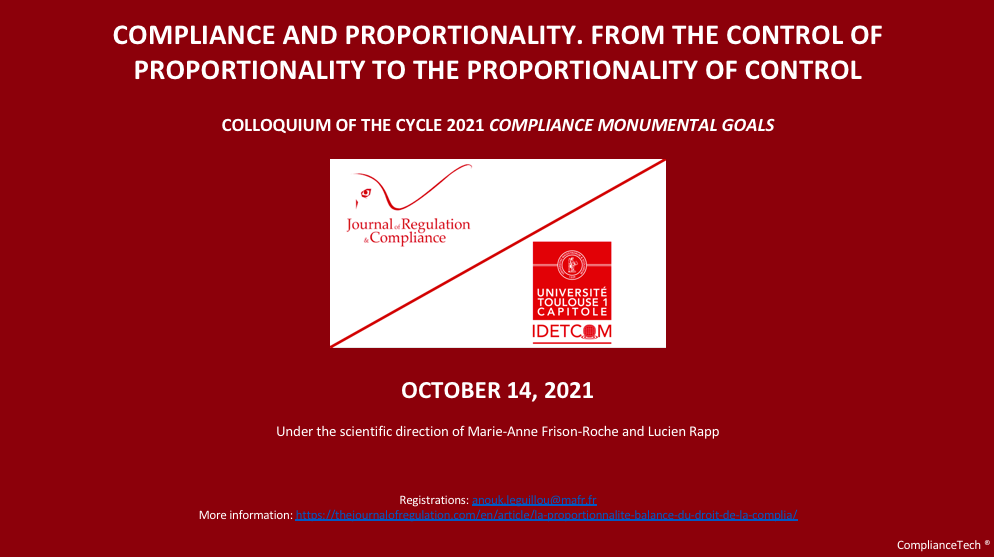
The colloquium will take place, a priori, on site in Toulouse, on October 14, 2021.
It will be broadcasted in live online.
🎥 Videos will be extracted.
► Presentation of the topic :
Compliance Law tends towards "Monumental Goals". This puts the concern, the calculation and the control of proportionality at the center. Proportionality is one of the most common references for compliance practices and strategies, but paradoxically, one of the least well defined. Perhaps even one of the most elusive.
For the German Federal Constitutional Court in Karlsruhe, the principle of proportionality allows the quantitative easing policies of the European Central Bank (ECB) to be monitored. This principle is linked to nothing less than the principle of democracy and is the basis of the control of ultra vires. In French law, proportionality refers to the provisions of Article 8 of the Déclaration des droits (Bill of Rights) of 1789, according to which the law should only establish penalties that are strictly and obviously necessary. In many areas of civil or business life, the compliance of behavior and the consequences of non-compliance are assessed on the basis of a graded assessment by the censor (competitor, regulator or judge).
Proportionality calls for action, which opens up a margin of appreciation to take into account the facts or circumstances. It also allows for the exercise of control over abuse of rights or excess of power. It goes beyond the office of the judge or the censor to forge one of its tools: the control of proportionality, which is obviously not the proportionality of the control.
How to integrate proportionality into compliance practices and strategies?
Does it introduce a certain tolerance in the assessment of situations and is it thus a factor of rediscovered freedom in the development of risk matrices?
Conversely, is it not synonymous with increased vigilance on the part of compliance officers, by leaving open the possibility of a reinforced control of their acts or decisions, by the evaluation of their advisability and not of their conformity alone?
► Working method:
🚧 The colloquium is built around 4 topics, which would be prepared in 4 working papers.
🚧 The writing of each working paper will have been entrusted by experts.
Secondly, these working papers will be available to be criticized by two practionners of Compliance technics.
For each topic, there will be these three sequences:
Presentation of the topic by the author of the working paper ;
Discussion by the two discussants, who will have read the working paper previously ;
Discussion with the public onsite and online.
The four topics chosen are:
1️⃣ Proportionality and Conformity
2️⃣ Proportionality and Evaluation
3️⃣ Proportionality and Normativity
4️⃣ Proportionality and Sanction
► registrations and information :
attendance to the manifestation is free, onsite or online
every registration for an attendance onsite will be supported by Toulouse-I-Capitole University
information will be available on a website opened by Toulouse-I-Capitole University
____
►Will speak, notably :
🎤 Marie-Anne Frison-Roche, professor of Regulation and Compliance Law, director of the Journal of Regulation & Compliance
🎤 Alexandra Mendoza-Carminade, professor at Toulouse-I-Capitole University
🎤Lucien Rapp, professor at Toulouse-I-Capitole University
🎤 Marc Segonds, professor at Toulouse-I-Capitole University
On November 16, 2010, the Comptroller and Auditor General of India made public a 96-page report (n° 19 of November 2010) in which it revealed gross irregularities suggesting favoritism in procedures for licensing mobile telephone operators and attributing frequencies from the mobile telephone spectrum over a period stretching from April 2003 to October 2009, on behalf of the Ministry of Communications and Information Technology. Following the revelation of this report, the Minister for Telecommunications, Andimuthu Raja, resigned from his post on the suggestion of the Prime Minister of India.
A series of decisions handed down by the European Court of Justice on March 9, 2010 reduces the burden of proof for environmental damages, in order to facilitate the application of the 'polluter pays' principle, and provides national regulatory authorities broad powers in enforcing environmental liability.
The translated summaries are done by the Editors and not by the Authors.
ENGLISH
The Autorità per le garanzie nelle comunicazioni (or “AgCom” – the Italian Regulatory Authority for electronic communications) issued a decision on January 11, 2012, setting regulatory remedies applicable to the Italian incumbent’s fixed next generation networks (NGN).
Italian next generation networks’ regulation complies with pro-competitive and pro-investment objectives provided for by EU sectoral law.
FRENCH
La Autorità per le garanzie nelle comunicazioni (ou “AgCom” - Autorité italienne de régulation pour les communications électroniques) a adoté une décision le 11 janvier 2012, imposant des engagements applicables à l’entreprise italienne de télécommunication, opérateur historique, en vue d’organiser la prochaine génération des réseaux.
Cette régulation italienne de la prochaine génération des réseaux de télécommunications est conforme aux objectifs retenus par les textes sectoriels de l’Union Européenne, dont les objectifs sont de favoriser la concurrence et l’investissement en la matière.
The French Act of October 22, 2010 establishes a Conseil de Régulation Financière et du Risque Systémique (Council of Financial Regulation and Systemic Risk), chaired by the Minister of the Economy. It is composed of the Governor of the Bank of France (who is also chairman of the Autorité de Contrôle Prudentiel ( Prudential Supervision Authority), its Vice-President, and the Presidents of the Autorité des Marchés Financiers ( Financial Markets Authority) and the Autorité des Normes Comptables (Authority of Accounting Standards), and three other competent individuals.
FRENCH
Article: La nature hybride du Conseil de Régulation Financière et du Risque Sytémique.
La loi du 22 octobre 2010 établit un Conseil de Régulation Financière et du Risque Systémique, dirigé par le Ministre de l'Économie. Il est composé du Gouverneur de la Banque de France (qui préside également l'Autorité de Contrôle Prudentiel), son Vice-Président, et les Présidents de l'Autorité des Machés Financiers, l'Autorité des Normes Comptables et trois autres individus compétents.
GERMAN
Artikel: Die hybride Natur der Conseil de Régulation Financière et du Risque Sytémique (der französische Rat für Finanzdienstleistungsregulierung und für Systemisches Risiko).
Das Gesetz vom 22. Oktober 2010 hat einen Conseil de Régulation Financière et du Risque Sytémique (Rat für Finanzdienstleistungsregulierung und für Systemisches Risiko) eingesetz, unter die Leitung der Wirtschaftsminister. Seine Mitglieder sind der Präsident der Banque de France (die französische Zentralbank) (der auch Vorsitzende der Autorité de Contrôle Prudentiel (Aufsichtbehörde) ist), der Vizepräsident der Banque de France, und die Präsidenten der Autoritédes Marchés Financiers(die Finanzdienstleistungsaufsichtsbehörde), der Autorité des Normes Comptables (die Rechnungslegungsstandardsbehörde) und drei andere fachkundigen Menschen.
ITALIAN
Articolo: La natura ibrida del Conseil de Régulation Financière et du Risque Systémique (Consiglio per la regolazione finanziaria ed il rischio sistemico).
Una legge francese del 22 ottobre 2010 ha creato il Conseil de Régulation Financière et du Risque Systémique (Consiglio per la regolazione finanziaria ed il rischio sistemico), presieduto dal Ministro dell’Economia. I membri di tale organismo sono: il Governatore della Banca di Francia (al contempo presidente della Autorité de Contrôle Prudentiel (l’autorità di controllo prudenziale), i vice-presidenti della Banca di Francia, i Presidenti della Autorité des Marchés Financiers (l’autorità dei mercati finanziari) e della Autorité des Normes Comptables (l’autorità per la creazione di standard in materia contabile) e da altri tre professionisti competenti.
SPANISH
Artículo: La naturaleza híbrida del Conseil de Régulation Financière et du Risque Sistématique (el Consejo francés de regulación financiera y del riesgo sistemático).
El Acto francés des 22 de octubre del 2010 establece un Conseil de Régulation Financière et du Risque Sistématique (Consejo de regulación financiera y del riesgo sistemático), dirigido por el Ministro de la Economía. Este cuerpo está compuesto por el Gobernador del Banco de Francia (quien también es el presidente de la Autorité de Contrôle Prudentiel (la Autoridad de control prudencial), su vicepresidente y los presidentes de Autorité des Marchés Financiers (la Autoridad de los mercados financieros) y la Autorité des Nromes Comptables (la Autoridad de normas de contabilidad) y tres otro indivíduos competentes.
CHINESE
记事:Conseil de Régulation Financière et du Risque Systémique(法国金融监管与系统风险理事会)的混合性质。
依据2010年10月22日法律而创建的Conseil de Régulation Financière et du Risque Systémique(法国金融监管与系统风险理事会)由法国经济工业和财政部长领导。该理事会由法兰西银行行长(同时主管Autorité de Contrôle Prudentiel(审慎监管局),审慎监管局副主席,Autorité des Machés Financiers(法国金融市场管理局)主席,Autorité des Normes Comptables(法国会计标准管理局)主席以及其他三家个体主管机构组成。
On June 19, 2012, the European Parliament adopted an extensively modified version of the draft text prepared by the European Commission on credit rating agencies. It does not address the issue of the concentration of the rating market, believing that this is a matter of competition and not of regulation. It reduces the scope of the rotation rule in three years and only for structured products. It requires agencies to issue a schedule of two or three dates in the year where they can change their sovereign debt notes. Next to these devices of ex ante regulation, Parliament adopts an ex post system, civil liability of agencies, in which it will be for them to demonstrate to investors that they have complied with the rules in force.
In Congo (Brazzaville), following the dissolution of the {Direction Générale de l’Administration Centrale des Postes et Télécommunications} (DGACPT — General Direction of the Central Administration of Posts and Telecommunications), two bodies have been implemented: the “Direction Générale des Postes et Télécommunications” (General Direction of Posts and Telecommunications), and the “Agence de Régulation des Postes et des Communications Electroniques” (ARPCE – Congolese Postal and Telecommunications Regulatory Agency).
FRENCH
Loi n° 11-2009 du 25 novembre 2009 portant création de l’agence de régulation des postes et des communications électroniques (Arpce)
Au Congo, après la dissolution de la Direction Générale de l'Administration Centrale des Postes et Télécommunications (DGACPT), deux organismes ont été mis en place : la Direction Générale des Postes et Télécommunications et l’« Agence de régulation des postes et des communications électroniques» (ARPCE), créé par la loi du 25 novembre 2009.
GERMAN
Kongolesisches Gesetz Nr. 11-2009 vom 25. November 2009 bezüglich auf der Durchführung der Agence de Régulation des Postes et des Communications Electroniques (ARPCE, Post- und elektronische Kommunikationsregulierungsagentur).
Nach der Auflösung der Direction Générale de l'Administration Centrale des Postes et Télécommunications (DGACPT - Hauptführung der Post- und Telekommunikationszentralverwaltung), wurden zwei Behörde eingefürht: die Direction Générale des Postes et Télécommunications (Hauptführung für Post- und Telekommunikationsdienst) und die Agence de Régulation des Postes et des Communications Electroniques (ARPCE, Post- und elektronische Kommunikationsregulierungsagentur).
SPANISH
Ley n° 11-2009 del 25 de noviembre del 2009 sobre la creación de la “Agence de Régulation des Postes et des Communications Electroniques” (ARPCE- una agencia de reglación de servicios postales y telecomunicaciones del Congo).
En Congo (Brazzaville), después de la disolución de la Direction Générale de l’Administration Centrale des Postes et Télécommunications (DGACPT —la Dirección General de la Administración Central de servicios postales y telecomunicaciones del Congo), dos cuerpos han sido introducidos : la “Dirección Générale des Postes et Télécommunications” (la Direccion General de Servicios Postales y Telecomunicaciones) y la “Agence de Régulation des Postes et des Communications Electroniques” (ARPCE– la agencia de regulación de servicios postales y telecomunicaciones del Congo).




 forthcoming in the series Regulations & Compliance, co-published by the Journal of Regulation & Compliance (JoRC) with Dalloz.