Madame Christine Lagarde, the French Finance Minister, gives a speech at the inauguration of the Autorité de contrôle prudentiel (ACP – Prudential Control Authority), implemented by the Ordinance of 21 January 2010, in which she explains the philosophy behind the ACP’s activities. Stability and solidity of the international financial system and consumer protection are the ACP’s main responsabilities.
In France, doyen Ripert, who wrote the most eminent treatises on both Civil Law and Corporate Law, possessed a genius that led him to be the first law scholar to study the relationship between Corporate Law and the economic organization of capitalism. In this fundamental work, he highlighted the benefits of the Société Anonyme: it’s majority rule is a tribute to efficiency, and its limitation of shareholders’ liability to the amount of their capital invested produces an incentive to invest. Ripert thereby studied law from an outsider’s perspective. Nobody has ever denied the relationship between the economic structure of the corporation and the legal structure of the corporation, just as no jurist has ever denied the link between the commercial transaction and the contract. Precisely, Ripert gave a sort of evaluation, a way of understanding law from the outside, instead of discussing law from the inside by substituting what the law is for what one wishes it would be. Economics were external to Law, Law adapted itself to Economics, and Economics were not at the heart of Law.
FRENCH
Le droit des sociétés, lorsqu’il est vu par le prisme de la Régulation : Industrie des services financiers et protection du marché de l’investissement
En France, le doyen Ripert qui écrivit tout à la fois les plus grands traités de droit civil et de droit commercial a eu l’ingéniosité d’être le premier juriste à étudier le rapport entre le droit des sociétés et l’organisation économique du capitalisme. Dans cet ouvrage fondamental, il soulignait les bienfaits de la société anonyme, par le tribut que la loi de la majorité rend à l'efficacité et par l'incitation à investir produite par la limitation de responsabilité des actionnaires à hauteur de leur apport. Il s'agissait de parler à propos du droit, dans une perspective extérieure à celui-ci. Nul n'a jamais ignoré les rapports entre la structure économique de l'entreprise et la société commerciale, de la même façon qu'aucun juriste n'a dénié le rapport entre l'échange marchand et le contrat. Mais précisément, il s'agissait d'un rapport, une façon de parler du droit en se situant en dehors de celui-ci, et non pas d'une intimité ou d'une substituabilité entre le droit et ce qui est attendu de lui. L'économie était vue comme extérieure, le droit se mettait en rapport avec elle, l’économie n'était pas au cœur du droit.
GERMAN
Artikel: Körperschaftsrecht durch das Prisma der Verordnung gesehen: der Finanzdienstleistungssektor und der Investorenschutz
In Frankreich war Doyen Ripert, der bedeutende Abhandlungen sowohl über Zivil- und als auch über Körperschaftsrecht schrieb, der erste Jurist, der das Verhältnis zwischen Körperschaftsrecht und der wirtschaftlichen Organisation des Kapitalismus untersuchte. In dieser entscheidenden Arbeit betonte er die Vorteile der Aktiengesellschaft (AG): Mehrheitsentscheidung führt zu maximaler Effizienz und Investitionen werden gefördert durch die Beschränkung der Haftung der Aktionäre. Ripert studierte Rechtswissenschaften somit aus der Perspektive eines Außenstehenden. Niemand hat zwar das Verhältnis zwischen der ökonomischen Struktur eines Unternehmens und seiner rechtlichen Struktur angezweifelt, ebenso wie kein Jurist die Verbindung zwischen dem Handelsgeschäft und dem Vertragsrecht leugnen würde. Jedoch gab Ripert eine Art von Evaluierung, eine Analyse des Rechts in der Perspektive eines Außenstehenden, anstatt von einem Insider-Standpunkt zu philosophieren was das Gesetz sagt und was es sagen sollte. Ökonomie und Recht waren zwei getrennte Disziplinen: das Recht musste sich zwar der Wirtschaft anpassen, jedoch befanden sich wirtschaftliche Beweggründe nicht im Zentrum der Rechtswissenschaft.
POLISH
Artykuł: Prawo o spółkach widziane z punktu widzenia Regulacji: Sektor usług finansowych i ochrona rynku inwesticji.
We Francji, Dziekan Ripert, który napisał najbardziej znane traktaty z prawa cywilnego i prawa handlowego, był jednocześnie pierwszym prawnikiem, który studiował relację istniejącą pomiędzy prawem o spółkach a ekonomiczną organizacją kapitalizmu. W swoim głównym traktacie, podkreślał korzystne strony francuskiej formy spółki z ograniczoną odpowiedzialnością (Société Anonyme) : Obowiązująca reguła większości nadaje skuteczności w działaniu, a ograniczenie odpowiedzialności wspólników w stosunku do zainwestowanego kapitału, zachęca do inwestowania. Riper analizował prawo w kontekscie innym niż kontekst prawny. Nikt nigdy nie zaprzeczał istnienia relacji pomiędzy strukturą ekonomiczną firmy i spółką handlową. Tak samo jak żaden prawnik nie negował związku istniejącego pomiędzy wymianą handlową i umową.
Ale to właśnie Ripert, zaproponował po raz pierwszy analizę prawa, wychodzac poza jego kontekst prawny, zamiast oceniać prawo z wewnętrznego, prawnego punktu widzenia lub próbować substytuowac prawo na takie jakie chciałoby się żeby było.
Ekonomia była zawsze traktowana odzielnie od prawa. Prawo dostosowywało się do ekonomii, a ekonomia nie była w centrum prawa.
SPANISH
El derecho corporativo visto a través de la prisma de la regulación: la industria de los Servicios financieros y la protección al inversor.
En Francia, el decano Ripert, quien escribió uno de los tratados más inminentes sobre el Derecho civil y el Derecho corporativo, poseía un genio que lo convirtió en el primer erudito en estudiar la relación entre el Derecho corporativo y la organización económica del capitalismo. En su obra fundamental, subraya los beneficios de la Sociedad Anónima: su regla de la mayoría es tributo a la eficiencia y la limitación que pone sobre los pasivos de los accionistas en cuanto al acceso al capital que han invertido se convierte en un incentivo más para invertir. Ripert ha logrado, por consiguiente, estudiar el derecho de una perspectiva ajena. Nadie ha negado nunca la relación entre la estructura económica de la corporación y la estructura legal de la corporación, tal como ningún jurista no ha negado nunca el lazo entre la transacción comercial y el contrato. Precisamente, Ripert da una clase de evaluación, una manera de comprender el derecho desde afuera, en vez de discutirlo desde adentro al substituir lo que el derecho es en la realidad y lo que desearíamos que el derecho fuera. La Economía se encontraba fuera de la esfera del Derecho, pero el Derecho se ha adaptado a la Economía, y la Economía no se encontraba en el núcleo del Derecho.
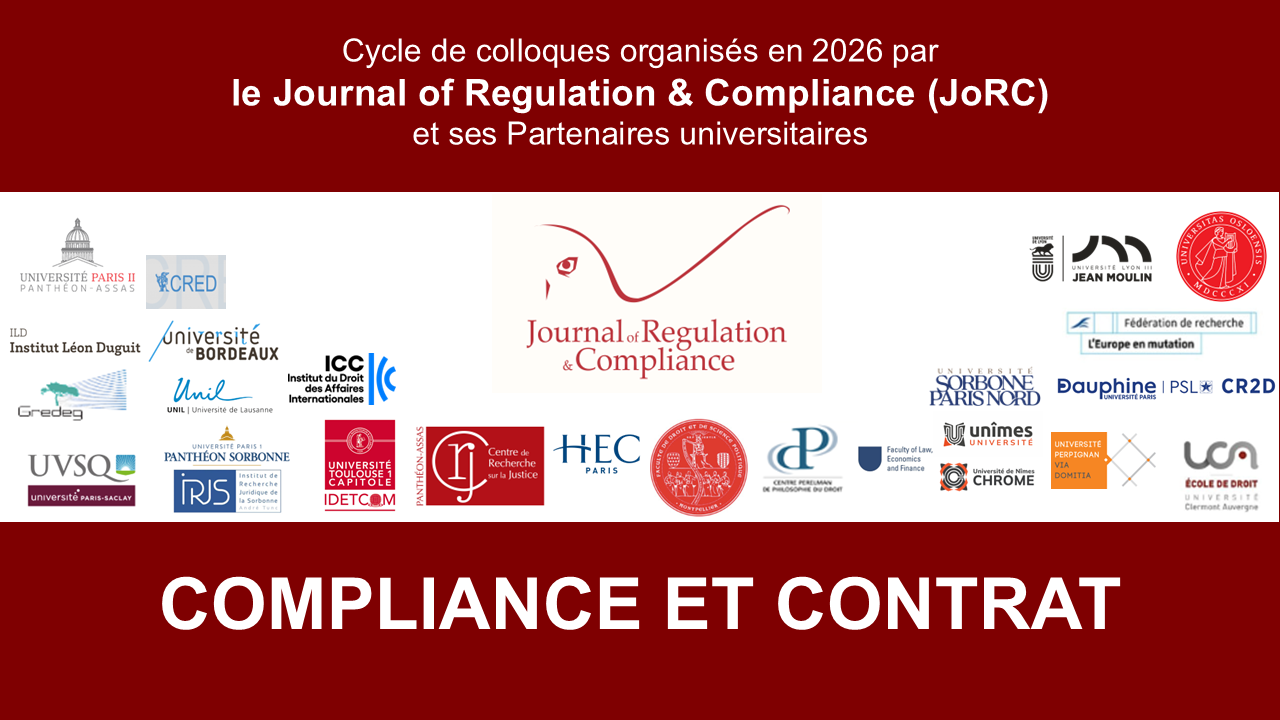
►Full reference : Journal of Regulation & Compliance (JoRC) and Panthéon-Assas University (Paris II), Le "contrat de compliance (The "compliance contract"') Paris, 12 June 2026.
To register for in-person or remote attendance: ...
As the number of places is limited, you will be asked to confirm your attendance 48 hours in advance.
🧮The event will take place in the auditorium, Rue Notre-Dame-des-Champs, 75006 Paris, on 12 June 2026, between 9.30 a.m. and 1.30 p.m.
_____
► Presentation of the topic : Companies have a legal obligation to put "compliance structures" in place, such as whistleblowing mechanisms, plans, information gathering systems and data security systems. Many adopt a management strategy that leads them to choose to outsource the implementation of this obligation, or even to outsource the compliance structure itself, which then most often takes the form of a platform, even though responsibility cannot be transferred. But the line between structure and behaviour, between responsibility for the decision and its implementation, becomes blurred.
The hypothesis examined here through the "Compliance Contract", which should not be confused with compliance clauses but which is linked to them, is the widespread use by companies of this type of contract, the existence and typology of which was identified in 2022. Corresponding to a very significant share of the "compliance market", perhaps a specific market, it could constitute a special contract, requiring at the very least a specific regime, either under Competition Law, Data Law, particularly Personal Data Law, etc.
____
Speakers will include :
🎤Bruno Deffains, Professor of Economics at the University of Paris Panthéon-Assas (Paris II)
🎤 Marie-Anne Frison-Roche, Professor of Regulatory Law and Compliance, Director of the Journal of Regulation & Compliance (JoRC)
On July 23, 2010 was published the awaited European-wide stress test, a mechanism designed by regulators to restore trust in markets through the mean of transparency. This paper examines the effect of trust on market from an economic perspective as well as from a sociological one. The paper demonstrated how trust, because it aims at achieving transparency which is Regulation’s number one tool, is not only necessary to economic growth but also participates to fulfilling regulatory objectives, such as market stability, risk prevention and consumer protection. Indeed, because Regulation is a mechanism aiming at preventing market failures, it needs as many tools, such as sociological ones (e.g. incentives) it may use to achieve such aim. The paper suggests that transparency is a tool for Regulation since it acts as a communicating vessel between regulatory objectives (microprudential) and supervisory ones (macroprudential), which both contribute to Regulation’s broader objective: the stability of a system.
FRENCH
Article: la régulation par la confiance: l'exemple des stress tests
Le 23 juillet 2010 a été publié le très attendu stress test à l'échelle européenne, un mécanisme conçu par les régulateurs pour restaurer la confiance dans les marchés par la transparence. Cet article examine les effets de la confiance sur les marchés dans une perspective économique et sociologique. L'article démontre en quoi la confiance, parce qu'elle a pour but d'installer la transparence, premier objectif de la Régulation, n'est pas seulement nécessaire à la croissance économique, mais participe également à l'accomplissement d'objectifs régulatoires, comme la stabilité du marché, la prévention du risque et la protection du consommateur. En effet, parce que la Régulation est un mécanisme visant à empêcher les défaillances de marché, elle a besoin d'autant d'instruments, y compris sociologiques (p.ex. les incitations), dont elle peut avoir usage pour atteindre cet objectif. L'article suggère que la transparence est un outil pour la Regulation puisqu'elle joue le rôle de transmetteur entre des objectifs régulatoires (micro-prudentiels) et des objectifs de supervision (macro-prudentiels), qui tous deux contriibuent à l'objectif plus large de la Régulation: la stabilité d'un système.
GERMAN
Artikel: Durch Vertrauern regulieren: das Beispiel den Stress Tests
Am 23. Juli 2010 wurden die erwarteten Ergebnisse den europaweiten Stress Tests bekanntgegeben. Diese Tests wurden von den Regulierungsbehörden dazu erfasst, um das Vertrauern auf Märkten durch Transparenz wiederherzustellen. Dieser Artikel erforscht die Auswirkung von Vertrauern auf Märkten auf einer ökonomischen und soziologischen Perspektive. Er zeigt, inwieweit Vertrauern, das den ersten Ziel der Regulierung, die Transparenz, einsetzen soll, nicht nur notwendig für die Wachstum ist, sondern auch für die Durchsetzung von Regulierungsziele, wie Marktstabilität, Riskverhütung, und Verbraucherschutz. Zwar ist Regulierung ein Mechanismus, das darauf zielt, Marktversagen zu vermeiden, sie braucht so viele Instrumente, einschliesslich soziologische Instrumente (z.B. Anreize), die sie brauchen könnte. Der Artikel deutet an, dass Transparenz ein Instrument der Regulierunh ist, da sie die Übertragung von Regulierungsziele (mikroprudentiel) und Überwachungsziele (makroprudentiel) erlaubt, was zum breiten Ziel der Regulierung beiträgt, und zwar die Systemstabiliserung.
SPANISH
La regulación a base de confianza: el ejemplo del estudio del estrés
El 23 de julio del 2010 fue publicado el muy esperado estudio del estrés, que se llevó a cabo a través de toda Europa, lo cual es un mecanismo diseñado por reguladores para restaurar la confianza en los mercados utilizando el valor medio de la transparencia. Este informe examina el efecto de la confianza sobre el marcado desde una perspectiva económica al igual que desde una perspectiva sociológica. El informe demuestra que la confianza, precisamente porque su objetivo es la transparencia que es el instrumento primordial de la Regulación, no sólo es necesaria para el crecimiento económico, sino que también contribuye a la realización de los objetivos regulatorios, como la estabilidad del mercado, la prevención del riesgo y la protección al consumidor. Por lo tanto, ya que la Regulación es un mecanismo cuyo objetivo es prevenir los fallos del mercado, necesita de la mayor cantidad de instrumentos posibles, como instrumentos sociológicos (por ejemplo, los incentivos), para cumplir con su meta. El informe sugiere que la transparencia es un instrumento para la Regulación ya que actúa como una nave comunicativa entre los objetivos regulatorios (microprudencial) y los objetivos de supervisión (macroprudencial), que juntos contribuyen al objetivo más amplio de la Regulación: la estabilidad del sistema.
ITALIAN
Articolo: Regolazione attraverso la fiducia: l’esempio degli stress test
Il 23 luglio 2010 é stato pubblicato il tanto atteso stress test a livello europeo, un meccanismo ideato dai regolatori al fine di rassicurare i mercati attraversola trasparenza. Tale studio esamina gli effetti della fiducia sul mercato da un punto di vista economico e sociologico. Lo studio dimostra come la fiducia, puntando a raggiungere una maggiore trasparenza, meccanismo primario della regolazione finanziaria, non é solamente necessaria per la crescita economica ma contribuisce inoltre a raggiungere gli obiettivi dei regolatori come la stabilità del mercato, la prevenzione del rischio e la protezione dei consumatori. Inoltre, poiché la regolazione é un meccanismo che vuole evitare i mancati funzionamenti del mercato, sono necessari per raggiungere tale scopo diversi strumenti, tra cui quelli sociologici (ad esempio gli incentivi). Questo studio suggerisce che la trasparenza é uno strumento di regolazione dal momento in cui costituisce il vaso comunicante tra gli obiettivi della regolazione (micropudenziale) e quelli della supervisione (macroprudenziale). Entrambi questi obiettivi contribuiscono al più ampio obiettivo della regolazione: la stabilità di un sistema.