
Search results (607 cards)

Updated: Sept. 25, 2012 (Initial publication: Jan. 10, 2011)
Sectorial Analysis
Fiche thématique (Finance, Environnement, Energie): Exécution d’un accord de coopération passé entre les régulateurs français de l’énergie et des marchés financiers concernant la régulation du marché des émissions de carbone.
Le 10 décembre 2010, la Commission de Régulation de l’Energie (CRE) ET L’Autorité des Marchés Financiers (AMF) ont signé un accord de coopération. La coopération entre ces deux régulateurs sectoriels a lieu dans un cadre plus général de réflexion sur une meilleure, voire future, régulation du marché des permis d'émission de CO2, et vise plus particulièrement ce but
GERMAN
Thematischer Bericht (Finanz, Umwelt, Energie): Erfüllung eines Kooperationsvertrages zwischen den französischen Energie- und Finanzdienstleistungsaufsichtsbehörden bezüglich auf der Regulierung vom Emissionsrechtehandel.
Am 10. Dezember 2010 haben die the Commission de Régulation de l’Energie (CRE – die französische Energieregulierungsbehörde) und die Autorité des marchés financiers (AMF – die französische Finanzdienstleistungsaufsichtbehörde) eine Vereinbarung geschlossen. Die Zusammenarbeit zwischen beiden Behorden ist Teil einer breiteren Überlegung über eine bessere, sogar zukünftige Regulierung des Emissionsrechtehandels – und zielt besonders darauf.
Informe temático (Finanza, Ambiente, Energía): Ejecución de un acuerdo de cooperación entre los reguladores franceses de finanza y de energía en relación a la regulación del mercado para las cuetos de emisión de gas de carbono.
El 10 de diciembre del 2010, la Commission de Régulation de l’Energie (CRE- La Comisión francesa de la regulación de energía) y la Autorité des marchés financiers (AMF – La Autoridad francesa de los mercados financieros) entraron en un memorándum de entendimiento (MoU). La cooperación entre estos dos reguladores basados en sectores distintos, es, primordialmente, centrado sobre el trasfondo, o bien, tiene como objetivo, una mejor regulación del mercado para las cuotas de emisiones de CO2 y se centre en dos principios (…).

Aug. 17, 2020
Newsletter MAFR - Law, Compliance, Regulation
Full reference: Frison-Roche, M.-A., Risk Mapping: is it legally different when it is made by Regulatory Bodies or by Regulated Enterprises?, in Newsletter MAFR - Law, Compliance, Regulation, 17th of August 2020
Read, by freely subscribing, other news of the Newsletter, MAFR - Law, Compliance, Regulation
Summary of the news
Each year, the Autorité des marchés financiers (French financial markets regulator), the European Central Bank and the Agence française anti-corruption (French anti-corruption agency) publish risk maps. At first glance, risk maps established by the regulator aim to both help regulator and the regulated company to face risks by anticipating them. These documents would only be an assistance brought to firms in their Compliance mission and not an injunction from the regulator to take into account the risks that it emphasizes.
However, Law forces firms to do their own risk maps under penalty of sanctions. Since the regulator has previously published its own risk map, can companies, obliged to write theirs, deviate from it? If the firm follows the map published by the regulator, can it protect itself against this if it is accused of not having fulfilled its compliance obligations? On the contrary, if the operator does not follow regulator's risk map, can this be blamed on it? Formally, regulator's risk maps do not come with an injunction to take it into account but, as everyone knows, any recommendation from a regulator or supervisor must be taken into account.
The legal solution could here be the implementation of a system of "comply or explain" which would mean that if the firm decides to no follow the risk map established by the regulator, it must be able to justify its choice.
To go further, read:
- Frison-Roche, M.-A., Legal Theory of Risk Mapping, center of Compliance Law, working paper, 2020
Aug. 19, 2020
Newsletter MAFR - Law, Compliance, Regulation
Full reference: Frison-Roche, M.-A., Regulators' Impartiality and contents control: "Les infidèles" case, Newsletter MAFR - Law, Compliance, Regulation, 19th of August 2020
Read by freely subscribing the other news of the Newsletter MAFR - Law, Compliance, Regulation
To go further, read the chapter of the book Compliance Tools: "The geographical pregnancy of Compliance tools" opened by an introductive chapter written by Jean-Baptiste Racine
Summary of the news
Impartiality of the regulator is one of the most important principles of Regulation and Compliance Law. However, this impartiality can be difficult to implement when the regulation object has a strong moral dimension.
In August 2020, various religious associations sized the Conseil National de Régulation de l'Audiovisuel sénégalais (Senegalese audiovisual regulatory authority) to ask the interdiction of broadcasting on television of the film "Les infidèles" telling the story of a married woman with multiple lovers.
First, the regulator distinguishes the sequences likely to be detrimental to cultural and religious identities and shocking sequences or likely to attack the dignity of the person. Then, it asks the deletion of indecent and obscene scenes and of scenes likely to be detrimental to cultural and religious identities, bans the broadcasting of the film in the television before 10.30 pm, asks an update of the trailer and requires the introduction of a pictogram "forbidden to children under 16" during the broadcasting. The CNRA judges itself able to regulate the content of telefilms in order to protect cultural identities with regards to the law of 4th of January setting its mission.
In 2012, a similar controversy surrounded, in France, the broadcasting of a different film with the same name. However, the purpose and the context were very different because the film was broadcasted at cinema, because it presented adultery men, because it was comic, because the competent regulator was not an administrative body but a professional body and because the broadcasting country was not the same. Here, only the poster was modified.
Thus, an impartial regulation must however taking into consideration "local cultural identities".
Updated: June 4, 2012 (Initial publication: May 27, 2012)
Breaking news
Updated: Sept. 17, 2012 (Initial publication: Sept. 11, 2012)
Breaking news

June 24, 2019
Breaking news
In what it presents as a set of guidelines designed by a risk-driven approach, the FATF published on 21 June 2019 recommendating to fight the use of crypto-assets and cryptocurrency platforms for launderind money and financing terrorism.
This fight against money laundering is (with the fight against corruption) often presented as the core of the Compliance Law. The FATF takes a large part of it. Even if this new branch of Law aims to crystallize other ambitions, such as the fight against tax fraud or climate change, or even the promotion of diversity or education and the preservation of democratie, the legislation of Compliance Law are mature in the matter of money laundering and the terrorism financing, as they are in the fight against corruption.
The news comes then not from the new legal mechanisms but rather from the new technological tools that could allow the realization of the behaviors against which these obligations of compliance have been inserted in the legal system. It is then to these technologies that the law must adapt. This is the case with crypto-assets and cryptocurrency platforms. Because these are rapidly evolving technologies, with the exercise of written guidelines in 2019 to inform the meaning of the provisions adopted in 2018, the FATF is taking the opportunity to change the definition it provides of crypto-assets and cryptocurrencies. So that a too narrow definition by the texts does not allow the operators to escape the supervision (phenomenon of "hole in the racket" - loophole)..
___
In fact, in October 2018, the FATC (Financial Action Task Force) developed 15 principles applying to these platforms, to allow this intergovernmental organization to carry out its general mission to combat money laundering and the financing of terrorism. These June 2019 recommendations are to interpret them.
In this very important document, where it is expressly stated that it is a matter of fixing the obligations of those who propose crypto-assets and crypto-currencies, the notion of self-regulation is rejected. Il est writter : "Regarding VASP (virtual assets services providers) supervision, the Guidance makes clear that only competent authorities can act as VASP supervisory or monitoring bodies!footnote-119, and not self-regulatory bodies. They should conduct risk-based supervision or monitoring, with adequate powers, including the power to conduct inspections, compel the production of information and impose sanctions. There is a specific focus on the importance of international co-operation between supervisors, given the cross-border nature of VASPs’ activities and provision of services."
On the contrary, it is a matter of elaborating the control obligations that these service providers must exercise over products and their customers (Due Diligences), which must be supervised by public authorities.
In order to exercise this supervision and monitoring, the national authorities themselves must ensure that they work together : "As the Virtual Assets Services Providers (VASP) sector evolves, countries should consider examining the relationship between AML/CF (Anti-Money Laundering and Counter Terrorist Financint) measures for covered VA activities and other regulatory and supervisory measures (e.g., consumer protection, prudential safety and soundness, network IT security, tax, etc.), as the measures taken in other fields may affect the ML/TF risks. In this regard, countries should consider undertaking short- and longer-term policy work to develop comprehensive regulatory and supervisory frameworks for covered VA activities and VASPs (as well as other obliged entities operating in the VA space) as widespread adoption of VAs continues".
After particularly interesting comparative law information on Italy, the Scandinavian countries and the United States, the report concludes: "International Co-operation is Key", because of the global nature of this activity.
Since the issue is not the global Regulation of these platforms and types of products, but only the possible modes of money laundering and terrorist financing to which they may give rise, the FATF recalls that neither crypto-products nor product suppliers are not referred to as such. As the guidance's title recalls, common to the 2018 document adopting the 15 principles and this interpretive document, these are "risk-based" rules. Thus, it is according to the situations that these - products and suppliers - that they may or may not present risks of laundering and financing of terrorism: depending on the type of transaction, the type of client, the type of country, etc. For example, from the moment that the transaction is anonymous, that is impossible to know the "beneficiary", or that it is transnational and instantaneous, which makes it difficult to supervise because of the heterogeneity of national supervisions little articulated between them.
In reports that public supervisors must have with crypto-product suppliers, they must adjust according to the level of risk presented by them, higher or lower: "Adjusting the type of AML/CFT supervision or monitoring: supervisors should employ both offsite and onsite access to all relevant risk and compliance information.However, to the extent permitted by their regime, supervisors can determine the correct mix of offsite and onsite supervision or monitoring of Virtual Assets Services Providers (VASPs). Offsite supervision alone may not be appropriate in higher risk situations. However, where supervisory findings in previous examinations (either offsite or onsite) suggest a low risk for ML/TF, resources can be allocated to focus on higher risk VASPs. In that case, lower risk VASPs could be supervised offsite, for example through transaction analysis and questionnaires".
This "adjustment" required does not prevent a very broad conception of the power of supervision. So, for nothing escapes the recommendations (and in particular the obligations that ensue for the suppliers of these products), the definition of the crypo-assets and crypo-currencies is this one: “Virtual asset” as a digital representation of value that can be digitally traded or transferred and can be used for payment or investment purposes. Virtual assets do not include digital representations of fiat currencies, securities, and other financial assets that are already covered elsewhere in the FATF Recommendations."
And for the same reason of effectiveness is posited the principle of technological neutrality: "Whether a natural or legal person engaged in Virtual Assets (VA) activities is a Virtual Asset Services Provider (VASP) depends on how the person uses the VA and for whose benefit. As emphasized above, ... then they are a VASP, regardless of what technology they use to conduct the covered VA activities. Moreover, they are a VASP, whether they use a decentralized or centralized platform, smart contract, or some other mechanism.".
The interpretative guidelines then formulate the obligations that these platforms have with regard to the supervisors they obey(question of the "jurisdiction", ratione loci ; ratione materiae): " The Guidance explains how these obligations should be fulfilled in a VA context and provides clarifications regarding the specific requirements applicable regarding the USD/EUR 1 000 threshold for virtual assets occasional transactions, above which VASPs must conduct customer due diligence (Recommendation 10); and the obligation to obtain, hold, and transmit required originator and beneficiary information, immediately and securely, when conducting VA transfers (Recommendation 16). As the guidance makes clear, relevant authorities should co-ordinate to ensure this can be done in a way that is compatible with national data protection and privacy rules. ".
These platforms are not uniformly defined due to the diversity of their activities. Because it is their activity that makes them responsible for this or that regulator. For example from the Central Bank or the Financial Regulator: "For example, a number of online platforms that provide a mechanism for trading assets, including VAs offered and sold in ICOs, may meet the definition of an exchange and/or a security-related entity dealing in VAs that are “securities” under various jurisdictions’ national legal frameworks. Other jurisdictions may have a different approach which may include payment tokens. The relevant competent authorities in jurisdictions should therefore strive to apply a functional approach that takes into account the relevant facts and circumstances of the platform, assets, and activity involved, among other factors, in determining whether the entity meets the definition of an “exchange”!footnote-121 or other obliged entity (such as a securities-related entity) under their national legal framework and whether an entity falls within a particular definition. In reaching a determination, countries and competent authorities should consider the activities and functions that the entity in question performs, regardless of the technology associated with the activity or used by the entity".
____
Reading this very important document, it is possible to make 6 observations:
1. Interpretative documents are often more important than rules interpretated themselves. En these guidances, first and foremost, these are major obligations that are stated, not only for platforms but also for national laws, and well beyond the issue of money laundering. So, it is laid: "Countries should designate one or more authorities that have responsibility for licensing and/or registering VASPs. ... at a minimum, VASPs should be required to be licensed or registered in the jurisdiction(s) where they are created. ".This is a general prescription, involving a general regulation of these platform, which registered in a general way, will probably be supervised in a general way.
Secondly, it is a series of binding measures that is required of the National legal systems, for example the possibility of seizing crypto-values.
It shows that the soft Law illustrates the continuum of the texts, and allows their evolution. Here the evolution of the definition of the object itself: the definition of crypto-assets and crypto-currencies is widened, so that the techniques of money laundering and terrorist financing are always countered, without it being necessary to adopt new binding rules. We are beyond mere interpretation. And even more of the principle of restrictive interpretation, classically attached to the Repressive Law ...
2. Fort the effectiveness of the Compliance Law, definition become extremely broad. Thus, to follow the FATF, the definititon off a financial institution is as follows: "“Financial institution” as any natural or legal person who conducts as a business one or more of several specified activities or operations for or on behalf of a customer". This is more the definition of a company in Competition Law!footnote-120....Why ? Because otherwise, an operator finds a status allowing him to escape the category and obligations listed. The principle of efficiency implies it. The principle of "legality", derived from criminal law, has hardly any existence. But this also corresponds to the general evolution of the financial world, in which one no longer stars from the organ (for example to be a"bank") but of activity, but from an activity or a fonction whose metamorphoses are so rapid that it is almost impossible to define them ....
3. In the same way, the definition of crypto-assets or crypto-currencies: "“Virtual asset” as a digital representation of value that can be digitally traded or transferred and can be used for payment or investment purposes. Virtual assets do not include digital representations of fiat currencies, securities, and other financial assets that are already covered elsewhere in the FATF Recommendations". This definition is purely operational because nothing can escape the FATF: all that is financial or monetary, whatever its form or support, its traditional form or a form that will be invented tomorrow, is within its competence and, through a such definition, is under national supervisors. In Compliance Law, and since everything is based on risk analysis, the idea is simple: nothing must escape obligations and supervision.
4. Platform apprehension is done by the criterion of activity, according to the "functional" method. Thus, its supervision, or even its regulation, and its obligations of compliance, will apply, depending on what it does, to the Financial Regulator (if it does ICO) or to others if it only uses tokens as an instrument of exchange. If it makes several uses, then it would fall under several Regulators (criterion ratione materiae).
5. The principle of "technological neutrality" is a classic principle in Telecommunications Law. Here we measure the interference between the principles of Telecommunications Law and Financial Law, which is logical because crypto-financial objects are born of digital technology. This neutrality allows both technological innovation to develop and supervision to be unhindered for not having foreseen an innovative technology appearing after the adoption of the legal text. Here again, the effectiveness of Compliance and risk management are served, without the innovation being thwarted, which is often opposed.
6. What is expected of national public authorities is a very wide "interregulation". This is both "positive". Indeed, this includes financial matters but also the security of networks, or the protection of consumers. It can be called equilibrium interregulation in that all goals converge. But this is also an "interregulation" that can be described as balance. Indeed, the FATF is concerned about the protection of personal data. However, it emphasizes that the effectiveness of the Compliance system must stop. But the protection of personal data is also a part of Compliance Law.... This is one of the major challenges in the future: the balance between security and the fight against global evils(here the fight against money laundering and terrorism) and the protection of the privacy of individuals, as both fall under Compliance, but both have opposite legal effects: one the transmission of information, and the other the secret of the information.
____
Updated: May 6, 2010 (Initial publication: May 6, 2010)
Contributions
Aug. 11, 2020
Newsletter MAFR - Law, Compliance, Regulation
Full reference: Frison-Roche, M.-A., Against money laundering, what time matters? Does it work, between ExAnte and ExPost? (BIL case), Newsletter MAFR - Law, Compliance, Regulation, 11th of August 2020
Read, by freely subscribing, the other news in the Newsletter MAFR - Law, Compliance, Regulation
Summary of the news
The activity of money laundering is detrimental not only in itself but also because it permits the development and the sustainability of other criminal activities such as drug trafficking, weapon trafficking or human beings selling. Fighting against money laundering could permit to indirectly fight against these underlying activities, by the way very difficult to fight. Thus, the fight against money laundering has become a "monumental goal", which justifies the adoption of tools sometimes much more powerful than those used by classical criminal Law. For the sake of efficiency, the legal obligation to prevent money laundering is given to every body able to do it, as banks, real estate agents or gaming society, under the penalty of sanction.
On 10th of August 2020, the Luxembourgish financial market supervisor convicts the International Bank of Luxembourg to pay a fine of 4,5 millions of euros because of weaknesses detected in its process of fight against money laundering. However, when the sanction has been pronounced, the bank had already remedied the weaknesses identified. It is important to observe that what is important for Compliance Law, it is not that a non compliant behavior is punished but rather that the crucial firm modifies its behavior in order to being more efficient in the realization of the "monumental goal", only concern of the public authority. Thus, an Ex Post sanction against the crucial operator is not an end in itself and can be justified only if it permits to incite the crucial operator to act or rather to desincite to do anything. Compliance Law is an Ex Ante legal system.
To go further, read:
- Frison-Roche, M.-A., Le couple Ex Ante - Ex Post, justificatif d'un droit spécifique et propre de la Régulation, 2006 (in French)
Sept. 9, 2020
Newsletter MAFR - Law, Compliance, Regulation
Full reference: Frison-Roche, M.-A., Freedom&Media: when Italian Media Regulation's real "goal" is not Pluralism Protection, Freedom of Establishment prevails (CJEU, 3 Sept.2020,Vivendi), Newsletter MAFR - Law, Regulation, Compliance, 9th of September 2020
Read by freely subscribing other news of the Newsletter MAFR - Law, Regulation, Compliance
Summary of the news
The media sector is organized on an equilibrium between the principle of competition and other concerns like information pluralism. Generally, competition Law by making market accessible to many competitors ensures information pluralism. But, this is not the case if an operator get an excessive market power, running risk not only for competition but also for information pluralism. It is the reason why the Italian legal system forbids the constitution of an operator gathering more than 40% of the total income generated by the media sector or more than 10% of the total income generated by the Italian communication sector.
In 2016, Vivendi, a French media group, got more than 28% of the Mediaset Group's actions and around 30% of its voting right. The Italian communication regulation authority sized by Mediaset demands in 2017 to Vivendi to ends its participations in the group Mediaset. Vivendi contested this decision before the regional administrative court which referred to the Court of Justice of the European Union in order to know if freedom of establishment can legitimately be discarded in favor of information pluralism in this concrete case. The Court of Justice answered, in a decision of 3rd of September 2020, that the restriction of the freedom of establishment can in principle be justified by a general interest objective such as information pluralism protection but that in this concrete case, this is not justified because the fact that a firm is committed in the transmission of contents does not necessarily give it the power to control the production of such contents.
We can learn three lessons form this case:
- The Court precises that even if the principle is the freedom of establishment, it is possible to discard it to protect information pluralism protection under the condition that the concerned member State do not use this legitimate power to create a political monopoly, the burden of proof falling on the person attacking national legislation and not on the Member State.
- The Court distinguishes transmission of contents and production of contents and explains that if the State rejects this decision, the burden falling to it to prove the concrete links between these two activities.
- This case shows that the power to share the respective places of the "principle" and of the "exception" always comes back to the judges.

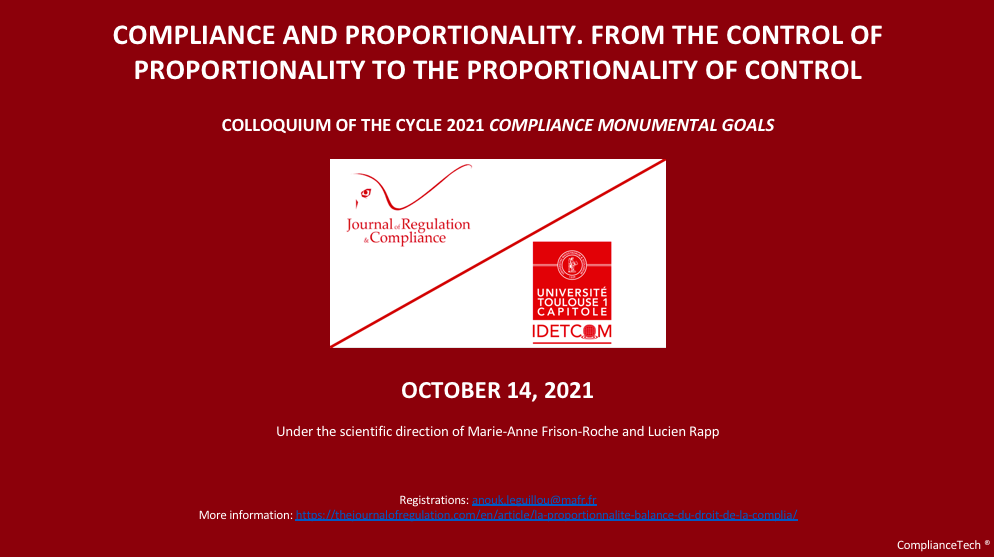
Oct. 14, 2021
JoRC
►This scientific manifestation is placed under the scientific responsibility of Marie-Anne Frison-Roche and Lucien Rapp.
This manifestation is organized by the Journal of Regulation & Compliance (JoRC) and by the IDETCOM of Toulouse-I-Capitole University.
📅 This colloquium is part of the cycle of colloquia organized in 2021 around the general topic about Compliance Monumental Goals
____
► Interventions during this colloquium will be the base for a specific chapter in :
📕 Les buts monumentaux de la Compliance,  forthcoming in the series Regulations & Compliance, co-published by the Journal of Regulation & Compliance (JoRC) with Dalloz.
📘Compliance Monumental Goals, forthcoming in the series Compliance & Regulation, co-published by the Journal of Regulation & Compliance (JoRC) and Bruylant.
____
The colloquium will take place, a priori, on site in Toulouse, on October 14, 2021.
It will be broadcasted in live online.
🎥 Videos will be extracted.
► Presentation of the topic :
Compliance Law tends towards "Monumental Goals". This puts the concern, the calculation and the control of proportionality at the center. Proportionality is one of the most common references for compliance practices and strategies, but paradoxically, one of the least well defined. Perhaps even one of the most elusive.
For the German Federal Constitutional Court in Karlsruhe, the principle of proportionality allows the quantitative easing policies of the European Central Bank (ECB) to be monitored. This principle is linked to nothing less than the principle of democracy and is the basis of the control of ultra vires. In French law, proportionality refers to the provisions of Article 8 of the Déclaration des droits (Bill of Rights) of 1789, according to which the law should only establish penalties that are strictly and obviously necessary. In many areas of civil or business life, the compliance of behavior and the consequences of non-compliance are assessed on the basis of a graded assessment by the censor (competitor, regulator or judge).
Proportionality calls for action, which opens up a margin of appreciation to take into account the facts or circumstances. It also allows for the exercise of control over abuse of rights or excess of power. It goes beyond the office of the judge or the censor to forge one of its tools: the control of proportionality, which is obviously not the proportionality of the control.
How to integrate proportionality into compliance practices and strategies?
Does it introduce a certain tolerance in the assessment of situations and is it thus a factor of rediscovered freedom in the development of risk matrices?
Conversely, is it not synonymous with increased vigilance on the part of compliance officers, by leaving open the possibility of a reinforced control of their acts or decisions, by the evaluation of their advisability and not of their conformity alone?
► Working method:
🚧 The colloquium is built around 4 topics, which would be prepared in 4 working papers.
🚧 The writing of each working paper will have been entrusted by experts.
Secondly, these working papers will be available to be criticized by two practionners of Compliance technics.
For each topic, there will be these three sequences:
- Presentation of the topic by the author of the working paper ;
- Discussion by the two discussants, who will have read the working paper previously ;
- Discussion with the public onsite and online.
The four topics chosen are:
1️⃣ Proportionality and Conformity
2️⃣ Proportionality and Evaluation
3️⃣ Proportionality and Normativity
4️⃣ Proportionality and Sanction
► registrations and information :
- attendance to the manifestation is free, onsite or online
- every registration for an attendance onsite will be supported by Toulouse-I-Capitole University
- information will be available on a website opened by Toulouse-I-Capitole University
____
►Will speak, notably :
🎤 Marie-Anne Frison-Roche, professor of Regulation and Compliance Law, director of the Journal of Regulation & Compliance
🎤 Alexandra Mendoza-Carminade, professor at Toulouse-I-Capitole University
🎤Lucien Rapp, professor at Toulouse-I-Capitole University
🎤 Marc Segonds, professor at Toulouse-I-Capitole University
____
See the program below: