Search results (625 cards)

Dec. 2, 2015
Compliance and Regulation Law Glossary
Access is a key concept in regulation since only a competitive market allows access for all to becom offerers and applicants. This is why regulations and regulators intervene ex ante to force access to natural monopolies, such as transport networks, for the benefit of other operators. Thus, Regulation compensates for market failures by imposing access. In addition to these access imposed for technical reasons, the Politics can still intervene to force for all access to common goods, such as culture, health, education, referring to the Social Contract. The foundation, political, is different.

Sept. 16, 2021
Events
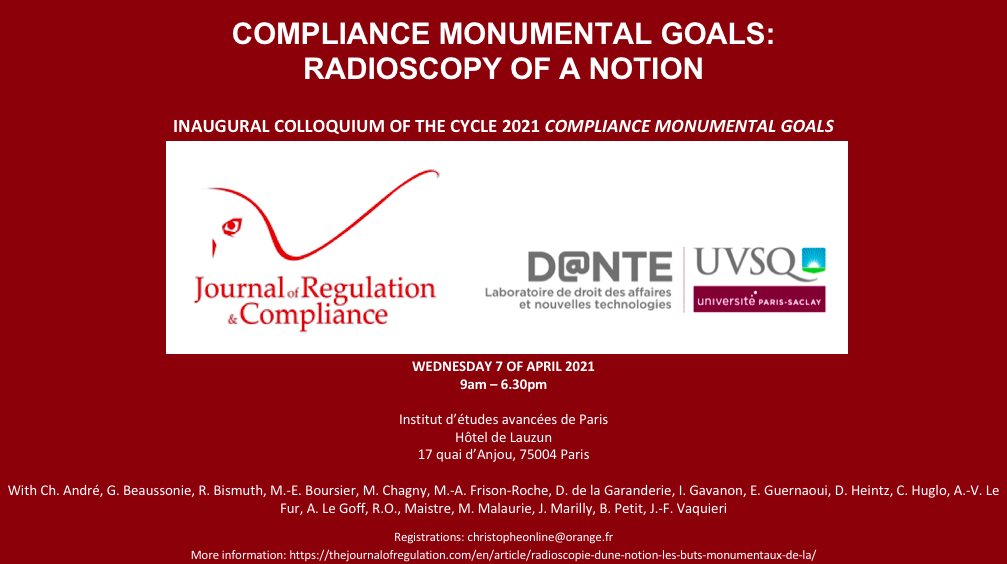
This colloquium co-organized between Laboratoire DANTE and the Journal of Regulation & Compliance (JoRC) inaugurates the 2021 series of colloquia devoted to the general theme of Compliance Monumental Goals. It is placed under the scientific direction of Christophe André, Marie-Anne Frison-Roche, Marie Malaurie and Benoît Petit.
___
The works of this colloquium will be integrated into a chapter in the two following books :
📕 Les buts monumentaux de la Compliance,  forthcoming in the Serie Regulations & Compliance , co published by the Journal of Regulation & Compliance (JoRC) and Dalloz.
📘Compliance Monumental Goals, forthcoming in the Serie Compliance & Regulation , co published by the Journal of Regulation & Compliance (JoRC) and Bruylant.
___
This colloquium will take place on September 16, 2021 at the Maison du Barreau. The manifestation will be opened to public onsite.
It is supported by Paris Place du Droit.
The manifestation is opened to public on site and is available online.
💼 to registration for the manifestation on site: christopheonline@orange.fr
💻 to registration for the manifestation online: https://zoom.us/webinar/register/8516215084724/WN_zLcUM4gPTNChaaB5SyxOYQ
____
Presentation of the colloquium Thematic: To understand the notion of "Monumental Goals", it is firstly necessary to take crossed perspectives on them, particularly through the prism of Labor Law, Environmental Law and Enterprise Law. Many questions appear. Does the notion of “Monumental Goals” present any substance in Law? Is it uniformly understood, or do specificities appear, forged by specific cultures and disciplinary practices? What are the sources and implicit references or echoes? Because even if we admit the part of novelty, there is undoubtedly an anchoring in traditional legal concepts, like the general interest or sovereignty. How does the shift from meta-legal (prima facie introduced by the concept) to legal take place, and where do any operational difficulties lie when legal actors are called upon to act? The question of a possible categorization of "Monumental Goals" will thus be explored, through these three legal disciplines whose historicity, goals and implications for firms differ.
These reflections allow to ask why and how these "Monumental Goals" are developed. Indeed, what is the relevance of the association of "Monumental Goals" and Compliance? Beyond theoretical considerations relating to the meaning of Law, is this really an effective alloy encouraging companies to behave differently? By what ways? These questions arise in particular with regard to the imperatives of legal certainty and the operative nature of the concept. The question of "Monumental Goals" will thus be explored by the operational actors of compliance, both those who act within companies and those who act from the lato sensu State sphere, for understanding whether this notion is a pure rhetoric figure or constitutes a particularly promising lever for the evolution of market behavior.
Notably with :
- Christophe André, maître de conférences à l'Université Paris - Saclay (lecturer at the Paris-Saclay University)
- Guillaume Beaussonie, professeur à l'Université Toulouse-1-Capitole (law professor at Toulouse-1-Capitole University)
- Regis Bismuth, professeur de droit à Sciences po, Paris (law professor at Sciences po Paris)
- Marie-Emma Boursier, doyen de l'Université Paris - Saclay (dean of the Paris-Saclay University)
- Muriel Chagny, professeur l'Université Paris - Saclay, directrice du Laboratoire Dante (Professor at the Paris-Saclay University, director of the Laboratory Dante)
- Marie-Anne Frison-Roche, professeur à Sciences po (Paris) (Professor at Sciences Po Paris)
- Isabelle Gavanon, avocate à la Cour d'Appel de Paris (attorney before the Paris Court of Appeal)
- Emma Guernaoui, ATER à l'Université Paris II Panthéon-Assas (ATER at Paris II Panthéon-Assas University)
- Dominique Heintz, avocat à la Cour d' appel de Paris (attorney before the Paris Court of Appeal)
- Christian Huglo, avocat à la Cour d' appel de Paris (attorney before the Paris Court of Appeal)
- Dominique de La Garanderie, avocat à la Cour d'appel de Paris (attorney before the Paris Court of Appeal)
- Anne-Valérie Le Fur, professeur à l'Université Paris - Saclay (Professor at Paris-Saclay University)
- Anne Le Goff, secrétaire générale déléguée d'Arkéa (Deputy Secretary general at Arkéa)
- Roch-Olivier Maistre, président du Conseil supérieur de l'audiovisuel (President of the French audiovisual regulation authority)
- Marie Malaurie, professeur à l'Université Paris-Saclay (professor at the Paris-Saclay University)
- Jérôme Marilly, avocat général à la Cour d'Appel de Paris (General attorney before the Paris Court of Appeal)
- Benoît Petit, maître de conférences (HDR) à l'Université Paris-Saclay (lecturer at the Paris-Saclay University)
- Jean-François Vaquieri, Secrétaire Général d'Enedis (Secretary General of Enedis)
____
Read a detailed presentation below:

Sept. 2, 2020
Newsletter MAFR - Law, Compliance, Regulation
Full reference: Frison-Roche, M.-A., For regulating or supervising, technical competence is required: example of the French creation of the "Pôle d'expertise de la régulation numérique", Newsletter MAFR - Law, Regulation, Compliance, 2nd of September 2020
Lire par abonnement gratuit d'autres news de la Newsletter MAFR - Law, Regulation, Compliance
Summary of the news
Through a decree of 31st of August 2020, the government created a national service, the "Pôle d'expertise de la régulation numérique" (digital regulation expertise pole). It has to furnish to State services a technical expertise in computer science, data science and algorithm processes in order to assist them in their role of control, investigation and study. The aim is to favor information sharing between researchers and State services in charge of regulating digital space.
As its acronym indicates, this pole of expertise aims to represents constance in a changing world. Moreover, more than being a national service, this organism must adopt a transversal dimension, its creation decree being signed by the Prime Minister, Minister of Economy, Minister of Culture and Minister of Digital Transition. The creation of such a pole shows the awareness of the government of the importance of technical competency in the regulation of digital space and of the necessity to centralize these expertises in one organ.
However, as the decree indicates, this pole of expertise could be consulted only by "State services", that excludes regulators which are independent from the State and which could put the pole in conflict of interest, and courts even if they are supposed to play a central role in the regulation of digital space and even if they are allowed to ask the advice of the regulator about some cases. But if regulators cannot size the pole, to whom does it benefit except the legislator and a few officials?
It would therefore have been better for this pole of expertise to be placed under the direction of regulatory and supervisory bodies, which would have enabled it to be able to be consulted both by regulators and by judges, both of whom are key players in digital regulation.

Updated: Sept. 25, 2012 (Initial publication: Sept. 9, 2010)
Sectorial Analysis
ENGLISH
The Federal Communications Commission (FCC) announced on August 5, 2010, that it will cooperate more closely with the Department of Justice (DoJ) in merger reviews in the telecommunications sector. This measure is intended to foster reconciliation of potentially divergent goals for mergers set forth by both authorities.
GERMAN
Die Federal Communications Commission (FCC, die amerikanische Bundeskommunikationsbehörde), wird im Bereich Fusionenüberwachung enger mit dem Department of Justice (das amerikanische Justizministerium) arbeiten.
Die FCC hat am 5. August 2010 bekannt gemacht, dass sie enger mit dem Department of Justice (das amerikanische Justizministerium) im Bereich Fusionenüberwachung in der Telekombranche. So wird die Annäherung von beide Behörde, die oft unterschiedliche Zielen bei Fusionen unterstützen, gefördert.
SPANISH
La American Federal Communications Commission (FCC – La Comisión americana de comunicaciones federales) anuncia cooperación más cercana con el Department of Justice (DoJ – El Departamento americano de justicia) en la revisión de fusiones.
La Federal Communicatins Commission (FCC – La Comisión americana de comunicaciones federales) anunció el 5 de agosto 2010 que tomará pasos para aumentar su operatividad con el Department of Justice (DoJ – El Departamento americano de Justicia) en la revisión de fusiones en el sector de telecomunicaciones. Esta medida sirve para fomentar la reconciliación entre objetivos potencialmente divergentes puesto en marcha por estas dos autoridades.
Other translations to come
Updated: May 9, 2012 (Initial publication: April 14, 2012)
Breaking news
Updated: Nov. 16, 2010 (Initial publication: Oct. 1, 2010)
I. Isolated Articles
ENGLISH
I would suspect that most regulatory law practitioners—whether they represent government or private interests--feel as if the tidewaters of global regulation have slowly but surely risen within the past few years. Those involved in the fields of competition, environmental or financial law must feel as if the global regulatory waters have reached up to their knees.
FRANCAIS
Article: le G-20 et la régulation économique mondiale: un moyen d'alimenter le développement progressif du droit international?
Je soupçonnerai volontiers que la majorité des praticiens du droit de la régulation - qu'ils représentent les gouvernements ou des intérêts publics - ont le sentiment que les eaux de la régulation mondiale ont monté lentement mais sûrement au cours des dernières années. Ceux qui exercent dans les domaines légaux de la concurrence, de l'environnement ou de la finance doivent eux avoir l'impression qu'elles ont atteint leurs genoux.
GERMAN
Artikel; Die G-20 und die globale wirtschaftliche Regulierung: ein Beitrag zur Entwicklung des internationalen Privatenrechtes?
Ich vermute, dass die meisten Praktiker des Regulierungsrechtes - entweder für öffentlichen- oder privaten Institutionnen arbeitend - das Gefühl haben, dass die Gewässer der globalen Regulierung letztlich langsam aber sicher angestiegen sind. Und diejenigen, die im Bereich Wettbewerb, Umwelt oder Finanz arbeiten, haben sicher das Gefühl, dass die Gewässer schon kniehoch sind.
ITALIAN
Il G20 e la regolazione economica globale: verso l’alimentazione di uno sviluppo progressivo del diritto internazionale?
Direi che la gran parte degli operatori in materia di regolazione normativa – portatori di interessi pubblici o privati – hanno la sensazione che la marea della regolazione economica globale sia, seppur lentamente, sicuramente salita negli ultimi anni. Coloro che operano in materia di diritto della concorrenza, diritto dell’ambiente o diritto finanziario devono aver la sensazione che le acque della regolazione siano arrivate fino alle ginocchia.
CHINESE
二十国集团和全球经济调控:促进国际法前进发展?
我猜测多数的法律规制从业者,无论是代表政府或是私人利益,都感觉到全球化调控的浪潮似乎已经减缓,但事实上其在过去的几年中依然增长。与竞争、环境和金融的相关法律领域很可能已经感到全球化调控的浪潮在与日俱增。
SPANISH
El G-20 y la regulación económica global: ¿alimentando el desarrollo progresivo del derecho internacional?
Yo sospecharía que la mayoría de aquellos que practican la ley – ya sea que representen los intereses públicos o privados – se sienten como si las aguas de la regulación global han aumentado lentamente durante los últimos años. Aquellos que están involucrados en el campo de la competición o las leyes ambientales o financieras ya deben de sentirse como si las aguas de la regulación global les han llegado hasta las rodillas.
Related articles
Updated: June 25, 2010 (Initial publication: June 3, 2010)
Grey Litterature
Updated: Sept. 26, 2011 (Initial publication: July 4, 2011)
Symposiums
ENGLISH
On May 20, 2011, a colloquium was held in Paris on the question of How should the Audit be regulated?, organized by The Journal of Regulation, l’Ecole de droit de la Sorbonne, and KPMG France, one of the Journal’s privileged partners. The participants were Jean-Luc Decornoy, Nathalie de Basaldua, Alain Couret, Marie-Anne Frison-Roche, Christine Thin, Stephen Haddrill, Claude Cazes, Etienne Wasmer, and Mara Cameran. The reflections and discussions bore upon the European Commission’s Green Paper on Audit Policy. The colloquium’s ambition was to discuss the methodological links that must guide the future of the Audit, both in relation to financial regulation and competition, and also to analyze what the inspirations for audit reform should be, especially by using the available economic studies. Each participant agreed that the most important goal was to ensure that the audit is of very high quality, and everything ought to converge towards this goal.
ITALIAN
Relazione bibliografica (Convegno): Vers quelle régulation de l’audit faut-il aller? (Come dovrebbe essere regolato l’audit ?)
Il 20 maggio 2011, si è tenuto a Parigi un convegno sulla questione di come dovrebbe essere regolato l’audit, organizzato da The Journal of Regulation, da l’Ecole de droit de la Sorbonne e KPMG France, partner privilegiato della rivista. I partecipanti erano Jean-Luc Decornoy, Nathalie de Basaldua, Alain Couret, Marie-Anne Frison-Roche, Christine Thin, Stephen Haddrill, Claude Cazes, Etienne Wasmer e Mara Cameran. Le riflessioni e le discussioni si sono concentrate sul Libro Verde della Commissione europea sulla politica in materia di audit. L’ambizione del convegno era di studiare i nessi metodologici che devono costituire le linee guida dell’audit, tenendo conto della regolazione finanziare e della libera concorrenza. Il convegno mirava inoltre ad analizzare le possibili piste di una riforma dell’audit, sulla base anche di studi di tipo economico. Ogni partecipante ha sottolineato che lo scopo più importante era quello di assicurare un’attività di audit di grande qualità, e che tutti gli sforzi dovrebbero convergere verso tale scopo.
SPANISH
Informe bibliográfico (Simposio): ¿En qué dirección debe dirigirse la regulación?
El 20 de mayo del 2011 se llevó a cabo un coloquio en París sobre la cuestión de “Cómo debe regularse la auditoría?” organizado por The Journal of Regulation, l’école de droit de la Sorbonne y el KPMG France, uno de los asociados principales de esta publicación. Los participantes incluyen Jean-Luc Decornoy, Nathalie de Basaldua, Alain Couret, Marie-Anne Frison-Roche, Christine Thin, Stephen Haddrill, Claude Cazes, Etienne Wasmer, and Mara Cameran. Las reflecciones y discusiones se centraron sobre el Papel Verde de la Comisión Europea sobre la política auditiva. La ambición de este coloquio era de discutir las conexiones metodológicas que deben guiar el futuro de la Auditoría, tanto en relación con la regulación de finanzas y la competencia, y también de analizar cuáles deben de ser las inspiraciones para la reforma de la auditoría, especialmente al usar los estudios económicos disponibles. Cada participante concertó que el objetivo más importante era de asegurar que la auditoría sea de alta calidad, y que todo ha de converger hacia este objetivo.
PORTUGUESE
Informe bibliográfico (Symposium): vers quelle régulation de l’audit faut-il aller ? Como deveria a auditoria ser regulada?
Em 20 de maio de 2011, um colóquio foi realizado em Paris sobre a questão Como deveria a auditoria ser regulada?, organizado por The Journal of Regulation, l’Ecole de droit de la Sorbonne, e KPMG France, um dos principais parceiros deste periódico. Os participantes foram Jean-Luc Decornoy, Nathalie de Basaldua, Alain Couret, Marie-Anne Frison-Roche, Christine Thin, Stephen Haddrill, Claude Cazes, Etienne Wasmer, e Mara Cameran. As reflexões e discussões surgiram a partir do Informe Verde sobre Política de Auditoria da Comissão Europeia. O propósito do colóquio foi discutir as ligações metodológicas que devem guiar o futuro da auditoria, ambos em relação com regulação financeira e concorrência, e também analizar quais deveriam ser as inspirações para a reforma da auditoria, especialmente usando os estudos econômicos disponíveis. Todos os participantes concordaram que o objetivo mais importante seria assegurar que a auditoria é de alta qualidade, e que tudo deve convergir para este objetivo.
Padrão contábil – Alternativa financeira – Auditoria – Mercado de auditoria – Falência – Big Four – Certificação – Colóquio – Concentração – Confiança – Conflito de interesses – Cooperação – Custo – Agência de notação – Operador crucial – Definição – Deontologia – Mercado desregulado – Eficiência – Europa – Mercado europeu de auditoria – Comissão Europeia – Especulação – Crise financeira – Mercado financeiro – Futuro – Mercado global – Objetivo – Informe Verde sobre auditoria – Incentivo – Independência – Informação – Informação assimétrica – Fórum de auditoria internacional – Itália – Auditoria conjunta – Responsabilidade – Gerente – Votação obrigatória – Mercado – Expectativas de mercado – Micro economia – Acaso moral – Opacidade – Opinião – Perímetro – Preço – Lucro – Bem público – Interesse público – Serviço público – Qualidade – Economia real – Informação do risco – Ceticismo – Responsabilidade social – Risco sistêmico – Raciocínio teleológico – Trust – Reino Unido – Estados Unidos da América.*
* Em The Journal of Regulation, estas palavras-chave são fornecidas pelo Editor e não pelo Autor.
Other translations forthcoming.
Updated: Sept. 19, 2012 (Initial publication: Aug. 28, 2012)
Sectorial Analysis
Translated Summaries
English
On 4 July 2012, the Conseil d’Etat (French Council of State) issued a rejection decision validating ARCEP’s dismissal to prosecute in an enforcement case initiated by an association of operators, AFORST. This case brings a broad look back on many years of ARCEP’s regulation of the electronic communications sector and more precisely on the pricing obligations imposed on the incumbent France Telecom within wholesale fixed markets. It provides interesting guidance on the enforcement procedure and on other recourses for competitors to ensure effectiveness of regulated prices.
French
Le 4 Juillet 2012, le Conseil d’Etat a rendu un arrêt validant l'arrêt de la procédure, du fait de la renonciation par l’ARCEP d’engager des poursuites dans une affaire d’exécution engagée par une association d’opérateurs, l’AFORST. Cette affaire apporte un perspective sur de nombreuses années en de régulation de l’ARCEP dans le secteur des communications électroniquesn et plus précisément sur les obligations imposées aux prix fixes de l’opérateur historique, France Télécom, dans les marchés de gros. Elle fournit des indications intéressantes sur la procédure d’exécution et sur d’autres recours pour les concurrents afin d’assurer l’effectivité de la régulation des prix.
Updated: Sept. 3, 2012 (Initial publication: Aug. 26, 2012)
Breaking news