
Search results (607 cards)

Updated: Jan. 23, 2012 (Initial publication: Dec. 5, 2011)
Doctrine
Updated: Jan. 2, 2012 (Initial publication: Jan. 2, 2012)
Doctrine
Updated: Nov. 15, 2011 (Initial publication: May 11, 2011)
Others
Updated: Dec. 14, 2011 (Initial publication: Dec. 5, 2011)
Doctrine

June 4, 2003
Doctrine
Complete reference : Idot, Laurence, La notion d'entreprise en droit de la concurrence, révélateur de l'ordre concurrentiel, in Mélanges en l'honneur d'Antoine Pirovano, L'ordre concurrentiel, Éditions Frison-Roche, Paris, 2003, p.523-545.

Aug. 14, 2019
Breaking news
Compliance Law, like Regulatory Law, of which it is an extension, is an Ex Ante Law.
It translates into a set of obligations that companies must perform to ensure that harmful behavior does not occur, such as bribery, money laundering, pollution, etc.
This results in "structural" obligations, such as the establishment of a risk map, a third-party vigilance system, internal controls, the adoption of codes.
The practical question that arises is whether to punish a company, it is necessary but it is sufficient that the company has not adopted these structural measures, or if it is also necessary that within it or through the persons whom it must be accountable (through the corporate officers and the employees, but also the suppliers, the sub-contractors, the financed operators, etc.) there were behaviors that Compliance Law prohibits, for example corruption, money laundering, pollution, safety-related accident, etc.
The question is probative. Its practical stake is considerable.
Because to obtain the conviction the prosecuting authority will have to demonstrate not only a failure in the structural device but also a behavioral failure.
Si l'on considère que le Droit de la Compliance est à la fois sur l'Ex Ante et sur l'Ex Post, alors l'autorité de poursuite qui requiert une sanction doit démontrer qu'il y a un comportement reprochable (Ex Post) et qu'à cela correspond une défaillance structurelle (par exemple le compte bancaire anormal n'a pas été signalé) ; si l'on considère que le Droit de la Compliance est purement en Ex Ante, alors même s'il n'y a pas de comportement reprochable en Ex Post, la seule défaillance structurelle suffit pour que l'entreprise qui doit l'organiser en son sein soit sanctionné.
If we consider that Compliance Law is both on the Ex Ante and the Ex Post, then the prosecuting authority that requires a sanction must show that there is a reprehensible behavior (Ex Post ) and that this corresponds to a structural failure (for example the abnormal bank account has not been reported); if we consider that Compliance Law is purely Ex Ante, then even if there is no reprehensible behavior in Ex Post, the only structural failure is enough for the company to be sanctioned, even if it does its best efforts, even if no prohibited behavior will have accured in Ex Post.
The second system, which is much more repressive and places a considerable burden on companies, even if there is no proven illicit behavior, is that of French Law, probably because of a tendency towards Ex Ante organization. ..
Mais il faut garder mesure. Et cette mesure est probatoire.
But we must keep measure. And this measure is probative.
This is what the Commission des Sanctions of the Agence Française Anticorruption -AFA (French Anti-Corruption Agency's Sanctions Committee) has just said, in its decision of 4 July 2019, SAS S. et Madame C.,(written in French) contradicting the position of its director, who acted as the prosecuting authority. This is yet another general proof of the autonomy of the Sanctions Committee vis-à-vis to the Administrative Authority of which it is a part, and in relation to its director, who nevertheless governs it. But, jurisdictional model obliges, he has here the status of prosecuting authority, is subject to the regime of this one and not to the regime of head of the entity. Demonstration of the "functional autonomy" of the sanctioning bodies within the administrative regulatory and compliance authorities.
Indeed, this important decision expresses with precision and reason the distribution of the "burden of the allegation" and the "burden of proof" on the prosecuting body and on the company pursued, as well as the role of presumption that the recommendations issued by the French Anti-corruption Authority can play.
Read the analysis below.

March 3, 2018
JoRC
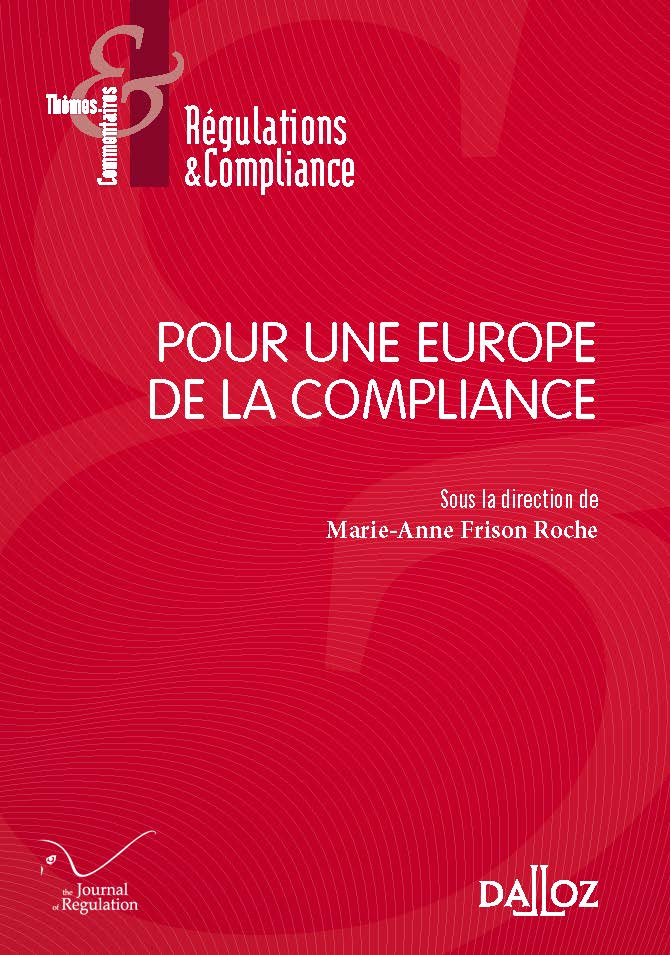
During the discussion that followed the inaugural conference for the Cycle Pour une Europe de la Compliance (For a Europe of Compliance) that Koen Lenaerts devoted to the role of the Court of Justice of the European Union in the construction of the Europe of Compliance, and after a first discussion led by Antoine Garapon, a problem has particularly emerged.
Indeed, President Koen Lenaerts has taken up the question of the influence of the adoption of a "compliance program" by a company when subsequently anticompetitive behavior is imputed to it.
Competition or regulatory authorities, as well as courts, have three possibilities: either to consider that the company had done what it could to prevent this behavior, to educate the persons in its charge, that this prevention not enough but must be taken into account in its "discharge" to lighten its sanction; on the contrary, to consider that the adoption of such a compliance program by the enterprise by which it expresses its express and pro-active desire to bear the efficiency of the standard itself while at the same time it disregards it constitutes an aggravating circumstance of its responsibility; consider that the fact must remain neutral in the judge's assessment of the behavior.
The Court of Justice stands by the third solution.
But everyone agrees that this is an essential question for which the arguments are well-founded, the European Commission, on the other hand, leaning towards the qualification of an aggravating fact.
During the discussion, it was emphasized in the opposite direction that in the perspective of Compliance as an incentive mechanism, not taking into account on the part of companies the adoption of such expensive programs is very discouraging for them. Moreover, this contradicts the definition of compliance as a "Trust pact" between the company and the public authority.
____
QWhat can be done to remain from this discussion of a very great interest?
So it's a question that is still open, because the arguments are strong and we could say that "everyone is right", and companies that want to take note of their behavior, and authorities who can not be abused by what would be only a screen of behavior violating Law.
The question is maybe whether the choice of "neutrality" of the Court of Justice is a solution of waiting or a decision of non-choice, because one could never know if a company is "sincere" or not when it has adopted a Compliance Program.
It is probably here that a solution could be found: in probative mechanisms. Because in these matters, it is by technical processes by which the subject of law (that is to say the company) reveals that it has done everything to achieve the Compliance purpose (obligation of means strengthened). ).
It is probably by formulating probative requirements of this kind that the Court of Justice could move out of its position of neutrality. While it is true that the judge must be "impartial" in relation to the facts, the attitude of giving no "relevance" to a fact as important as the compliance programs is inherently annoying. It seems difficult to associate a substantive rule, nor is it desirable to practice casuistry. But, because Economic Law lends itself to it, a probationary system that the Court would make clear would perhaps be a good solution.
____
Dans l'ouvrage qui paraîtra à la fin du cycle de conférences, un article sera inséré dans l'ouvrage sur cette question plus particulière de la portée des programmes de conformité sur l'appréciation du comportement de l'opérateur au regard des faits qui lui sont reprochés, question sur laquelle les différents régulateurs des différents systèmes juridiques divergent.
In the book that will be published at the end of the conference cycle, an article will be inserted in it on this particular question of the effects of compliance programs on the appreciation of the behavior of the enterprises with regard to the facts that are reproached, an issue on which the different regulators of the different legal systems diverge. For the moment.
Updated: June 24, 2011 (Initial publication: June 15, 2011)
I. Isolated Articles
ENGLISH
The role of fibre is very important towards connecting to ultra-fast broadband, one of the key action areas of the Digital Agenda. But, Europe is late in its fibre deployment, especially when compared to other advanced economies such as the United States or Japan. At the same time, however, there is still no standard for a European fibre strategy: public as well as private stakeholders are having very different approaches in local FTTx deployment sometimes leading to a waste in private and public funds and being mainly focused on dense areas. This article aims to propose an efficient model for fibre network deployment that can be applied to all European Member States. The model provides high-margin incentives for operators to install fibre network across the whole country, while maximising households’ fibre connection rate through an automatic migration scheme. In a period of weak growth and budget restrictions, the catch-up in ultra-fast broadband internet requires more than ever an efficient policy to maximise the deployment of FTTH at the lowest cost possible to the public. The proposed model serves as an ideal choice given this context.
Alternative operator - Budget - Connexion - Copper network - Cost - Digital agenda - Duplication - Effeciency - Essential facility - Europe - Fiber optic - France - Incentive - Incumbent operator - Infrastructure - Internet - Natural economic monopoly - Network - Price - Provider - Regulatory policy *
* In The Journal of Regulation, these keywords are done by the Editor and not by the Author.
PORTUGUESE
Artigo: Do cobre à fibra: uma política de regulação ótima.
O papel da fibra é muito importante em conexões de banda larga de alta velocidade, uma das principais ações na área da Agenda Digital. No entanto, a Europa está atrasada no desenvolvimento da fibra, especialmente quando comparada com outras economias avançadas como Estados Unidos ou Japão. Ao mesmo tempo, porém, ainda não há um patamar para uma estratégia europeia para a fibra: detentores de haveres públicos e privados têm tido diferentes posturas no desenvolvimento de FTTx local, o que leva às vezes a um desperdício de fundos públicos e privados e sendo sobretudo registrado em áreas de densidade. Este artigo objetiva propor um modelo eficiente para o desenvolvimento da rede de fibra que possa ser aplicado para todos os Estados Membros Europeus. O modelo prevê incentivos altos para operadores para instalar redes de fibra por todo o país, enquanto maximiza a taxa de conexões domésticas de fibra através de um esquema de migração automática. Em um período de crescimento desacelerado e restrições orçamentárias, um novo impulso em banda larga de alta velocidade requer mais do que nunca uma política eficiente para maximizar o desenvolvimento de FTTH ao menor custo possível para o público. O modelo proposto serve como uma escolha ideal dado este contexto.
Operador alternativo – Orçamento – Conexão – Rede de cobre – Custo – Agenda digital – Duplicação – Eficiência – Facilidades essenciais – Europa – Fibra ótica – França – Incentivo – Operador – Infra-estrutura – Internet – Monopólio natural econômico – Rede – Preço – Provedor – Política de regulação*.
* No Journal of Regulation, as palavras-chave são fornecidas pelo Diretor, e não pelo Autor.
ITALIAN
Articolo: Dal rame alla fibra: un’ottima politica di regolazione
Il ruolo della fibra è molto importante per la connessione ad alta velocità, una delle azioni centrali dell’agenda digitale. Tuttavia l’Europa è in netto ritardo per quando riguarda lo sviluppo della fibra, in particolare rispetto all’economia di altri paesi come gli Stati Uniti o il Giappone. Questo si capisce, però, in quanto non esiste uno standard per la strategia dell’Europa in materia di fibra: gli attori privati e pubblici del settore della fibra stanno avendo degli approcci differenti nei confronti della realizzazione dei FTTx, e tali approcci spesso si concludono in uno spreco di investimenti e si concentrano spesso su aree ad alta densità. Questo articolo si propone di trovare un modello efficace per la realizzazione di una rete a fibra in tutti gli Stati membri. Questo modello prevede degli incentivi elevati per gli operatori che installano delle reti a fibra ottica nei loro paesi, e massimizza la percentuale di connessioni a fibra ottica per nucleo familiare con un sistema di migrazione automatico. In un periodo di crescita ridotta e restrizioni di budget, lo sviluppo di connessioni a fibra ottica richiede una politica quanto mai efficace per massimizzare lo sviluppo del FTTH ai minimi costi possibili per i conti pubblici. Il modello proposto costituisce una scelta essenziale, in considerazione del contesto esistente.
Agenda digitale - Budget - Connessione - Connessioni su rame - Costi - Duplicazione - Efficienza - Europa - Fibra ottica - Fornitore - Francia - Incentivi - Infrastruttura - Infrastruttura essenziale - Internet - Monopolio economico naturale - Operatore alternativo - Operatore storico - Prezzo - Politica di regolazione - Rete *
* In The Journal of Regulation, le parole chiave sono responsabilità dell’Editore e non dall’Autore.
SPANISH
Artículos: Del cobre a la fibra : una política regulatoria óptima
El rol de la fibra óptica es de gran importancia en lo que concierne la conexión al ancho de banda ultrarrápida, una de las áreas claves de acción en la Agenda Digital. Sin embargo, Europa se encuentra atrasada en cuanto a su desarrollo, especialmente en comparación con otras economías avanzadas, como la de los EEUU o Japón. No obstante, todavía no existe un estándar para una estrategia europea para la red de fibra óptica; accionistas, tanto privados como públicos, han estado adoptando diferentes acercamientos a la implementación de los FTTx, lo cual suele llevar a un enfoque sobre áreas demasiado densas y al desperdicio de fondos privados y públicos. Este artículo tiene como objetivo proponer un modelo eficiente para el desarrollo de la red de fibras ópticas que podría aplicarse a todos los miembros de la Unión Europea. El modelo provee incentivos de gran margen de ganancias para operadores para la instalación de estas redes de fibras a través del país entero y al mismo tiempo maximiza la conexión rápida de fibras en todas las viviendas facilitado por el uso de un esquema de migración automática. En un periodo de crecimiento débil y restricciones presupuestarias, el “catch-up” en el Internet de banda ancha ultrarrápida requiere ahora más que nunca una política eficaz para maximizar el desarrollo del FFTH y minimizar el coste incurrido por el público.
Other translations forthcoming.
Updated: March 29, 2011 (Initial publication: Feb. 7, 2011)
I. Isolated Articles
ENGLISH
In order to properly conceive the role of law in the economic sphere, a problem that is usually designated as “good regulation”, it can be instructive to confront what such a concept denotes to one of the most prominent theories of the rule of law in modern societies, the theoryof F. A. Hayek.
FRENCH
Article: Régulation et politique. Réflexions sur l’état de droit.
Afin d’appréhender adéquatement le rôle de la loi dans la sphère économique – un problème habituellement désigné comme relevant de la « bonne régulation » - il peut être instructif de mettre en relief ce qu’un tel concept apporte à l’une des théories les plus marquantes de l’état de droit dans les sociétés modernes: celle de F. A. Hayek.
GERMAN
Artikel : Regulierung und Politik : Überlegungen über den Rechtsstaat.
Um die Rolle des Gesetzes im wirtschaftlichen Sphäre vollständig erfassen zu können – ein Problem normalerweise mit dem Begriff “good regulation” benennt wird –ist es nützlich zu betonen, was solch einen Begriff zu einer der wichtigsten Theorie des Rechtstaates im modernen Gesellschaften mit sich bringen kann – und zwar die, von F. A. Hayek.
SPANISH
Artículo: Regulación y política: reflexiones sobre el imperio de la ley.
Para poder correctamente concebir el rol de la ley in la esfera económica, un problema que es usualmente designado como ‘buena regulación,’ puede ser instructivo confrontarse a lo que tal concepto denota a una de las teorías más prominentes del imperio de la ley en las sociedades modernas, la teoría de F. A. Hayek.
Updated: Jan. 2, 2012 (Initial publication: Jan. 2, 2012)
Neutrality in Systems of Economic Regulation
Translated Summaries
In The Journal of Regulation the summaries’ translation are done by the Editors and not by the authors
ENGLISH
The debate on Net Neutrality faces a major difficulty, namely that of its legal status: does there exist a “legal principle”—meaning a rule somewhere within the entire body of law—with mandatory force that could be used to counter infrastructure operators’ discriminatory practices?
FRENCH
Le débat sur la neutralité du Net fait face à une difficulté majeure, à savoir son statut juridique: existe-t-il un «principe juridique», qui exprime une règle dans l’ensemble du système juridique - avec une force obligatoire qui pourrait être utilisée pour contrer les pratiques discriminatoires des opérateurs d’ infrastructure ?
SPANISH
El debate sobre la Neutralidad de la Red se enfrenta a una gran dificultad, primordialmente en cuanto a su estatus legal: ¿realmente existe un “principio legal” – es decir, una regla que se encuentra dentro de la disciplina del derecho – con fuerza mandataria que podría ser usado para enfrentar a las prácticas discriminatorios que practican los operadores de infraestructura?
ITALIAN
Il dibattito sulla neutralità della rete si trova di fronte ad una difficoltà rilevante dal punto di vista del suo fondamento giuridico: esiste una norma giuridica obbligatoria – intesa come una norma legale – che possa essere utilizzata contro le pratiche discriminatorie degli operatori?
....................
Other translations forthcoming.